5G Interfaces Explained
The main 5G interfaces define how the NG-RAN reaches the 5G Core and how NG-RAN nodes communicate with each other internally. The most important architecture interfaces are NG, Xn, F1, and E1.
A good way to read the interface map is simple. NG reaches the core. Xn reaches neighboring RAN nodes. F1 connects the CU and DU inside a split gNB. E1 connects CU-CP and CU-UP when the central unit is split again.
Quick facts
| Main RAN interfaces | NG, Xn, F1, and E1. |
|---|---|
| Access-to-core boundary | NG reaches the AMF and UPF from the NG-RAN. |
| Inter-node RAN boundary | Xn connects NG-RAN nodes to each other. |
| Split-gNB boundaries | F1 connects CU and DU, while E1 connects CU-CP and CU-UP. |
| Control and user split | NG, Xn, and F1 each have control and user sides in practical deployments. |
| Specification baseline | 3GPP TS 38.401, TS 38.300, and TS 23.501. |
Why 5G interfaces matter
5G interfaces are not just transport links. They show where signaling terminates, where traffic flows, and how mobility, context management, and split-gNB behavior are distributed across the system.
In practical work, the interface model is often the fastest way to isolate the right fault domain. If registration fails, the useful question is not just “is 5G down?” but “which interface should carry the next step?” If mobility fails, the useful question is whether the problem sits on Xn, NG, or a split-RAN interface such as F1.
5G interfaces in the architecture
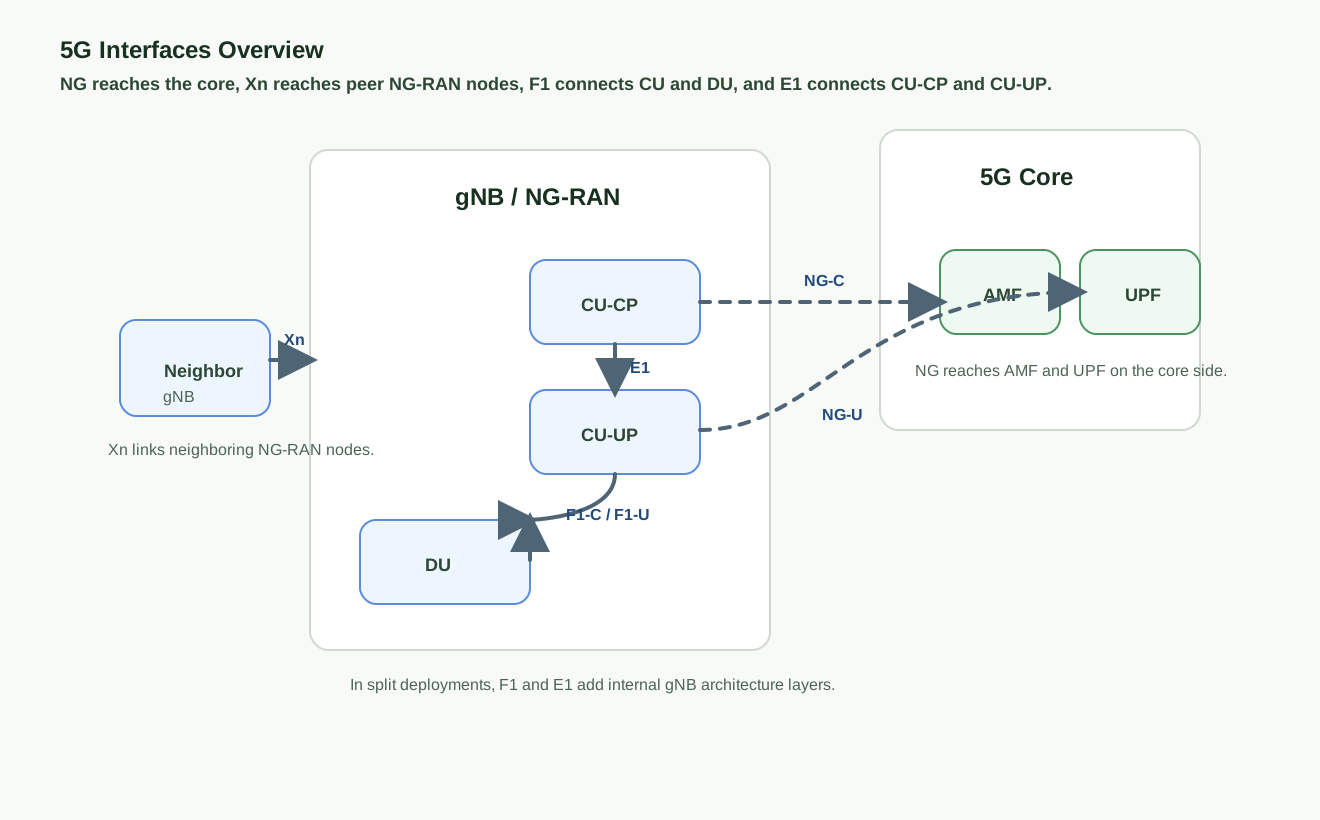
Overview of main 5G interfaces
| Interface | Connects | Plane | Main role |
|---|---|---|---|
| NG-C | NG-RAN and AMF | Control plane | Access signaling, NAS transport, paging, and UE context control. |
| NG-U | NG-RAN and UPF | User plane | User traffic between the RAN and the 5GC. |
| Xn-C | NG-RAN node and NG-RAN node | Control plane | Mobility, context transfer, load coordination, and inter-node signaling. |
| Xn-U | NG-RAN node and NG-RAN node | User plane | Forwarding between NG-RAN nodes when inter-node user-plane support is needed. |
| F1-C | gNB-CU and gNB-DU | Control plane | Split-gNB control coordination. |
| F1-U | gNB-CU and gNB-DU | User plane | Split-gNB user-plane transport. |
| E1 | gNB-CU-CP and gNB-CU-UP | Split coordination | Interworking between central-unit control and user functions. |
NG interface
The NG interface is the access-to-core boundary in 5G. It is split into NG-C toward the AMF and NG-U toward the UPF.
NG is where the NG-RAN hands access signaling and user traffic into the 5GC. In practical terms, it is the interface family behind registration-side signaling, paging coordination, context setup, and the main data path into the UPF.
| NG side | Main protocol family | What to remember |
|---|---|---|
| NG-C | NGAP | Used for control-plane signaling between gNB and AMF. |
| NG-U | GTP-U | Used for access-side user-plane traffic between gNB and UPF. |
Open the NG interface deep dive for the full control and user-plane view.
Xn interface
The Xn interface connects NG-RAN nodes to each other. It is split into Xn-C for signaling and Xn-U for user-plane forwarding support.
Xn is the main peer-to-peer interface inside the NG-RAN. It matters most for inter-gNB mobility, context transfer, dual-connectivity support, load coordination, and other inter-node coordination tasks that should not be read as pure core-network behavior.
| Xn side | Main protocol family | What to remember |
|---|---|---|
| Xn-C | XnAP | Used for inter-gNB control signaling, mobility preparation, and context exchange. |
| Xn-U | RAN user-plane forwarding transport | Used when inter-node user-plane forwarding is needed during mobility or similar scenarios. |
Open the Xn interface deep dive for the inter-gNB view.
F1 interface
The F1 interface exists inside a split gNB deployment and connects the gNB-CU to the gNB-DU. It is one of the clearest signs that 5G RAN architecture is more distributed than LTE.
F1 lets higher-layer behavior stay more centralized while lower-layer and timing-sensitive radio functions stay closer to the DU side. In practical deployments, this is the interface that makes the CU-DU split operational.
| F1 side | Main protocol family | What to remember |
|---|---|---|
| F1-C | F1AP | Used for control signaling between CU and DU. |
| F1-U | F1 user-plane transport | Used for user-plane transport between CU and DU. |
Use the 5G F1AP message library to study the signaling family around F1.
E1 interface
The E1 interface is used when the central unit is itself split into gNB-CU-CP and gNB-CU-UP. This adds another layer of flexibility inside the RAN by separating central control behavior from central user-plane behavior.
E1 matters most in scalable and cloud-oriented deployments, where the control and user sides of the CU are managed independently. It is not an access-to-core interface and not a peer-gNB interface; it is an internal central-unit coordination boundary.
| Interface | Main protocol family | What to remember |
|---|---|---|
| E1 | E1AP | Used for CU-CP to CU-UP coordination in split-CU deployments. |
Use the 5G E1AP message library to study the signaling family around E1.
Control plane and user plane across 5G interfaces
A useful way to understand the whole interface set is by following the split between control plane and user plane.
| Plane | Main interfaces |
|---|---|
| Control plane | NG-C toward the AMF, Xn-C between NG-RAN nodes, F1-C between CU and DU, and E1 for CU-CP to CU-UP coordination. |
| User plane | NG-U toward the UPF, Xn-U between NG-RAN nodes, and F1-U inside split-gNB deployments. |
5G interfaces and the gNB split
One of the clearest reasons to study this page is to understand how the interface model changes when the gNB is split. In a monolithic deployment, the gNB mainly uses NG and Xn. In a split deployment, the same node may also rely on F1 and sometimes E1.
That is one of the biggest architectural differences between 5G and LTE. The 5G interface map was designed from the beginning to support a decomposed RAN node rather than assuming one fixed access-node shape.
5G interfaces and mobility
Mobility in 5G often spans more than one interface. Xn is used for direct inter-gNB coordination. NG matters when AMF or UPF participation is required. F1 can also matter when the mobility path crosses CU-DU split boundaries inside the serving or target side.
This is why mobility analysis in 5G can feel more distributed than LTE. A single user symptom may involve radio reconfiguration, inter-node coordination, core-facing signaling, and split-RAN transport all in one procedure.
5G interfaces and protocol families
| Interface | Main protocol family |
|---|---|
| NG-C | NGAP |
| NG-U | GTP-U |
| Xn-C | XnAP |
| Xn-U | Xn user-plane transport |
| F1-C | F1AP |
| F1-U | F1 user-plane transport |
| E1 | E1AP |
Common troubleshooting angles across 5G interfaces
- NG problems often show up as registration, paging, or access-to-core user-plane issues.
- Xn problems often show up during inter-gNB mobility, context transfer, or dual-connectivity coordination.
- F1 problems often show up in split-gNB deployments when DU-side radio behavior and CU-side control behavior stop lining up.
- E1 problems often show up when CU-CP and CU-UP coordination breaks in more distributed central-unit deployments.
- User-plane trouble after healthy signaling often points to NG-U, Xn-U, F1-U, or the forwarding side of the path rather than to the main control procedures.
- Control-plane trouble often points to the signaling family on that interface, such as NGAP, XnAP, F1AP, or E1AP, plus the underlying SCTP/IP transport where relevant.
FAQ
What are the main interfaces in 5G RAN architecture?
The main 5G RAN interfaces are NG, Xn, F1, and E1. NG reaches the core, Xn reaches neighboring RAN nodes, F1 connects CU and DU, and E1 connects CU-CP and CU-UP.
What is the difference between NG and Xn?
NG connects the NG-RAN to the 5GC, while Xn connects NG-RAN nodes to each other.
What is F1 in 5G?
F1 is the interface between the gNB-CU and the gNB-DU in a split-gNB deployment.
What is E1 in 5G?
E1 is the interface between gNB-CU-CP and gNB-CU-UP when the central unit is split into separate control and user-plane units.
Why are 5G interfaces important?
They show how signaling, traffic, mobility coordination, and split-RAN behavior are distributed across the 5G system.
Key takeaways
- The main 5G interfaces are NG, Xn, F1, and E1.
- NG reaches the core, while Xn reaches neighboring NG-RAN nodes.
- F1 and E1 are what make split-gNB deployments readable and operationally useful.
- The interface model repeats the wider 5G split between control plane and user plane.
- Understanding these interfaces makes registration, session setup, handover, and split-RAN troubleshooting much easier to place.