N11 Interface in 5G Explained
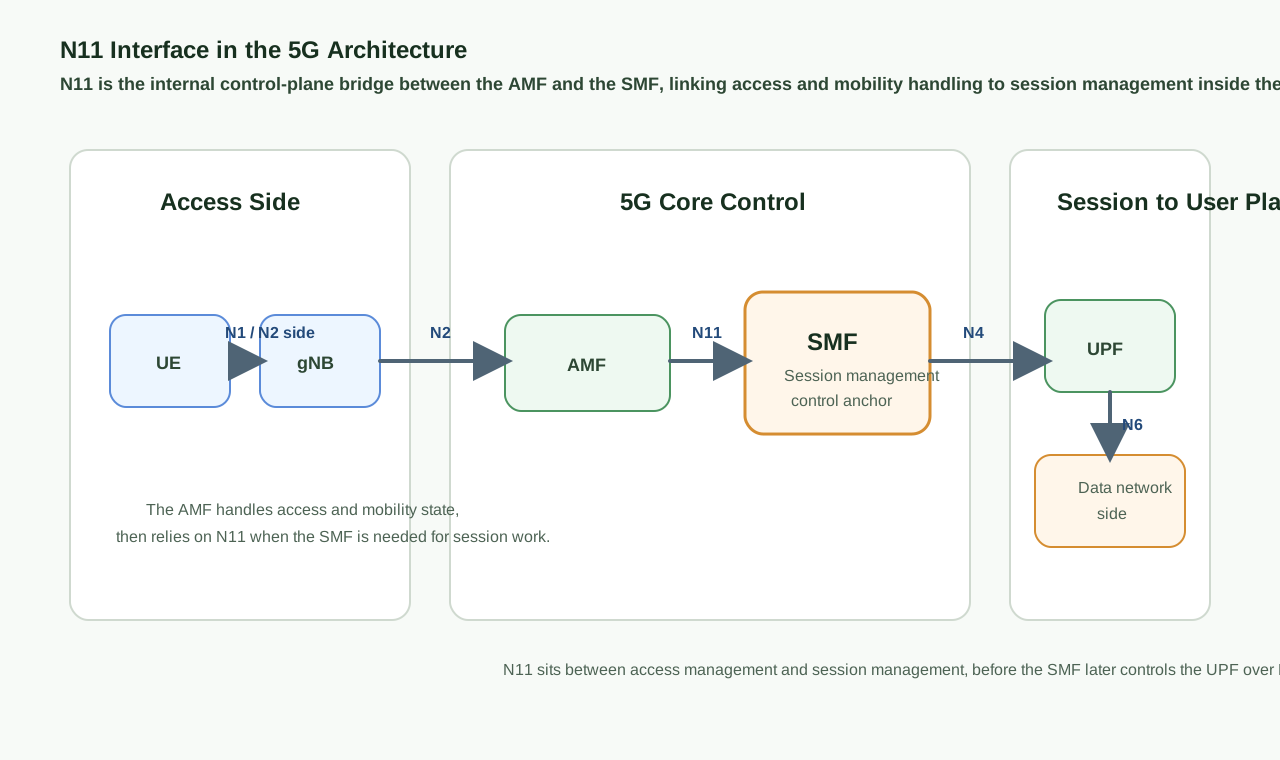
The N11 interface is the control-plane reference point between the AMF and the SMF in the 5G System. It is one of the key internal interfaces inside the 5G Core because it connects access and mobility control with session management.
In practical terms, N11 matters whenever the AMF needs the SMF for PDU session handling, session-related control procedures, or mobility-driven session updates. If N2 is the access-to-core control edge, N11 is the internal 5GC control bridge behind it.
Quick facts
| What it is | N11 is the control-plane reference point between the AMF and the SMF. |
|---|---|
| What it coordinates | Access-side control and mobility state in the AMF with session-management behavior in the SMF. |
| Where it matters most | PDU session establishment, modification, release, and mobility-related session coordination. |
| How it fits in 5GC | N11 is the internal 5GC bridge between access control and session control. |
| Best companion pages | Pair N11 with N1, N2, N4, AMF, SMF, and PDU session procedures. |
| Specification baseline | 3GPP TS 23.501, TS 23.502, and TS 29.502. |
Why N11 matters
N11 is where the 5G Core shows its modular design most clearly. The AMF owns access and mobility control, while the SMF owns session behavior. N11 is how those two responsibilities stay aligned when the UE needs real data service.
That makes N11 one of the most useful interfaces for understanding “registration is fine, but the session never really comes together” problems inside the 5GC.
N11 interface in the 5G architecture
What the N11 interface is used for
- Coordination related to PDU session establishment.
- Updates related to PDU session modification.
- Control signaling for session release.
- Mobility-related session coordination when access-side changes affect the session side.
- AMF to SMF interaction needed to keep access, session, and user-plane state aligned.
A simple summary is that N11 is the interface that helps turn a successfully registered UE into a UE with an active and correctly managed data session.
N11 connects access control to session control
One of the most useful ways to understand N11 is to look at the two functions it connects.
| Function | Main role |
|---|---|
| AMF | Access and mobility management. |
| SMF | Session management and user-plane control. |
Since 5G separates these roles more cleanly than LTE did, N11 becomes the key interface where they coordinate whenever session-related work is needed.
N11 and PDU session establishment
The PDU Session Establishment Procedure is one of the clearest places where N11 matters. The UE and access side may initiate the procedure, but the AMF still needs the SMF to handle the session logic.
- The UE initiates a session-related request through NAS.
- The AMF receives that request through the access side.
- The AMF interacts with the SMF over N11.
- The SMF handles session logic and downstream user-plane control.
- The resulting session state is reflected back through the rest of the system.
N11 and the AMF
From the AMF side, N11 is the interface used to reach session management. The AMF itself is focused on registration, access-side control, mobility, reachability, and NAS-related state. When a procedure needs session-management involvement, N11 is the path that gets the SMF into the picture.
N11 and the SMF
From the SMF side, N11 is the interface used to receive the control input that ties session behavior to UE access-side state. The SMF owns session management, user-plane control, and the downstream behavior that later reaches interfaces such as N4.
N11 and N4: how they work together
| Interface | Connects | Main role |
|---|---|---|
| N11 | AMF and SMF | Access and session-control coordination. |
| N4 | SMF and UPF | User-plane control and UPF programming. |
A useful mental model is that N11 helps create and align the session intent, while N4 is the next control step that turns that intent into real user-plane behavior in the UPF.
N11 in the service-based architecture
The 5G Core is built around a Service-Based Architecture. N11 is a stage-2 architectural reference point, while the detailed realization of AMF and SMF interaction is expressed through service-based APIs and stage-3 specifications.
That makes N11 both an architectural relationship and a practical control-plane interaction inside the service-based 5GC.
N11 vs N1 and N2
| Interface | Endpoints | Main role |
|---|---|---|
| N1 | UE and AMF | Logical NAS signaling. |
| N2 | gNB and AMF | Access-network control-plane signaling. |
| N11 | AMF and SMF | Internal 5GC control-plane coordination between access management and session management. |
A simple rule of thumb is: N1 is UE-to-core logical signaling, N2 is access-network-to-core signaling, and N11 is internal-core signaling between the AMF and SMF.
N11 vs LTE architecture
| LTE EPC | 5G Core |
|---|---|
| More tightly coupled access and session handling. | Clear split between AMF and SMF. |
| More node-oriented core behavior. | More modular and service-based core design. |
| Fewer cleanly separated internal control roles. | More explicit internal control relationships such as N11. |
Common troubleshooting angles for N11
| Symptom | What to check on N11 |
|---|---|
| PDU session establishment failure after successful registration | Check whether the AMF and SMF are coordinating the session request correctly. |
| Mismatch between AMF-side UE state and SMF-side session state | Check whether access-side changes were reflected correctly into session handling. |
| Session modification failure | Check whether AMF-to-SMF control exchange stayed aligned with the intended session update. |
| Stale session state after release | Check whether release coordination between AMF and SMF completed cleanly. |
| Mobility-related service problem | Check whether AMF and SMF stayed synchronized when access-side movement affected session behavior. |
FAQ
What is the N11 interface in 5G?
The N11 interface is the control-plane reference point between the AMF and the SMF.
What is N11 used for?
N11 is used for coordination between access and mobility management and session management, especially around PDU session procedures.
Does N11 carry user data?
No. N11 is a control-plane interface. User-plane traffic runs on interfaces such as N3, N6, and N9.
What is the difference between N11 and N4?
N11 connects AMF and SMF for control-plane coordination, while N4 connects SMF and UPF for user-plane control.
Why is N11 important?
Because it links UE access state managed by the AMF with session state managed by the SMF.
Key takeaways
- N11 is the control-plane reference point between AMF and SMF.
- It is a key internal 5GC interface that connects access and mobility control with session management.
- N11 is especially important for PDU session establishment, session modification, release, and mobility-related session coordination.
- N11 is distinct from N1, N2, and N4, which sit at different layers or connect different functions.
- Understanding N11 is essential for diagnosing session-control problems inside the 5G Core.