5G Dual Connectivity Explained
Dual Connectivity (DC) in 5G lets a UE use two radio nodes at the same time, improving throughput, reliability, and mobility behavior. It is one of the key architecture concepts behind smooth LTE-to-5G evolution and higher-performance multi-node deployments.
In practical terms, Dual Connectivity means the UE has a Master Node that anchors the main control relationship and a Secondary Node that adds extra radio resources. The exact node combination depends on whether the deployment is EN-DC, NR-DC, or another Multi-RAT variant.
Quick facts
| What it is | Dual Connectivity lets a UE use two radio nodes at the same time instead of relying on a single serving node. |
|---|---|
| Main node roles | The Master Node anchors the control plane, while the Secondary Node adds extra radio resources. |
| Common types | EN-DC, NR-DC, and NE-DC are the main architecture patterns. |
| Bearer view | Traffic may stay on the master side, the secondary side, or be split across both. |
| Typical protocol split | The split is commonly explained at PDCP level for user-plane handling. |
| Why engineers care | Dual Connectivity matters for NSA evolution, throughput expansion, mobility smoothness, and multi-node troubleshooting. |
What is Dual Connectivity?
Dual Connectivity means the UE is connected to two radio nodes instead of only one. The classic model is:
- Master Node (MN) for the primary connection and control anchoring
- Secondary Node (SN) for additional radio resources
A good mental shortcut is simple: the control relationship is usually anchored on the master side, while the user plane may stay on one side or be distributed across both sides depending on the bearer arrangement.
Dual Connectivity architecture
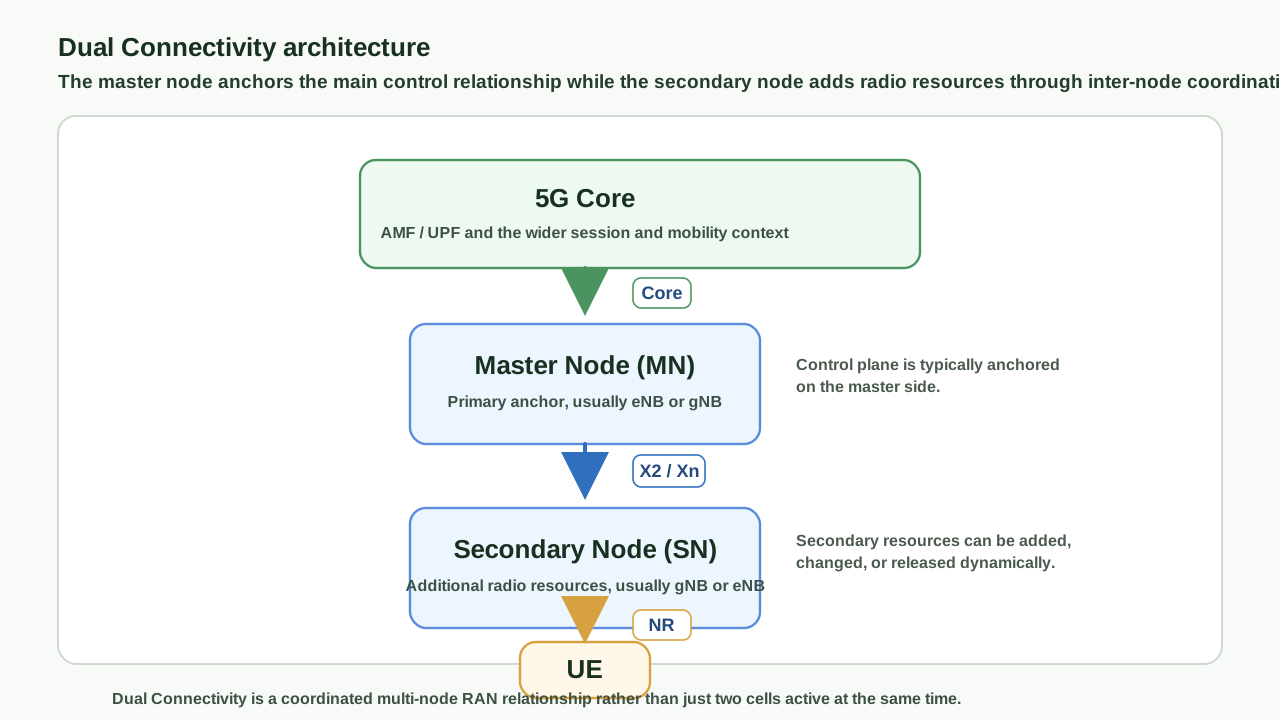
This architecture view matters because Dual Connectivity is not just “two cells at once.” It is a coordinated multi-node RAN relationship with explicit control and user-plane behavior, node roles, and inter-node coordination paths.
Key concepts
| Concept | Meaning in practice |
|---|---|
| Master Node | Primary access anchor that usually handles the control-plane relationship and anchors the UE context. |
| Secondary Node | Additional radio node that contributes extra capacity, coverage help, or multi-node flexibility. |
| Multi-node user plane | User data may stay on one side or be distributed across both nodes depending on bearer design. |
Types of Dual Connectivity
| Type | Typical node relationship | Main use |
|---|---|---|
| EN-DC | LTE eNB as Master Node and NR gNB as Secondary Node | Very important for early 5G NSA deployments. |
| NR-DC | NR node as Master Node and another NR node as Secondary Node | Pure NR multi-node Dual Connectivity in 5G-oriented deployments. |
| NE-DC | NR node as Master Node and LTE node as Secondary Node | Useful when the architecture needs NR-led control with LTE support on the secondary side. |
The most commonly discussed type is EN-DC because it played a major role in the migration from LTE anchor behavior to NR expansion in non-standalone deployments.
Control plane vs user plane
Dual Connectivity makes the separation between signaling and data especially important.
| Plane | Typical Dual Connectivity behavior |
|---|---|
| Control plane | Usually anchored on the Master Node through RRC and related access-side signaling. |
| User plane | May stay on the master side, the secondary side, or be distributed across both nodes depending on bearer treatment. |
This is why a Dual Connectivity issue may look fine in control-plane traces but still behave badly on the user plane if the bearer mapping or inter-node data handling is wrong.
Bearer types in Dual Connectivity
Dual Connectivity is easiest to understand when you look at how bearers are carried.
| Bearer type | Main behavior |
|---|---|
| MCG bearer | Served only by the Master Cell Group, which means the master side carries the traffic. |
| SCG bearer | Served only by the Secondary Cell Group, which means the secondary side carries the traffic. |
| Split bearer | Traffic can be distributed across master and secondary paths rather than staying on just one side. |
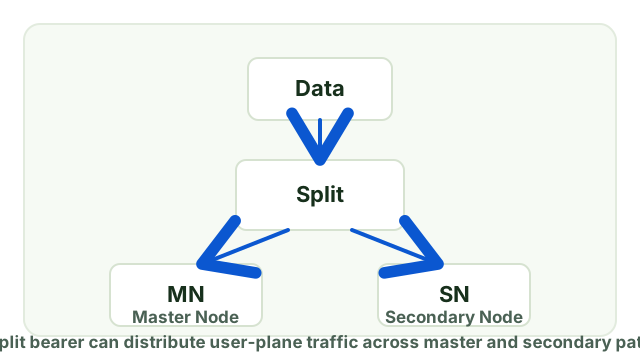
The split-bearer idea is one of the most practically important parts of Dual Connectivity because it is where higher throughput meets higher complexity.
Protocol layer split
Dual Connectivity is commonly explained with a PDCP-level split on the user-plane side. That matters because PDCP is a natural place for distribution, reordering support, and coordinated handling across two radio legs.
- It supports efficient data distribution.
- It helps explain ordering and duplication behavior.
- It gives engineers a practical place to reason about split-bearer complexity.
Dual Connectivity vs Carrier Aggregation
| Feature | Dual Connectivity | Carrier Aggregation |
|---|---|---|
| Node model | Multiple nodes | Typically one node |
| Complexity | Higher, because inter-node coordination matters | Lower, because behavior remains inside one main node context |
| Flexibility | High | More limited |
| Backhaul dependence | Yes, because nodes must coordinate | Much less central to the concept |
Benefits of Dual Connectivity
- Higher throughput because resources from two nodes can be used together.
- Improved coverage because the secondary side can strengthen the radio situation.
- Smoother mobility behavior because the network can add or change secondary resources without always tearing down the full structure.
- Better reliability because multi-node access can reduce dependence on a single radio leg.
Dual Connectivity and mobility
Dual Connectivity and mobility are tightly linked. A lot of the real value comes from the network being able to change the secondary side without always performing a full primary-node mobility event.
- SN Addition adds a secondary node to the current structure.
- SN Modification changes parameters or secondary-side behavior.
- SN Release removes the secondary side when it is no longer useful or stable.
That is why Dual Connectivity often feels like a bridge between pure bearer architecture and mobility architecture. The structure is not fixed; it is something the network can reshape dynamically.
Dual Connectivity procedures
Procedure-level reading helps a lot here, because Dual Connectivity can look conceptually simple until you need to trace the exact reconfiguration path.
RRC role in Dual Connectivity
On the control side, RRC is the key protocol to study for Dual Connectivity. It handles:
- secondary-node configuration
- bearer setup and reconfiguration
- measurement-driven multi-node decisions
- mobility-related reshaping of the DC structure
In practical trace analysis, RRCReconfiguration and MeasurementReport are usually where the story becomes visible.
Dual Connectivity and QoS
Dual Connectivity is also a QoS question, not only a topology question. QoS flows still need to be mapped into bearers and radio-side behavior, and split-bearer handling means the user plane must remain coherent even when it spans two nodes.
- QoS flows still need correct DRB treatment.
- Traffic may be split across nodes, which increases coordination complexity.
- PDCP-related behavior becomes important for ordering and multi-leg continuity.
Dual Connectivity challenges
- Synchronization between nodes
- Backhaul or inter-node latency
- Packet reordering complexity
- Signaling complexity
- Uneven behavior between control success and user-plane quality
This is the trade-off at the heart of Dual Connectivity: more flexibility and performance, but a harder multi-node problem to debug.
Common troubleshooting areas
- Secondary-node addition failure where the structure never becomes fully active.
- Split-bearer issues where traffic mapping works in signaling but fails under load.
- Throughput imbalance where the secondary leg adds little practical value.
- Packet loss or reordering when multi-leg transport handling is not clean.
- Xn or X2 coordination issues that break inter-node alignment.
- Measurement-trigger instability causing repeated secondary-side changes.
FAQ
What is dual connectivity in 5G?
A feature that lets the UE connect to two radio nodes at the same time instead of using only one serving node.
What is EN-DC?
EN-DC is E-UTRA NR Dual Connectivity, where LTE and NR work together with LTE commonly acting as the master side.
What is NR-DC?
NR-DC is NR Dual Connectivity, where both sides of the dual-connectivity setup are NR nodes.
What is a split bearer?
A bearer where user-plane traffic can be distributed across both master and secondary sides rather than staying on only one node.
Why is dual connectivity used?
To improve throughput, strengthen radio performance, and make multi-node access more flexible during evolution and mobility-heavy scenarios.
Key takeaways
- Dual Connectivity lets the UE use two radio nodes at the same time.
- Master Node and Secondary Node are the two key architecture roles.
- EN-DC, NR-DC, and NE-DC are the main deployment patterns to know.
- MCG bearers, SCG bearers, and split bearers are central to the user-plane model.
- RRC, measurements, and inter-node coordination are what make Dual Connectivity work or fail in practice.
References
- 3GPP TS 37.340 - Multi-connectivity; Overall description; Stage-2 Primary 3GPP architecture reference for Multi-RAT Dual Connectivity and the main node-role concepts.
- 3GPP TS 38.300 - NR and NG-RAN overall description; Stage-2 High-level NR architecture reference for NG-RAN behavior and NR-side placement of Dual Connectivity concepts.
- 3GPP TS 38.331 - NR RRC protocol specification RRC reference for configuration, measurement-driven changes, and Dual Connectivity-related signaling behavior.