gNB in 5G Explained
The gNB (gNodeB) is the main radio-access node in the 5G NG-RAN. In the 5G architecture, the NG-RAN connects to the 5G Core over the NG interface and to other NG-RAN nodes over Xn. The gNB is therefore the main access-side node that links the UE's NR radio connection to the 5GC's control-plane and user-plane functions.
Unlike the LTE eNodeB, the gNB was designed from the start to support functional decomposition. A gNB may be split into gNB-CU-CP, gNB-CU-UP, and gNB-DU, with F1 and E1 used between those units. That makes the gNB one of the clearest examples of 5G's flexible, cloud-friendly access architecture.
Quick facts
| What it is | The gNB is the main radio-access node in the 5G NG-RAN. |
|---|---|
| Core-facing role | It connects to the 5G Core over NG, reaching the AMF on the control side and the UPF on the user side. |
| Peer-node role | It connects to neighboring NG-RAN nodes over Xn for mobility and coordination. |
| Split architecture | A gNB may be split into gNB-CU-CP, gNB-CU-UP, and gNB-DU, with F1 and E1 between those units. |
| Radio-side role | It terminates the NR access-side stack and turns mobility, QoS, and session intent into actual radio behavior. |
| Why it matters | Registration, PDU session setup, paging, handover, QoS delivery, and most access-side troubleshooting all pass through the gNB. |
gNB in the 5G architecture
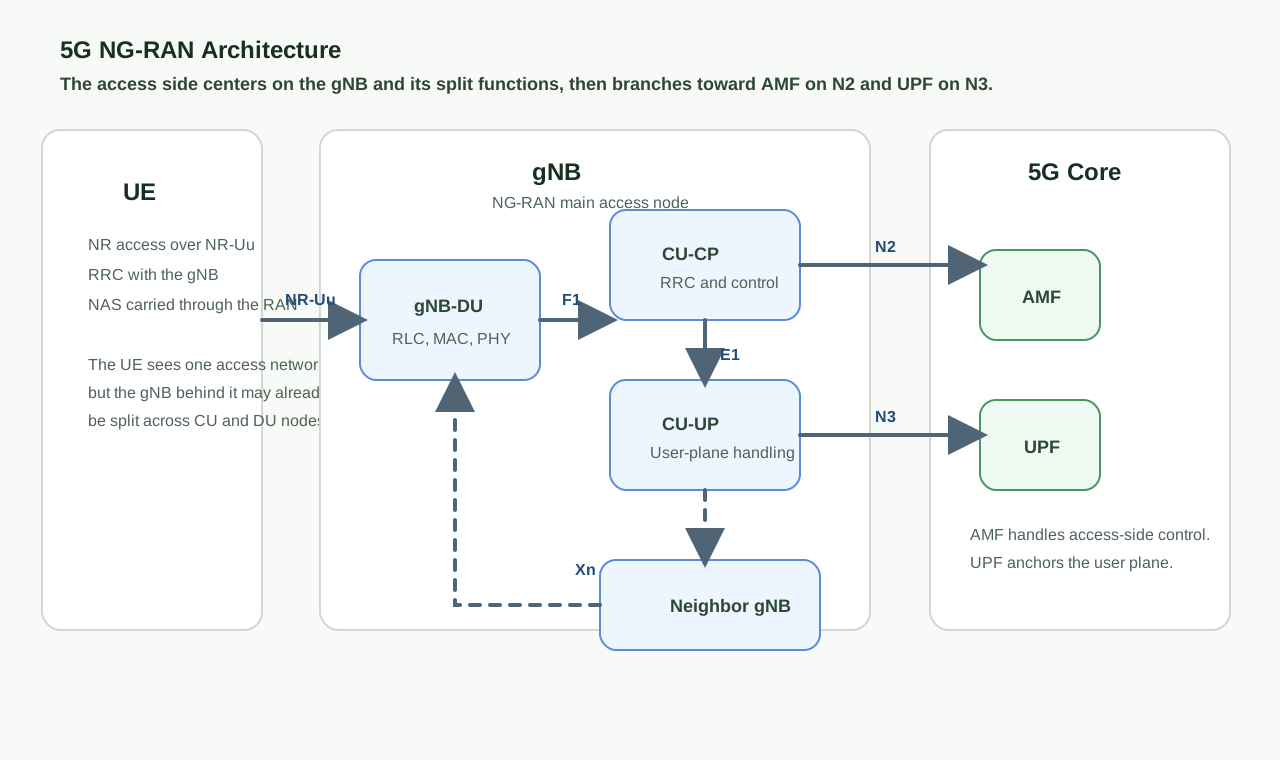
What does the gNB do?
At a practical level, the gNB is responsible for the access-side behavior that makes 5G work. It provides NR radio access toward the UE, terminates the NR control and user plane on the radio side, forwards user-plane traffic toward the UPF, and exchanges control-plane signaling with the AMF.
From an engineering perspective, this means the gNB is the point where radio measurements and mobility decisions become real network behavior, QoS treatment becomes radio scheduling and bearer handling, and core-network decisions become access-side state and transport behavior.
gNB as the main NG-RAN node
The gNB is the central node of the NG-RAN. The NG-RAN architecture places the gNB on the access side of the 5GS, connected to the AMF and UPF over NG and to neighboring NG-RAN nodes over Xn.
That makes the gNB the main place where 5G RAN topics come together: radio protocol handling, mobility, bearer realization, split-RAN deployment, and access-to-core integration. If you understand the gNB clearly, the rest of the 5G access architecture gets much easier to place.
gNB functional split: CU-CP, CU-UP, and DU
One of the biggest architectural changes in 5G is that a gNB may be split into multiple functional units. A gNB may consist of a gNB-CU-CP, one or more gNB-CU-UPs, and one or more gNB-DUs.
| Component | Main role |
|---|---|
| gNB-CU-CP | Central control-plane side of the gNB, commonly associated with RRC and higher-level control handling. |
| gNB-CU-UP | Central user-plane side of the gNB, used when central-unit user processing is separated from control handling. |
| gNB-DU | Distributed unit kept closer to lower-layer and timing-sensitive radio functions. |
| F1-C and F1-U | Interfaces between CU and DU for control coordination and user-plane transport. |
| E1 | Interface between CU-CP and CU-UP when the central unit is itself split. |
The split matters because it lets operators centralize higher-layer processing, distribute radio-related functions closer to the cell site, and scale control and user functions independently. That flexibility is one of the biggest reasons the gNB is more deployment-friendly than the LTE eNodeB.
Control plane and user plane role of the gNB
| Plane | gNB role |
|---|---|
| Control plane | RRC termination toward the UE, NAS transport toward the AMF, paging support, mobility coordination, and access-side UE context handling. |
| User plane | NR data transport toward the UE, QoS-aware access-side handling, and NG-U or N3 forwarding toward the UPF. |
This split is one of the main reasons 5G can independently scale mobility and session control versus data transport. It also helps troubleshooting, because control-plane and user-plane faults often separate along the same boundaries.
Main interfaces of the gNB
| Interface | Connects | Main role |
|---|---|---|
| NR-Uu | UE and gNB | NR radio interface for access-side control and user-plane transport. |
| NG | gNB and 5GC | Main access-to-core boundary, reaching the AMF on the control side and the UPF on the user side. |
| Xn | gNB and neighboring NG-RAN node | Inter-node mobility, coordination, context transfer, and forwarding support. |
| F1 | gNB-CU and gNB-DU | Split-gNB control and user-plane coordination. |
| E1 | gNB-CU-CP and gNB-CU-UP | Coordination across split control-plane and user-plane central-unit functions. |
The easiest way to keep the gNB interface picture straight is this: NR-Uu faces the UE, NG faces the 5GC, Xn faces peer NG-RAN nodes, and F1 or E1 only appear when the gNB itself is split.
gNB and the NR protocol stack
The gNB terminates the NR access-side protocol stack toward the UE. From a practical viewpoint, the gNB handles RRC on the control side and SDAP, PDCP, RLC, MAC, and PHY on the access side, with the exact placement depending on how the gNB is functionally split.
This matters because the gNB is not just a forwarding device. It is the access-side protocol-processing node that turns 5GC session and mobility intent into real radio behavior.
gNB and mobility
The gNB is deeply involved in 5G mobility. The NG-RAN architecture uses Xn for inter-node coordination and the NG interface when the 5G Core must participate more directly.
- radio measurement handling
- handover preparation
- target-cell coordination
- access-side context transfer
- user-plane path updates through the core as needed
This is why mobility debugging in 5G often focuses first on the gNB and its neighboring RAN relationships. Even when the AMF and UPF are involved, the access-side decision and execution logic still lives heavily at the gNB.
gNB and QoS
In 5G, QoS is more flexible than in LTE because the 5GS architecture introduces QoS flows. The gNB is one of the main places where those flows are translated into access-side handling.
- radio-side QoS enforcement
- scheduling behavior
- mapping service intent into actual user experience
In practical engineering terms, the gNB is where core-network QoS decisions become actual radio treatment.
gNB vs LTE eNodeB
| Feature | LTE eNodeB | 5G gNB |
|---|---|---|
| Access network | E-UTRAN | NG-RAN |
| Core interface | S1 | NG |
| Peer-node interface | X2 | Xn |
| Native split architecture | Limited | CU-CP, CU-UP, and DU split |
| Core integration | EPC | 5GC |
The gNB is not just a renamed eNodeB. The NG interface, Xn interface, and built-in CU-DU and CU-CP or CU-UP decomposition make it much more flexible architecturally.
How the gNB fits into end-to-end 5G procedures
- Registration through the access path to the AMF.
- PDU session establishment through the access path to the UPF.
- Paging through the RAN-side reachability path.
- Handover through NG-RAN and core coordination.
- QoS handling through access-side bearer and scheduling behavior.
This is why the gNB is one of the highest-value architecture topics on a 5G reference site. It links radio access, interfaces, mobility, QoS, and core integration all at once.
FAQ
What is a gNB in 5G?
The gNB is the main radio-access node in the 5G NG-RAN. It connects the UE to the 5G Core over NG and to neighboring NG-RAN nodes over Xn.
What is the difference between gNB and eNodeB?
The gNB belongs to the 5G NG-RAN and connects to the 5GC over NG, while the eNodeB belongs to LTE E-UTRAN and connects to the EPC over S1. The gNB also supports built-in CU-CP, CU-UP, and DU split architecture.
Can a gNB be split into multiple units?
Yes. A gNB may consist of a gNB-CU-CP, multiple gNB-CU-UPs, and multiple gNB-DUs.
What interfaces does the gNB use?
The main gNB interfaces are NR-Uu, NG, Xn, F1, and E1, depending on the deployment model and split architecture used.
Does the gNB handle both control and user plane?
Yes. The gNB participates in both the control plane and the user plane, connecting to the AMF on the control side and the UPF on the user side.
Key takeaways
- The gNB is the main radio-access node in the 5G NG-RAN.
- It connects the UE to the 5GC over NG and to neighboring NG-RAN nodes over Xn.
- A gNB may be split into gNB-CU-CP, gNB-CU-UP, and gNB-DU, using F1 and E1 interfaces.
- The gNB is central to RRC handling, mobility, QoS enforcement, NAS transport, and user-plane forwarding.
- Understanding the gNB is essential for reading 5G registration, PDU session, paging, handover, and NG-RAN deployment behavior.
References
- 3GPP TS 38.401 - NG-RAN architecture description Primary NG-RAN architecture reference for gNB, NG, Xn, F1, and split-gNB structure.
- 3GPP TS 23.501 - System architecture for the 5G System (5GS) 5GS architecture reference for AMF, UPF, control-plane and user-plane separation, and QoS flow concepts.
- 3GPP TS 38.470 - F1 general aspects F1 reference for CU and DU interconnection within a split gNB.
- 3GPP TS 38.300 - NR and NG-RAN overall description; Stage-2 High-level NR protocol and architecture reference for radio-side protocol placement and behavior.