5G NR Measurement Configuration Explained
Measurement configuration in 5G NR defines how a UE measures radio conditions and reports them to the gNB. It is a core part of mobility control, handover preparation, and radio optimization.
On the signaling side, the gNB delivers this behavior through RRC, usually by sending or updating a MeasurementConfig inside RRCReconfiguration. That configuration tells the UE what to observe, which rules to apply, and when a report should be generated.
Quick facts
| What it is | Measurement configuration tells the UE what to measure, when to evaluate it, and when to report it back to the gNB. |
|---|---|
| Main container | The core RRC structure is MeasurementConfig. |
| Key building blocks | MeasObject, ReportConfig, MeasId, QuantityConfig, and MeasGapConfig. |
| Main signaling message | It is typically delivered or updated through RRCReconfiguration. |
| Main engineering use | It drives handover preparation, mobility stability, inter-frequency measurements, and inter-RAT reporting. |
| Common tuning knobs | Thresholds, hysteresis, time-to-trigger, filters, and measurement gaps. |
Where measurement configuration fits
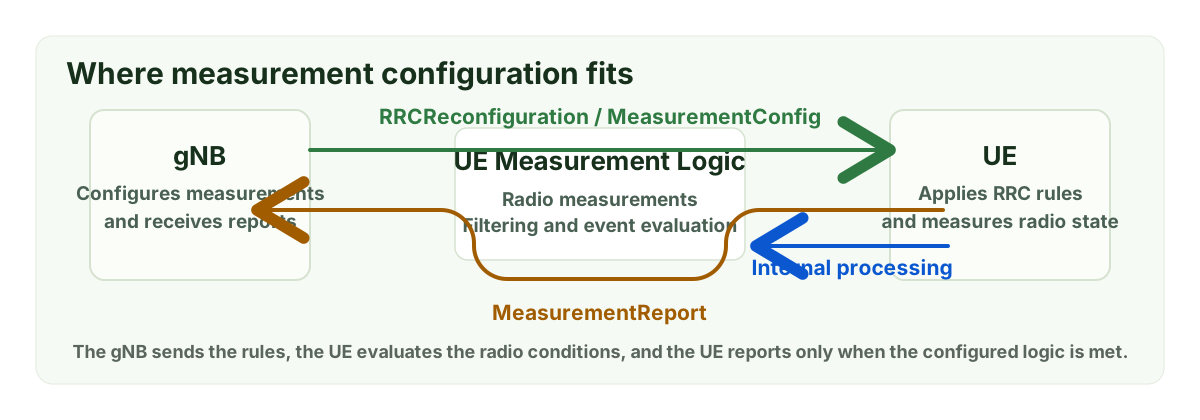
The operational flow is simple in concept even though the RRC structure is detailed. First, the gNB configures measurement parameters. Then the UE performs measurements, applies filters and event logic, and sends reports only when the configured conditions are met.
- gNB configures measurement parameters.
- UE performs measurements on the configured target set.
- UE evaluates thresholds, offsets, hysteresis, and time-to-trigger logic.
- UE sends MeasurementReport when the configured rule fires.
What is MeasurementConfig?
MeasurementConfig is the main RRC structure used to configure UE measurements. It is the container that ties together the objects being measured, the reporting rules, and the mapping between them.
In practical terms, it answers three questions for the UE: what to measure, when to report, and how to evaluate the results.
Key components of measurement configuration
| Component | Main role |
|---|---|
| MeasObject | Defines what the UE should measure, such as NR frequencies, neighbor cells, or inter-RAT targets. |
| ReportConfig | Defines when the UE should report, including event-based or periodic reporting behavior. |
| MeasId | Links a measurement object to a reporting configuration. |
| QuantityConfig | Controls how measurement quantities such as RSRP, RSRQ, and SINR are filtered and evaluated. |
| MeasGapConfig | Defines gaps that let the UE measure other frequencies or RATs when continuous observation is not possible. |
MeasurementConfig
 ├── MeasObjectList
 ├── ReportConfigList
 ├── MeasIdList
 ├── QuantityConfig
 └── MeasGapConfig
Measurement objects in detail
A measurement object defines what the UE should measure. This is the part of the configuration that points the UE toward the right frequency layer, cell set, or inter-RAT target.
| Measurement object | Typical use |
|---|---|
| MeasObjectNR | Used for NR carriers, SSB-related measurement targets, and neighbor NR cells. |
| MeasObjectEUTRA | Used when the UE needs to measure LTE targets for inter-RAT mobility or fallback scenarios. |
This is one of the first places to inspect when the UE is reporting against the wrong layer, missing a target frequency, or failing to trigger the mobility branch the network expected.
Reporting configuration in detail
ReportConfig defines when the UE should send a report. This includes both event-driven logic and periodic reporting options.
- Event-based reporting is commonly used for mobility and includes A1, A2, A3, A4, A5, B1, and B2 style logic.
- Periodic reporting is useful when the network wants recurring visibility rather than threshold-triggered reports.
- Thresholds define the trigger levels.
- Hysteresis helps avoid unstable toggling around a threshold.
- Time-to-trigger prevents single short-lived radio changes from causing immediate reporting.
In day-to-day tuning work, this is where the network trades speed against stability. Aggressive settings can move the UE faster, while conservative settings can reduce ping-pong behavior and signaling noise.
Measurement identity mapping
MeasId is the glue between what is measured and when it should be reported. It binds a measurement object to a reporting configuration.
MeasId1 -> (NR frequency 3500 MHz, Event A3)
This mapping is what gives the configuration its flexibility. The gNB can point different frequency layers or target systems at different event rules without rebuilding the entire structure from scratch.
Quantity configuration
QuantityConfig defines how measurement quantities are filtered and evaluated. In practical terms, it shapes how stable or reactive the UE's internal measurement view becomes.
- RSRP filtering affects received-power stability.
- RSRQ filtering affects how quality trends are smoothed.
- SINR filtering affects how quickly interference-related changes appear in reporting behavior.
Poor filtering choices can produce noisy reports, delayed decisions, or mobility behavior that looks random until you inspect the actual filter settings.
Measurement gaps
Measurement gaps give the UE time to measure other frequencies or other RATs when it cannot continuously observe them while staying on the current serving configuration.
- They are especially relevant for inter-frequency measurements.
- They also matter for inter-RAT measurements such as NR to LTE mobility support.
- If they are missing or misaligned, the UE may simply never collect the measurement evidence the network expects.
Measurement configuration and mobility
Measurement configuration directly shapes mobility quality. Handover timing, neighbor visibility, frequency priorities, and inter-RAT readiness all depend on the measurement rules the gNB sends.
- It drives handover decisions in connected mode.
- It supports inter-frequency mobility readiness.
- It supports inter-RAT mobility and fallback behavior.
- It affects whether mobility looks late, early, missing, or unstable in live traces.
5G NR Mobility
Read how measurement logic becomes Xn or NG handover behavior.
5G NR Measurement Events
Study the trigger conditions that decide when MeasurementReport is sent.
5G Measurement Reporting
Follow the configured path from radio condition to report delivery.
5G Xn Handover
See how measured neighbor quality can drive direct inter-gNB mobility.
Measurement configuration and RRC
On the signaling side, measurement configuration is an RRC topic. The gNB sends it to the UE through RRC, usually in RRCReconfiguration, and updates it when radio conditions, neighbor priorities, or mobility strategy need to change.
That makes RRC traces the natural first stop when the UE appears to be measuring the wrong thing, reporting at the wrong time, or not reporting at all.
Measurement configuration and beam management
In NR, measurement behavior is often more granular than a simple cell-level view. Beam-aware operation means the UE may evaluate multiple beam candidates within or across cells, and the measurement configuration needs to align with that beam-centric reality.
This is one reason 5G mobility tuning can feel more delicate than earlier systems. The network is not only choosing cell-level thresholds, but also shaping how beam-level radio behavior becomes measurement evidence.
Common issues in measurement configuration
- Incorrect thresholds that make reporting too eager or too late.
- Missing measurement objects so the UE never evaluates the intended target.
- Wrong MeasId mapping so valid measurements are tied to the wrong reporting logic.
- Improper gap configuration that blocks inter-frequency or inter-RAT observation.
- Too much reporting causing signaling load and unstable decisions.
- Too little reporting causing late handovers or poor radio visibility.
Optimization considerations
Measurement configuration is mostly about trade-offs. Faster reporting can improve reactivity but increase noise and signaling. More conservative filtering can improve stability but make mobility appear sluggish.
| Tuning area | Main trade-off |
|---|---|
| Thresholds | How easily the UE enters reporting conditions. |
| Hysteresis | Stability versus responsiveness near the trigger boundary. |
| Time-to-trigger | Reaction speed versus resistance to short transient fades. |
| Filtering | Smoother measurements versus faster visibility of real radio changes. |
| Measurement gaps | Visibility into other layers versus interruption cost and scheduling complexity. |
FAQ
What is MeasurementConfig in 5G?
It is the RRC structure that defines how the UE performs measurements, evaluates them, and reports them.
What is MeasObject?
It defines what the UE should measure, such as a frequency layer, neighbor cell set, or inter-RAT target.
What is ReportConfig?
It defines when the UE should report, including event logic, thresholds, hysteresis, and time-to-trigger.
What is MeasId?
It links a measurement object to a reporting configuration so the UE can apply the right reporting rule to the right target.
Why are measurement gaps needed?
They give the UE time to measure other frequencies or RATs when continuous observation is not possible on the current serving configuration.
Key takeaways
- Measurement configuration controls how the UE measures and reports radio conditions.
- MeasurementConfig is the main RRC structure behind that behavior.
- MeasObject, ReportConfig, and MeasId are the core pieces to place first.
- Filtering, hysteresis, time-to-trigger, and gaps are the tuning knobs that most strongly affect behavior.
- Mobility quality is heavily shaped by measurement configuration quality.
References
- 3GPP TS 38.331 - NR RRC protocol specification Primary RRC reference for MeasurementConfig, MeasObject, ReportConfig, MeasId, and measurement-related signaling.
- 3GPP TS 38.300 - NR and NG-RAN overall description; Stage-2 High-level NR architecture reference for mobility concepts, measurements, and access-side behavior.