5G NR Mobility Explained
Mobility in 5G NR keeps a UE connected, reachable, and service-continuous while it moves across cells, gNBs, and tracking areas. It is a core NG-RAN function, but it also depends on the 5G Core for access and mobility management.
In the 5G architecture, the gNB handles radio-side mobility execution, the AMF handles access and mobility management on the core side, and mobility procedures operate across NR-Uu, Xn, and NG interfaces.
Quick facts
| What it is | 5G mobility keeps the UE reachable and service-continuous while it moves across cells, gNBs, and tracking areas. |
|---|---|
| Main RAN node | The gNB handles radio-side mobility execution, measurement control, and handover preparation. |
| Core function | The AMF handles access and mobility management on the 5G Core side. |
| Key interfaces | NR-Uu, Xn, NG-C/N2, and NG-U/N3 are the most important mobility-related paths. |
| Main states | Mobility behavior differs across RRC Idle, RRC Inactive, and RRC Connected states. |
| Troubleshooting focus | Measurements, handover timing, Xn reachability, NG fallback, bearer continuity, and post-handover QoS. |
Where mobility fits in 5G architecture
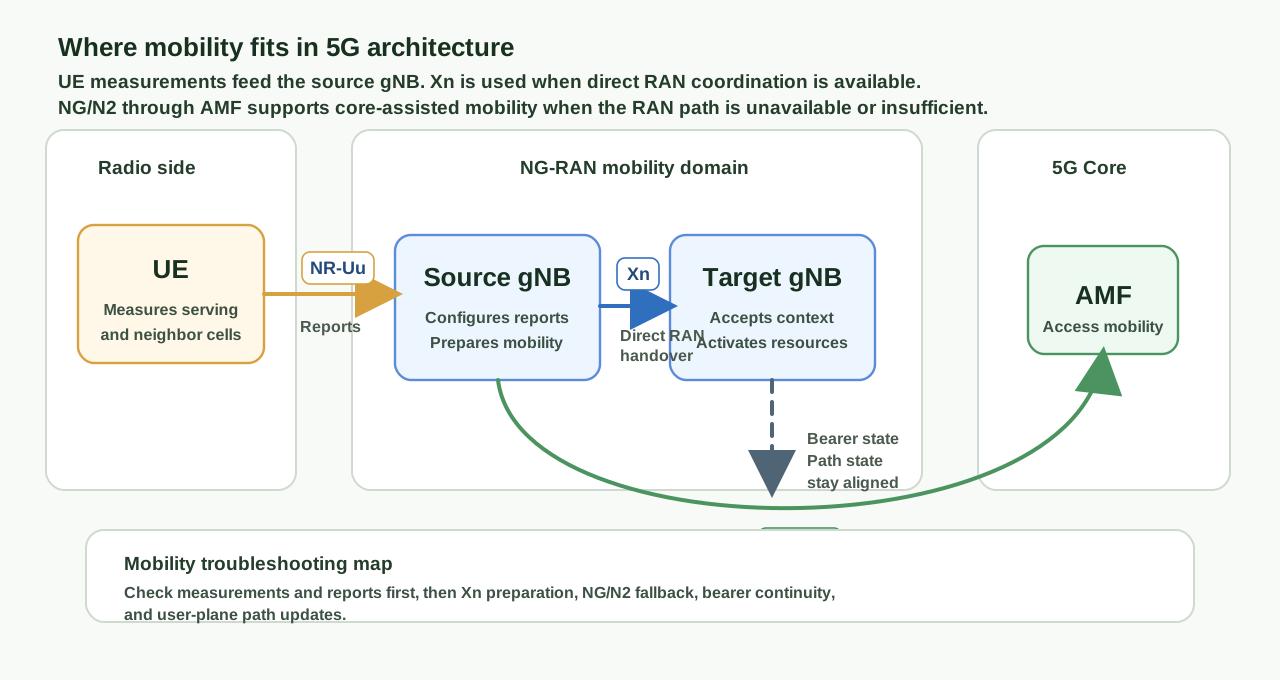
Mobility operates at several layers at once. The UE measures radio conditions over NR-Uu, the gNB configures measurements and executes access-side decisions, neighboring gNBs coordinate over Xn when available, and the AMF becomes involved when the mobility path needs core-side control.
That layered design is the reason 5G mobility troubleshooting needs more than one trace view. A failed handover can be caused by radio measurement timing, RRC configuration, Xn reachability, NG signaling, bearer continuity, or user-plane path update behavior.
Types of mobility in 5G
5G mobility behavior changes depending on the UE state. A UE that is idle, inactive, or connected has a different relationship with the gNB and core network.
| Mobility type | Who controls it | Main behavior |
|---|---|---|
| Idle mode mobility | Mostly UE-controlled | The UE performs cell reselection while the network tracks reachability at registration area level. |
| RRC Inactive mobility | UE and network context | The UE can move with preserved context and later resume without rebuilding every access-side step from zero. |
| Connected mode mobility | Network-controlled | The gNB configures measurements, receives reports, prepares target resources, and executes handover. |
Measurement-based mobility
Connected-mode mobility is driven by radio measurements. The gNB configures what the UE should measure, the UE observes serving and neighbor cells, and the UE reports results when the configured conditions are met.
- RSRP helps describe received reference-signal power.
- RSRQ helps describe received reference-signal quality.
- SINR helps describe signal quality relative to interference and noise.
- Measurement events such as A3, A5, B1, and B2 are common mobility triggers.
Those measurement events are configured through RRC signaling. In practical trace analysis, measurement configuration and MeasurementReport behavior are usually the first place to look when handover timing appears late, early, unstable, or missing.
Handover in 5G
A handover transfers a UE from one cell or gNB context to another while trying to preserve service continuity. The exact path depends on whether the target is inside the same gNB domain, reachable through Xn, or requires stronger 5G Core participation through NG/N2.
| Handover type | Typical path | Why it matters |
|---|---|---|
| Intra-gNB handover | Inside the same gNB domain | Often lighter operationally, but still depends on correct RRC and radio resource handling. |
| Xn handover | Source gNB to target gNB over Xn | Preferred when direct NG-RAN coordination is available, usually reducing core involvement. |
| NG / N2 handover | Source and target path coordinated through AMF | Useful when Xn is unavailable, unsuitable, or when the mobility context needs stronger core control. |
Xn vs NG mobility
| Feature | Xn handover | NG / N2 handover |
|---|---|---|
| Main path | Direct source gNB to target gNB coordination. | Source and target access nodes coordinate through the AMF. |
| Core involvement | Lower during preparation and execution. | Higher, because AMF participates directly. |
| Typical use | Normal inter-gNB mobility when Xn is available. | Fallback, special topology, unavailable Xn, or core-controlled cases. |
| Troubleshooting clue | Inspect XnAP, context transfer, and Xn-U forwarding where applicable. | Inspect NGAP/N2 signaling, AMF participation, and path-switch behavior. |
RRC role in mobility
RRC is the radio-control protocol that turns mobility policy into concrete UE behavior. It configures measurements, carries reports, controls reconfiguration, and supports state transitions.
- RRCReconfiguration is central to handover and radio configuration changes.
- MeasurementReport lets the UE send configured measurement results to the network.
- RRCRelease can move the UE away from connected state and may include suspend-related behavior.
Mobility and bearer continuity
During mobility, the radio link changes, but the service should remain continuous. That means DRBs, QoS flow mapping, PDU Session resources, and user-plane path handling must stay aligned with the new access-side state.
In practical terms, a handover can look successful on the control plane while still producing packet loss, media glitches, or QoS degradation if bearer continuity or user-plane forwarding is not handled correctly.
5G Radio Bearers
Understand SRBs, DRBs, QoS flow mapping, and SDAP before debugging mobility continuity.
PDU Session Modification
See how active session resources can change after policy, QoS, or path updates.
Session Recovery After Path Switch
Useful when mobility succeeds but user-plane recovery becomes the real issue.
Mobility and the 5G Core
The AMF supports mobility by tracking UE reachability, managing access context, coordinating NG/N2 handover paths, and handling registration-area updates. The UPF may remain the user-plane anchor while the access path changes, or the user-plane path may need to be updated depending on the mobility case.
This is why mobility is not only a radio problem. The gNB may execute the access-side handover, but the core must still keep the UE context, reachability, and user-plane path consistent.
Mobility in RRC Inactive state
5G introduces RRC Inactive as a useful middle ground between fully connected and idle behavior. The UE can reduce signaling and battery use while keeping enough context to resume faster than a full fresh setup in suitable cases.
- UE context can be retained for faster access restoration.
- Resume behavior can reduce signaling overhead compared with a full rebuild.
- Mobility context changes during inactive state must still be handled carefully.
Mobility challenges in 5G
5G can make mobility more demanding than earlier systems because deployments may use high-frequency bands, dense small cells, massive MIMO, beamforming, and split-RAN transport. Each of those can affect the timing and reliability of mobility decisions.
| Challenge | Mobility impact |
|---|---|
| High-frequency bands | Smaller cells and higher path loss can mean more frequent mobility decisions. |
| Massive MIMO and beamforming | Beam-level behavior can matter before cell-level handover is even considered. |
| Ultra-dense networks | More neighbors increase measurement, coordination, and optimization complexity. |
| Split RAN | Transport latency and F1/E1 health can affect how cleanly mobility-related state is handled. |
Typical mobility procedures and call flows
These procedure pages are the best next step when you want to move from architecture concepts to actual signaling sequences.
Measurement Reporting
How measurements feed the handover decision loop.
Xn Handover
Direct inter-gNB mobility using Xn.
N2 Handover
Core-assisted mobility through AMF participation.
Mobility Registration Update
Core-side location refresh when the UE moves across registration-area context.
RRC Reconfiguration
Radio-side configuration changes used across many mobility paths.
Service Request
Return-to-service path that often follows paging or inactive/idle recovery.
Common mobility issues
- Handover failure when preparation, execution, or completion breaks.
- Late handover where radio conditions degrade before the move completes.
- Early handover or ping-pong where the UE moves too aggressively between cells.
- Measurement misconfiguration causing missing, noisy, or misleading reports.
- Xn connectivity issues breaking direct inter-gNB mobility.
- NG fallback delays when core-assisted mobility is slower than expected.
- QoS degradation after handover because bearer or path handling is not aligned.
FAQ
What is mobility in 5G?
Mobility in 5G keeps a UE reachable and service-continuous while it moves across cells, gNBs, and tracking areas.
What is the difference between idle and connected mobility?
Idle mobility is mainly UE-controlled through cell reselection, while connected mobility is network-controlled through measurement reporting and handover.
What is Xn handover?
Xn handover is inter-gNB mobility using the Xn interface for direct source-to-target NG-RAN coordination.
What is NG handover?
NG handover is a mobility path where the 5G Core, especially the AMF, participates directly in handover coordination.
What is RRC Inactive state?
RRC Inactive is a lower-signaling state that lets the UE keep resumable context and return to active service faster in suitable cases.
Key takeaways
- 5G mobility spans idle, inactive, and connected behavior.
- Measurements drive connected-mode mobility decisions.
- Xn handover is preferred when direct inter-gNB coordination is available.
- NG/N2 handover involves stronger AMF participation and is used when the direct RAN path is not enough.
- RRC controls measurement configuration, reporting, reconfiguration, release, and resume behavior.
- Bearer continuity is what turns a successful handover into a good user experience.
References
- 3GPP TS 38.300 - NR and NG-RAN overall description; Stage-2 High-level NR and NG-RAN architecture reference for RRC states, mobility concepts, and radio protocol context.
- 3GPP TS 38.331 - NR RRC protocol specification RRC reference for MeasurementReport, RRCReconfiguration, RRCRelease, and mobility-related configuration.
- 3GPP TS 38.401 - NG-RAN architecture description NG-RAN architecture reference for gNB, NG, Xn, CU-DU split, and access-to-core relationships.
- 3GPP TS 23.502 - Procedures for the 5G System 5GS procedure reference for registration, service request, handover, and mobility-related core behavior.