5G NR Radio Bearers Explained
In 5G NR, a radio bearer is the access-side bearer used between the UE and the gNB. Radio bearers are part of the wider 5G service and QoS architecture that connects the UE, NG-RAN, and 5G Core.
5G distinguishes between Signalling Radio Bearers (SRBs) for RRC and NAS signaling and Data Radio Bearers (DRBs) for user-plane data. On the data side, 5G adds a flexible model where QoS flows are mapped to DRBs with help from the SDAP sublayer.
Quick facts
| What it is | A 5G NR radio bearer is the access-side bearer between the UE and the gNB. |
|---|---|
| Signaling bearers | SRBs carry RRC and NAS signaling. Common SRBs include SRB0, SRB1, SRB2, with SRB3 and SRB4 used in specific scenarios. |
| Data bearers | DRBs carry user-plane data between UE and gNB. |
| 5G QoS model | 5G maps QoS flows to DRBs rather than treating every service as a simple one-to-one bearer chain. |
| Key protocol | SDAP supports QoS flow to DRB mapping and QFI marking in the NR user plane. |
| Specification baseline | 3GPP TS 38.331, TS 38.300, and TS 37.324. |
Where radio bearers fit in 5G architecture
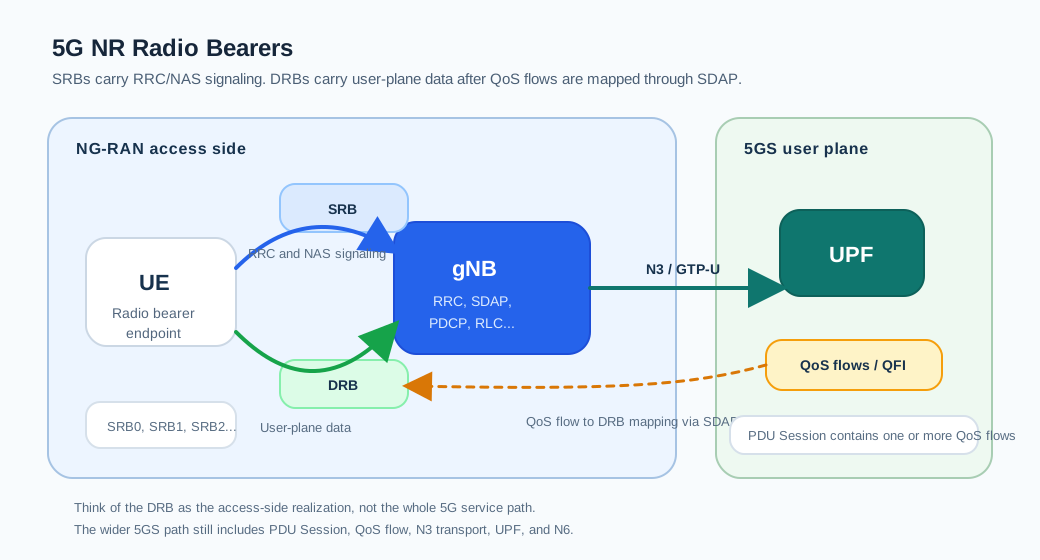
In 5G, the radio bearer is the NG-RAN-side transport path between the UE and the gNB. Above that access-side view, the wider 5GS user plane is organized around PDU Sessions, QoS flows, and N3 user-plane transport between gNB and UPF.
This is a major difference from a simple LTE-style bearer chain explanation. In 5G, the service side works with QoS flows, and the access side realizes those flows through DRBs and radio scheduling behavior.
What is a radio bearer in 5G?
At a practical level, a radio bearer is the logical bearer used by NR on the access side to transport either signaling traffic or user-plane traffic. It gives the NG-RAN a way to separate control from data, apply radio-specific behavior, and map 5GS QoS treatment into access-side handling.
- Radio bearers separate signaling from user data.
- They support registration, bearer configuration, mobility, and QoS updates.
- They let the gNB translate core-side QoS intent into access-side radio behavior.
Signalling Radio Bearers (SRBs)
Signalling Radio Bearers are radio bearers used for RRC and NAS signaling. TS 38.331 defines SRBs as radio bearers used only for transmission of RRC and NAS messages.
| SRB | Main use | Logical channel context |
|---|---|---|
| SRB0 | Early RRC messages before dedicated signaling is established. | CCCH. |
| SRB1 | RRC messages, possible piggybacked NAS, and NAS before SRB2 is established. | DCCH. |
| SRB2 | NAS messages and some RRC messages after security activation. | DCCH, typically lower priority than SRB1. |
| SRB3 | Specific RRC messages in dual-connectivity scenarios such as (NG)EN-DC or NR-DC. | Scenario-specific dedicated signaling. |
| SRB4 | RRC messages that include application-layer measurement report information. | Dedicated signaling context. |
SRBs are the control-signaling foundation of NR access. Without them, the UE cannot complete RRC connection handling, carry NAS toward the 5GC, receive bearer configuration, or maintain control signaling during mobility.
Data Radio Bearers (DRBs)
A Data Radio Bearer is the radio bearer used for user-plane data traffic. DRBs are the access-side bearers over which user-plane data is exchanged between UE and gNB.
Once registration and PDU Session resource handling are in place, DRBs carry service traffic such as internet data, application traffic, IMS media, and other QoS-sensitive user-plane packets.
SRB vs DRB
| Bearer type | Used for | Examples |
|---|---|---|
| SRB | Signaling. | RRC setup, NAS transport, security, reconfiguration, and mobility control messages. |
| DRB | User data. | IP traffic, app traffic, media traffic, IMS user plane, and QoS-sensitive service packets. |
The split is similar in spirit to LTE, but 5G adds a more explicit QoS-flow-based mapping model on the DRB side.
QoS flows and DRBs in 5G
One of the most important 5G concepts is that the user-plane model is built around QoS flows. The 5GC and PDU Session side work with QoS flows, while the NG-RAN access side realizes those flows through DRBs.
- A new QoS flow can arrive from the core side.
- The gNB checks whether an existing DRB can carry that flow.
- If needed, the gNB establishes a new DRB.
- The UE receives or updates QFI-to-DRB mapping rules through RRC signaling.
This mapping is one of the core design features that makes 5G bearer handling more flexible than a simple one-service, one-bearer model.
SDAP and QoS flow to DRB mapping
The SDAP (Service Data Adaptation Protocol) sublayer is a key 5G addition to the radio user plane. It supports transfer of user-plane data, mapping between a QoS flow and a DRB, and marking of the QoS Flow ID (QFI) in packets.
SDAP is the layer that makes QFI-aware bearer handling practical on the access side. It lets the network use configured or reflective mapping behavior while keeping the radio bearer model manageable.
DRB reuse vs new DRB establishment
Not every new QoS flow needs a new DRB. A gNB may decide to establish a new DRB, but it can also keep the flow on an existing DRB and update the QFI-to-DRB mapping. A QoS flow can also be released from a DRB without releasing the DRB itself if that DRB still carries other flows.
- One DRB may carry one or more QoS flows.
- Mapping rules can change over time.
- DRBs may persist while individual QoS-flow mappings are added or removed.
Radio bearers and RRC in 5G
Radio bearers in NR are configured and controlled through RRC signaling. RRC messages can set up, modify, or release signaling and data radio bearers through bearer-related configuration.
This makes bearer analysis tightly connected to RRC analysis. SRBs carry the control signaling itself, DRBs are configured by RRC-driven procedures, and QFI-to-DRB mapping is often delivered through RRC Reconfiguration.
Radio bearers and PDU Sessions
DRBs do not exist in isolation. On the 5GS side, they are tied to PDU Sessions and QoS flows. A useful model is:
| Layer | Concept | How to think about it |
|---|---|---|
| 5GS/session level | PDU Session | The service/session container in the 5G system. |
| QoS level | QoS flow | The differentiated QoS treatment inside the PDU Session. |
| Access level | DRB | The NG-RAN-side bearer realization for mapped QoS flows. |
Radio bearers and mobility
Radio bearers are deeply tied to mobility. Handover and resume procedures may need to preserve or update bearer configuration, QoS-flow-to-DRB mapping, and PDCP or RLC behavior for continuity.
This is why handover troubleshooting is not just about whether the target cell accepts the UE. It is also about whether the target side applies the correct bearer and mapping state after the mobility step.
Typical procedures and call flows using radio bearers
- PDU Session Establishment: session and user-plane resources are created before DRBs carry service traffic.
- QoS Flow Establishment: a new QoS flow is added and mapped onto access-side DRB behavior.
- QoS Flow Modification: existing service treatment changes, often requiring updated QFI-to-DRB mapping.
- RRC Reconfiguration: the access-side procedure that commonly carries bearer, mapping, and mobility updates.
- Service Request: a registered UE returns to active service and user-plane or bearer usability is restored.
- Handover: bearer continuity depends on preserving or rebuilding the correct bearer and mapping state on the target side.
PDU Session Establishment
See how the session and user-plane path are created before DRBs carry service traffic.
QoS Flow Establishment
Follow the service-side QoS flow setup that later maps onto DRB behavior in NG-RAN.
QoS Flow Modification
Use this when existing bearer treatment changes because policy, service, or QoS rules changed.
RRC Reconfiguration
Read the access-side procedure that commonly carries bearer, mapping, and mobility updates.
Service Request
Connect idle or inactive service return to user-plane restoration and bearer reactivation.
Xn Handover
Trace bearer continuity when the UE moves between gNBs using RAN-side mobility coordination.
Common troubleshooting angles for 5G radio bearers
- SRB setup failure during initial access or reconfiguration.
- DRB setup failure after QoS-flow or session signaling.
- Mismatch between QoS flow intent and DRB realization.
- Incorrect QFI-to-DRB mapping.
- User plane exists in the core, but the DRB is not properly created or updated in NG-RAN.
- QoS-flow mapping is released without the correct UE update.
- Bearer continuity issues during handover, resume, or reestablishment.
FAQ
What is a radio bearer in 5G?
A radio bearer in 5G is the access-side bearer between the UE and the gNB. NR uses SRBs for signaling and DRBs for user-plane data.
What is the difference between SRB and DRB in 5G?
SRBs carry RRC and NAS signaling, while DRBs carry user-plane traffic.
How many SRBs are there in 5G NR?
TS 38.331 defines SRB0, SRB1, SRB2, and additional SRBs such as SRB3 and SRB4 for specific scenarios.
How do QoS flows relate to DRBs?
In 5G, QoS flows are mapped to DRBs on the access side. SDAP supports this mapping and QFI marking.
Does every QoS flow need its own DRB?
No. A gNB may reuse an existing DRB for a new QoS flow or establish a new DRB if needed.
Key takeaways
- 5G NR uses SRBs for signaling and DRBs for user-plane data.
- SRBs are used for RRC and NAS signaling.
- 5G user-plane architecture is built around QoS flows mapped to DRBs.
- The SDAP sublayer supports QoS flow to DRB mapping and QFI marking.
- Understanding radio bearers is essential for analyzing PDU Sessions, QoS behavior, RRC configuration, and handover continuity.
References
- 3GPP TS 38.331 - NR RRC protocol specification Primary RRC reference for SRB definitions, RadioBearerConfig, and bearer-related radio configuration.
- 3GPP TS 38.300 - NR and NG-RAN overall description Architecture reference for NG-RAN, QoS flow to DRB behavior, and PDU Session resource examples.
- 3GPP TS 37.324 - SDAP protocol specification SDAP reference for user-plane data transfer, QFI marking, and QoS flow to DRB mapping.
- 3GPP TS 38.300 Release 15 - NR and NG-RAN overall description Additional NG-RAN baseline useful for mobility and bearer-mapping context.