5G NR CORESET - Control Resource Set
The 5G NR CORESET, or Control Resource Set, is the physical time-frequency region used for PDCCH. It tells the UE where control can exist before the UE can decode grants, downlink assignments, paging control, or other DCI-carrying candidates.
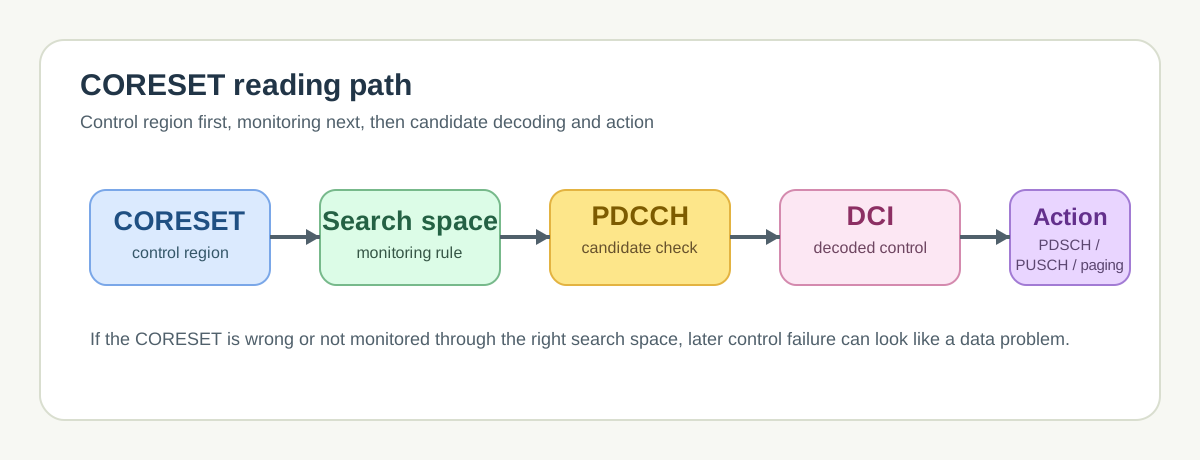
Read CORESET together with search space. CORESET defines the control region itself, while search space defines the monitoring pattern inside that region. The two together form the control-entry path for scheduled NR operation.
| Technology | 5G NR |
|---|---|
| Full name | Control Resource Set |
| Main specs | 3GPP TS 38.211, 38.213, 38.331 |
| Release | Release 18 |
| Main use | Physical control region for PDCCH monitoring and DCI delivery |
| Main building blocks | Frequency-domain resources, duration, REGs, CCEs, mapping type, search-space association |
| Duration | 1, 2, or 3 OFDM symbols |
| Related pages | PDCCH, Search Space, DCI Formats, BWP, Frame Structure |
Contents
Overview
CORESET is not a transport channel and not a message format. It is the physical control region in which PDCCH is mapped. Without CORESET, there is no practical place for the UE to look for valid PDCCH candidates.
- CORESET belongs to the downlink physical-control path.
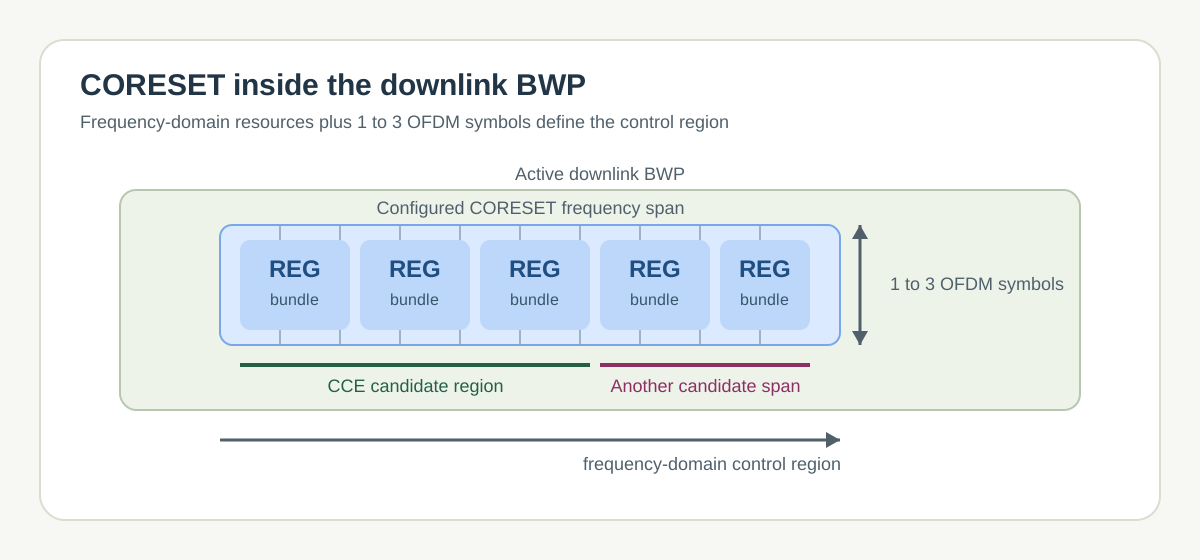
- It sits inside the active downlink BWP.
- It is defined by frequency-domain resources and symbol duration.
- It is tied to REGs, CCEs, aggregation level, and PDCCH candidate construction.
- It is used with common and UE-specific search spaces.
Quick interpretation
| Role | Physical control region for PDCCH monitoring and DCI delivery |
|---|---|
| Configured by | ControlResourceSet and related RRC signaling, or the common initial-access control path for CORESET 0 |
| Main dimensions | Frequency-domain resource bitmap plus 1 to 3 OFDM symbols of duration |
| Resource hierarchy | REGs build CCEs, and CCEs build PDCCH candidates with aggregation levels 1, 2, 4, 8, or 16 |
| Main variants | Interleaved or non-interleaved CCE-to-REG mapping, common or dedicated control usage, CORESET 0 or non-zero CORESET |
| Main impact | Control coverage, blind decoding load, paging reach, grant delivery, and access behavior |
How the CORESET model works
A CORESET is defined in the frequency domain and the time domain. Frequency-domain placement is carried by a
45-bit bitmap in the ControlResourceSet configuration, and duration is set to 1, 2, or 3 OFDM
symbols. That creates the physical region in which PDCCH candidates can exist.
Frequency-domain resources
The RRC configuration uses frequencyDomainResources to describe the control region across the
BWP. In practical reading, this tells you how wide the control region is and which RB groups are usable for
control placement.
Duration
CORESET duration can be 1, 2, or 3 OFDM symbols. Short duration reduces control overhead, while larger duration provides more control resources. Three-symbol duration is a specific configuration case and is not the default reading assumption for every deployment.
REGs, CCEs, and aggregation
PDCCH inside a CORESET is built from resource element groups and control channel elements. A CCE is formed from REGs, and one PDCCH candidate uses one or more CCEs depending on aggregation level. Aggregation levels 1, 2, 4, 8, and 16 are supported.
Mapping type
The cce-REG-MappingType can be non-interleaved or interleaved. Interleaved mapping adds
parameters such as reg-BundleSize, interleaverSize, and
shiftIndex. These settings affect how control resources are spread across the CORESET and how
robust the control path is against frequency-selective conditions.
Precoder and DM-RS context
precoderGranularity controls how the UE interprets common precoding across the control region.
pdcch-DMRS-ScramblingID affects the PDCCH DM-RS initialization. When that field is absent, the
serving-cell physical cell identity is used.
TCI and later Release 18 control behavior
Dedicated CORESETs can carry PDCCH beam and QCL context through TCI-related settings. Release 18 keeps the newer control-state handling around unified TCI and indicated TCI-state application, which matters when multiple control pools or beam-linked control paths are configured.
| Field or concept | Purpose |
|---|---|
controlResourceSetId | Identifies the CORESET instance; value 0 is used for the common CORESET path |
frequencyDomainResources | Defines the frequency-domain control region within the BWP |
duration | Defines how many OFDM symbols the CORESET spans |
cce-REG-MappingType | Selects interleaved or non-interleaved mapping between CCEs and REGs |
reg-BundleSize | Sets REG bundle size for interleaved mapping |
interleaverSize | Sets the interleaving size used in interleaved mapping |
shiftIndex | Controls the interleaving shift for resource placement |
precoderGranularity | Sets how common precoding is interpreted across the control region |
tci-PresentInDCI | Allows DCI to indicate TCI state usage for PDCCH-related control reading |
pdcch-DMRS-ScramblingID | Sets the scrambling initialization for PDCCH DM-RS when configured |
Operational view
Read CORESET as the physical anchor for control delivery. The important question is not only how it is configured, but whether it gives the UE a usable control region for the expected search spaces and DCI load.
CORESET 0
CORESET 0 is the common control-region path used during initial access. It is tied to the Type0 common search space and to early control delivery around SSB, PBCH, and SIB1 acquisition. This is the control entry point before dedicated control configuration takes over.
Common vs dedicated control regions
Common control is used for shared entry and system-level procedures. Dedicated CORESETs support UE-specific control, richer scheduling patterns, beam-related control assumptions, and later serving-cell behavior.
Search-space association
A CORESET becomes operational only when one or more search spaces point to it. Search spaces define monitoring symbols, slot periodicity, candidate counts, and the DCI formats expected in that control region.
Monitoring limits and control load
The UE does not monitor unlimited control candidates. Candidate counts, non-overlapped CCE limits, and blind decoding expectations all shape how large and how busy a CORESET can be in practice.
| Reading area | Why it matters |
|---|---|
| CORESET 0 | Determines whether the early control path for initial access and SIB1 is available |
| Search-space link | Determines when and where the UE actually monitors inside the CORESET |
| Aggregation level | Balances control robustness against control overhead |
| Mapping type | Shapes how control resources are spread across the CORESET in frequency |
| TCI and beam context | Determines whether control follows the expected beam and QCL assumptions |
Where CORESET appears in real procedures
Initial access
SSB -> PBCH / MIB -> CORESET 0 -> Type0 common search space -> PDCCH -> SIB1 and later access controlThis is the main CORESET 0 entry path. If the common CORESET is not usable, the UE may fail before dedicated control configuration ever begins.
Scheduled operation
Active BWP -> CORESET -> search space -> PDCCH candidate -> DCI -> PDSCH or PUSCH actionThis is the normal dedicated-control path for scheduled downlink and uplink operation.
Paging and common control
Common search space -> CORESET -> paging-related PDCCH -> paging procedurePaging and other common-control procedures depend on the right common search-space and CORESET relationship, not only on the higher-layer paging trigger.
Troubleshooting
Start with CORESET when PDCCH looks missing, when the UE misses grants or paging, or when access works up to broadcast but stalls at the first control step.
- Check whether the active BWP contains the expected CORESET.
- Check whether the search space actually points to the right CORESET.
- Check whether duration, frequency-domain resources, and mapping type match the intended control design.
- Check whether the expected aggregation level is realistic for the observed control coverage.
- Check whether TCI and beam-related control assumptions match the observed serving-beam behavior.
| Symptom | What to inspect first |
|---|---|
| UE misses PDCCH in initial access | CORESET 0 placement, Type0 common search space, SSB/PBCH path, and common-control timing |
| Paging seems absent | Common search-space association, CORESET availability in the monitored BWP, and paging monitoring setup |
| Uplink grants are missed | Dedicated CORESET, search-space periodicity, aggregation level, and DCI candidate monitoring |
| Control works on one beam but not another | TCI state handling, beam-linked control assumptions, and whether PDCCH follows the expected QCL path |
| Control overhead looks too large | CORESET width, symbol duration, candidate counts, and whether aggregation levels are larger than needed |
Common reading mistakes
- Treating CORESET as the same thing as search space.
- Looking only at DCI content while ignoring whether the control region itself is usable.
- Assuming control failure is a data-channel problem before checking common-control placement.
- Ignoring the active BWP when reading CORESET frequency-domain placement.
- Reading beam-related PDCCH issues without checking TCI and PDCCH DM-RS context.
References
- 3GPP TS 38.211 Release 18 - PDCCH, CORESET structure, REG and CCE mapping, and physical control-resource behavior
- 3GPP TS 38.213 Release 18 - control procedures, search-space monitoring, candidate limits, and CORESET 0 related control behavior
- 3GPP TS 38.331 Release 18 -
ControlResourceSet, search-space configuration, TCI, and control-related RRC signaling
FAQ
What is CORESET in 5G NR?
CORESET is the Control Resource Set. It is the physical control region where the UE monitors for PDCCH candidates.
What is the difference between CORESET and search space?
CORESET defines the physical region. Search space defines when and where the UE should monitor inside that region.
What is CORESET 0?
CORESET 0 is the common control-resource set used in the initial-access path and tied to the Type0 common search space.
How many symbols can a CORESET span?
A CORESET spans 1, 2, or 3 OFDM symbols depending on configuration.
Why does CORESET matter for troubleshooting?
Because missed control does not always mean bad DCI or bad data-channel quality. The problem may start earlier with CORESET placement, monitoring setup, or beam-related control assumptions.