5G NR DCI Formats
DCI, or Downlink Control Information, is the control payload carried on PDCCH. It tells the UE what action to take next, such as receiving PDSCH, transmitting PUSCH, applying slot-format indications, or following other special control instructions.
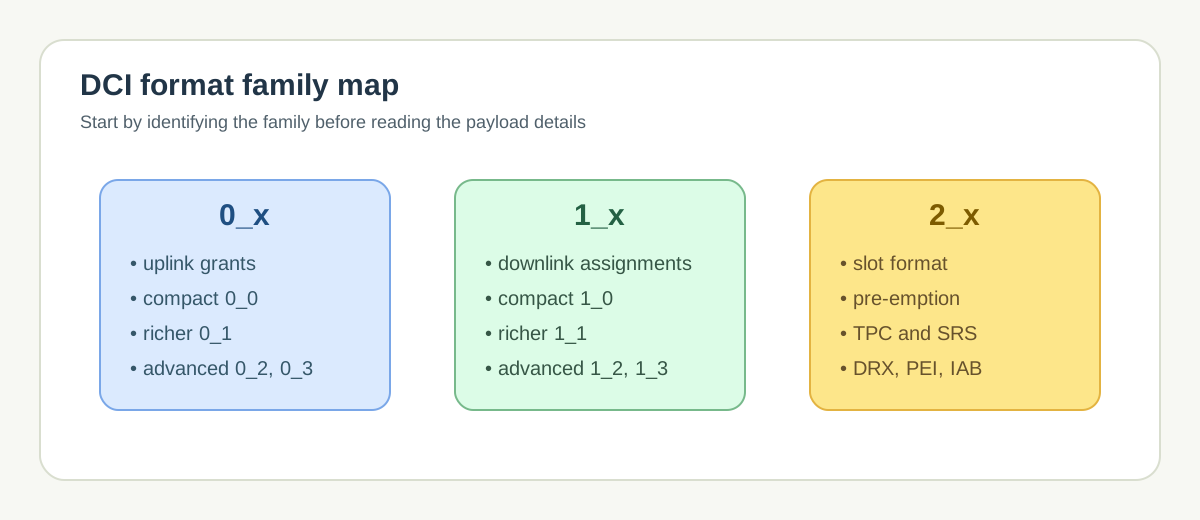
Read DCI as a payload family rather than one single format. NR uses the 0_x, 1_x, and 2_x families. The family, CRC scrambling, and associated search space together tell the UE how to interpret the control.
| Technology | 5G NR |
|---|---|
| Area | PHY control information |
| Main specs | 3GPP TS 38.212, 38.213, 38.331 |
| Release | Release 18 |
| Main use | Carries scheduling and control payloads on PDCCH |
| Main families | 0_x uplink-related, 1_x downlink-related, 2_x special control and indication formats |
| Main reading points | Search-space type, CRC scrambling, format family, payload meaning, and resulting radio action |
| Related pages | PDCCH, Search Space, CORESET, PDSCH, PUSCH, PUCCH |
Contents
Overview
DCI is the logical meaning carried by a decoded PDCCH payload. A PDCCH candidate is just a control candidate until the CRC and search-space context identify which DCI format family applies.
- The 0_x family is used for uplink-related scheduling control.
- The 1_x family is used for downlink-related scheduling control.
- The 2_x family is used for special control indications and advanced control functions.
- The monitored DCI formats depend on Search Space type and configuration.
- Payload size handling is part of the DCI design because the UE may monitor multiple format families in the same cell.
Quick interpretation
| Role | PDCCH control payload that drives scheduling and other PHY control actions |
|---|---|
| Where it appears | Decoded from PDCCH candidates inside a monitored CORESET and search space |
| Main families | 0_x, 1_x, and 2_x |
| Main interpretation keys | Search-space type, CRC scrambling identity, format family, payload size, and serving-cell context |
| Main impact | Grant reception, downlink assignment, slot-format control, power control, paging-related control, and other procedure behavior |
How the DCI model works
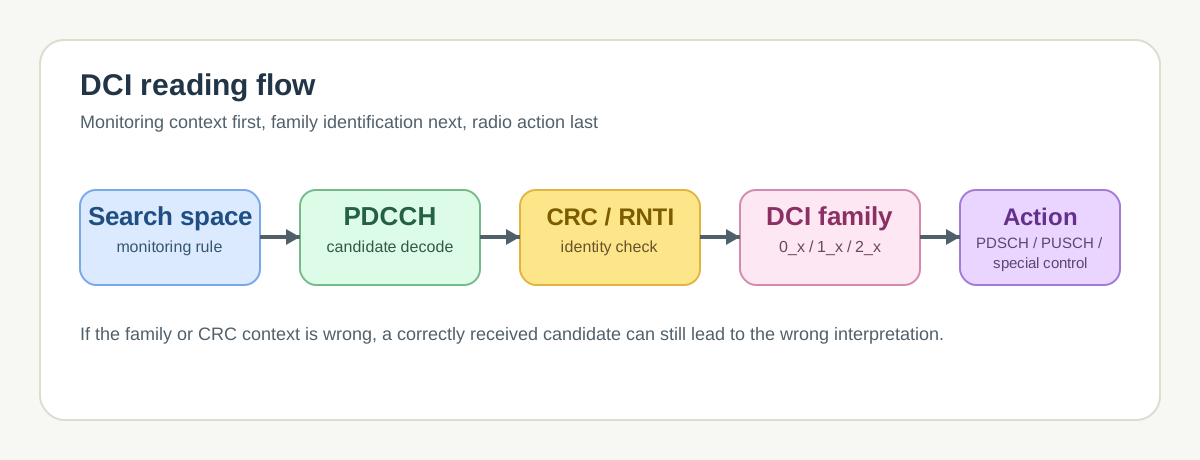
DCI is not decoded in isolation. The UE first monitors a configured search space inside an associated CORESET, tries possible PDCCH candidates, applies CRC checking with the relevant RNTI context, and then interprets the payload according to the monitored DCI format family.
Search-space context
The search space tells the UE which DCI formats are expected in a given monitoring context. Common search spaces usually monitor the fallback and common-control families. UE-specific search spaces monitor richer dedicated families such as 0_1 and 1_1, and Release 18 also extends this with multicast-related monitoring.
CRC scrambling and identity
CRC scrambling identifies the control target and helps distinguish control types. The same candidate position can mean very different things depending on whether the CRC is associated with a C-RNTI, SI-RNTI, P-RNTI, RA-RNTI, INT-RNTI, TPC-related RNTIs, or another control identity.
Payload size handling
DCI size is not arbitrary. Release 18 keeps the size-equalization and ambiguity-handling rules that allow the UE to monitor several formats without impossible combinations of identical-sized candidates in overlapping contexts. This matters most when 0_0 and 1_0, or 0_1 and 1_1, or later family variants are monitored together.
Fallback versus richer scheduling formats
The 0_0 and 1_0 formats are the more compact fallback formats. The 0_1 and 1_1 families carry richer resource and feature signaling. Release 18 also includes later 0_2, 1_2, 0_3, and 1_3 monitoring combinations in advanced and multicast-related control contexts.
| Reading element | Why it matters |
|---|---|
| Search-space type | Defines which DCI format family the UE should expect to monitor |
| CRC scrambling identity | Defines the control target and often the procedure context |
| Payload size | Affects ambiguity handling, blind decoding load, and coexistence of multiple DCI formats |
| Format family | Defines whether the resulting control is uplink-related, downlink-related, or special indication |
| Serving-cell and BWP context | Defines which carrier, BWP, and radio action the decoded control actually applies to |
DCI format families
Family summary
| Family | Main role | Typical effect |
|---|---|---|
| 0_x | Uplink-related scheduling control | Leads to uplink transmission behavior such as a PUSCH grant |
| 1_x | Downlink-related scheduling control | Leads to downlink reception behavior such as a PDSCH assignment |
| 2_x | Special control and indication formats | Leads to slot-format, pre-emption, power-control, SRS, DRX, early paging, IAB, or other special control actions |
Scheduling formats
| Format | Role | Reading notes |
|---|---|---|
| DCI format 0_0 | Compact uplink-related scheduling format | Usually the fallback uplink grant view and often paired with 1_0 in compact monitoring contexts |
| DCI format 1_0 | Compact downlink-related scheduling format | Usually the fallback downlink assignment view and often paired with 0_0 in compact monitoring contexts |
| DCI format 0_1 | Richer uplink-related scheduling format | Used when more scheduling detail or feature signaling is needed in UE-specific monitoring |
| DCI format 1_1 | Richer downlink-related scheduling format | Used when more assignment detail or feature signaling is needed in UE-specific monitoring |
| DCI formats 0_2 and 1_2 | Extended scheduling family | Appear in advanced monitoring combinations and must be read together with search-space and size coexistence rules |
| DCI formats 0_3 and 1_3 | Multicast-related scheduling family | Release 18 search-space extensions support multicast-related monitoring combinations such as formats0-3, formats1-3, and formats0-3-And-1-3 |
Special control formats
| Format | Main use | Reading notes |
|---|---|---|
| DCI format 2_0 | Slot format indication | Controls DL, UL, and flexible-symbol interpretation for slot-format behavior |
| DCI format 2_1 | Pre-emption indication | Marks PRB and symbol resources where no transmission is intended for the UE |
| DCI format 2_2 | TPC command group | Used for transmit-power control of PUCCH and PUSCH-related control paths |
| DCI format 2_3 | SRS switching | Used when SRS-related uplink switching and adjustment behavior is configured |
| DCI format 2_4 | Additional special control | Used in Release 16 and later special-control cases configured through common search-space extensions |
| DCI format 2_5 | IAB-specific control | Monitored by IAB-MT for availability and resource indication behavior |
| DCI format 2_6 | DRX-related control | Configured only on the SpCell and used for cell-level DRX operation changes |
| DCI format 2_7 | Early indication of paging | Used with PEI-related monitoring in idle or inactive-state paging preparation |
| DCI format 2_9 | Cell DRX operation change | Release 18 common-control extension used for cell DRX operation indication |
Where DCI appears in real procedures
Initial access and common control
CORESET 0 -> common search space -> PDCCH -> fallback DCI -> SIB1 and early control pathEarly common control usually starts from compact DCI interpretation rather than richer dedicated scheduling.
Dedicated downlink scheduling
UE-specific search space -> PDCCH -> DCI 1_x -> PDSCH receptionDownlink scheduling depends on the 1_x family and the associated monitoring context.
Dedicated uplink scheduling
UE-specific search space -> PDCCH -> DCI 0_x -> PUSCH transmissionUplink grant handling depends on the 0_x family and the related serving-cell and BWP view.
Special control procedures
special search space -> PDCCH -> DCI 2_x -> slot format / power / pre-emption / DRX / paging indication actionThe 2_x family is where non-standard scheduling actions become visible and where many control-side issues are misread if the format family is not identified first.
Troubleshooting
Start with DCI format reading when a PDCCH candidate is present but the resulting action looks wrong, when the UE misses grants only in one monitoring context, or when special control behavior such as slot format or power control does not match the expected procedure outcome.
- Check whether the monitored search space allows the expected DCI format family.
- Check whether CRC scrambling identity matches the intended control procedure.
- Check whether payload size coexistence rules make the monitored candidate ambiguous.
- Check whether the decoded family matches the expected action, such as 0_x for uplink and 1_x for downlink.
- Check whether special 2_x control is being mistaken for normal scheduling control.
| Symptom | What to inspect first |
|---|---|
| Grant seems missing | Whether the correct 0_x or 1_x family is monitored in the configured search space |
| Downlink action is wrong after decode | Whether the candidate is really a 1_x format and whether CRC scrambling matches the intended target |
| Uplink action is wrong after decode | Whether the candidate is really a 0_x format and whether serving-cell context is interpreted correctly |
| Slot or power behavior changes unexpectedly | Whether a 2_x special-control format is present and should be read before looking at data scheduling |
| Control decode seems ambiguous | Payload-size coexistence, overlapping monitoring formats, and blind decoding context |
Common reading mistakes
- Treating all DCI as one generic scheduling payload.
- Ignoring CRC scrambling identity when deciding what a decoded candidate means.
- Reading 2_x special-control formats as if they were normal grants.
- Ignoring the monitored search-space type and assuming richer families are always active.
- Looking at the payload bits before confirming the DCI family and procedure context.
References
- 3GPP TS 38.212 Release 18 - DCI format definitions, payload sizing, coding, and size coexistence rules
- 3GPP TS 38.213 Release 18 - monitoring procedures and special-control behavior for DCI 2_x families
- 3GPP TS 38.331 Release 18 - search-space configuration and monitored DCI-format families, including Release 18 multicast extensions
FAQ
What is DCI in 5G NR?
DCI is Downlink Control Information. It is the control payload carried on PDCCH and used to signal scheduling and other control actions.
What is the difference between DCI format 0 and format 1?
The 0_x family is uplink-related. The 1_x family is downlink-related.
What is the 2_x family used for?
The 2_x family is used for special control indications such as slot format, pre-emption, power control, SRS switching, DRX-related control, early paging indication, and other advanced control cases.
Why do DCI sizes matter?
Because the UE may need to monitor multiple DCI families in overlapping control contexts, and size handling is part of avoiding ambiguous blind-decoding situations.
Why does DCI matter in troubleshooting?
Because a successfully decoded control candidate can still be misread if the family, CRC scrambling, or search space context is wrong.