5G Low Throughput Troubleshooting - NR Radio Performance Checks
5G low throughput troubleshooting starts by asking a practical question: is the problem really a radio-side throughput limitation, or is something higher in the stack creating the same user-visible symptom? In NR, the fastest answer usually comes from checking CQI, MCS, PDSCH allocation, layer count, HARQ pressure, and beam quality together.
For beginners, this page is the radio-side checklist for “why is 5G slow?” For experienced engineers, it is a structured workflow for separating scheduler limits, radio-quality limits, BWP limits, and decode-efficiency problems before chasing higher-layer explanations.
| Primary keyword | 5G low throughput troubleshooting |
|---|---|
| Main focus | Radio-side throughput bottlenecks in NR |
| Most useful checks | CQI, MCS, PRB usage, layers, HARQ, BLER, beam quality, active BWP |
| Best paired pages | PDSCH, link adaptation, HARQ, beamforming, throughput calculator |
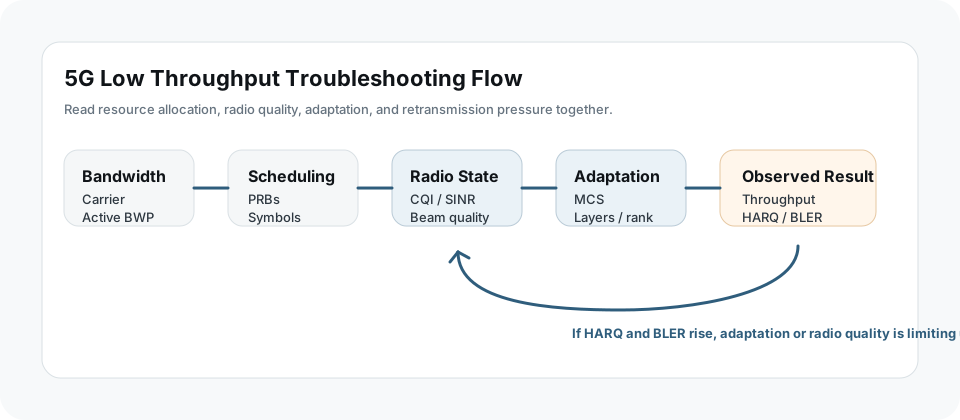
What low throughput means in simple terms
In plain language, low throughput means the UE is getting less useful payload than the cell, carrier, or signal conditions seem to suggest it should. That can happen because the network is not scheduling much data, because the radio cannot support aggressive transport choices, or because repeated retransmissions are eating into usable throughput.
- Good signal bars do not guarantee high throughput.
- Throughput falls when PRB use, MCS, or layers stay lower than expected.
- Radio instability often appears as retransmission pressure and conservative scheduling.
- The fastest answer comes from correlating PDSCH, CQI, MCS, and HARQ, not from looking at one metric alone.
Fast triage before deep troubleshooting
| Question | Why it matters |
|---|---|
| Is the issue downlink, uplink, or both? | This tells you whether to focus first on PDSCH, PUSCH, or a shared radio-quality bottleneck. |
| Is the active BWP smaller than expected? | A small active BWP can cap usable scheduling even when the carrier itself is wide. |
| Are PRBs actually being allocated? | Low PRB use usually means scheduler scarcity or policy limits, not purely bad RF. |
| Is MCS consistently low? | Low MCS is often the most direct sign that the radio cannot sustain more aggressive transport. |
| Are HARQ retransmissions high? | High HARQ pressure means throughput is being consumed by recovery instead of fresh payload. |
Common radio-side root causes
Too little downlink allocation
If PDSCH grants stay small, throughput remains low even when radio conditions could support more. This is often a scheduler, load, or policy issue rather than a raw RF issue.
Low CQI and conservative MCS
When the link looks uncertain, link adaptation drives MCS downward. That protects decode reliability, but it also reduces payload efficiency.
Low rank or unstable layers
If the cell is capable of multi-layer transmission but the UE remains stuck at low rank, actual throughput can sit far below theoretical cell capability.
High HARQ pressure
Excessive HARQ retransmissions are one of the clearest radio-side signs of throughput loss. The network is spending time repairing failed transport rather than sending fresh data.
Beam or channel instability
Unstable beamforming or weak CSI can create fluctuating CQI, unstable MCS, lower layer usage, and repeated retransmissions.
Bandwidth / BWP -> PRB allocation -> CQI / MCS / layers -> HARQ outcome -> observed throughputHow low throughput usually shows up in practice
| Observed symptom | Most likely radio interpretation |
|---|---|
| Good RSRP but low user throughput | SINR, scheduling scarcity, conservative MCS, or low rank is often the real limiter. |
| Throughput spikes then collapses | Beam instability, mobility effects, interference, or unstable adaptation is likely involved. |
| Wide carrier but low rate | Check active BWP, allocated PRBs, and whether the scheduler is actually using the full radio opportunity. |
| High BLER and many retransmissions | The transport profile is too aggressive for the current radio state, or the channel is too unstable. |
| Low throughput only at cell edge | Coverage, beam reach, interference, and robust-but-slow transport settings are the usual causes. |
What to check in logs, traces, and KPIs
- active BWP and whether it matches the expected bandwidth context
- PDSCH PRB allocation and symbol allocation over time
- CQI trend rather than one isolated CQI sample
- MCS level, fluctuation, and whether it tracks channel quality sensibly
- rank or layer count and whether multi-layer operation is actually sustained
- HARQ retransmission count, BLER, and decode-failure pressure
- beam or CSI stability if throughput changes with movement or orientation
- whether the problem is only downlink or also visible on uplink
Common failure patterns and what they usually mean
Low CQI and low MCS together
This is the most straightforward radio-quality bottleneck. The scheduler is seeing poor channel conditions and reacting conservatively.
Healthy CQI but poor throughput
Look harder at PRB allocation, active BWP, and whether the scheduler is simply not granting enough resources.
Good throughput at first, then drop after mobility or rotation
This often points to beam management, CSI freshness, or changing interference rather than a static cell-load issue.
Low rate with high HARQ and high BLER
The radio is spending too much effort on recovery. That usually means adaptation is too optimistic, the beam is unstable, or the channel has become harsher than the scheduler assumptions.
Engineer workflow for low throughput troubleshooting
- Confirm whether the issue is downlink, uplink, or both.
- Check active bandwidth context and BWP before reading throughput expectations.
- Inspect PRB allocation and scheduling consistency.
- Read CQI, MCS, and layer behavior together, not in isolation.
- Check HARQ and BLER to see whether lost payload is being replaced by retransmissions.
- Correlate beam or mobility changes if the throughput issue is unstable rather than constant.
- Use the throughput calculator to compare real observations with realistic theoretical limits.
Beginner takeaway
When 5G is slow, the answer is usually not one single metric. Start with resource allocation, radio quality, MCS, layers, and HARQ together, and the bottleneck becomes much easier to identify.
Advanced engineer notes
- High RSRP with low throughput often means the real limiter is SINR, scheduler behavior, or rank collapse.
- Small active BWP is one of the easiest ways to overestimate expected throughput from carrier bandwidth alone.
- Repeated HARQ with unstable MCS is often more revealing than looking at average throughput alone.
- If the symptom appears only under motion, orientation change, or partial blockage, beam behavior deserves priority attention.
FAQ
How do I troubleshoot low throughput in 5G NR?
Start with PRB allocation, CQI, MCS, layer count, HARQ pressure, and active BWP before jumping to higher-layer assumptions.
Why is 5G throughput low even when signal strength looks good?
Because throughput depends on more than signal strength. SINR, scheduling, layers, HARQ, and beam stability can all limit performance.
What causes PDSCH throughput problems?
Too few resources, low MCS, low rank, high retransmissions, or unstable radio conditions are the usual causes.
Is CQI enough to explain throughput?
No. CQI helps, but you still need PRB allocation, MCS, layers, HARQ, and BWP context to explain the real user rate.
Use the calculator and decoder with this workflow
Once you have the radio-side picture, compare the observed result with the 5G NR Throughput Calculator and use the 3GPP Decoder when you need to inspect the configuration and signaling that shaped the radio behavior.