5G NR Physical-Layer Measurements
5G NR physical-layer measurements are the signal, quality, timing, and positioning quantities taken from NR reference signals and related radio resources. They provide the PHY input used by cell selection, beam management, mobility, CSI reporting, and many troubleshooting workflows.
Read this page as the main PHY measurement entry point. It connects SSB-based measurements, CSI-RS-based measurements, uplink SRS-based measurements, timing and positioning quantities, and the RRC measurement configuration that turns raw L1 values into reports and mobility decisions.
| Technology | 5G NR |
|---|---|
| Main spec | 3GPP TS 38.215 |
| Related specs | 3GPP TS 38.331, TS 38.133, and TS 38.211 |
| Release | Release 18 |
| Main downlink quantities | SS-RSRP, CSI-RSRP, SS-RSRQ, CSI-RSRQ, SS-SINR, CSI-SINR |
| Main uplink quantity | UL SRS-RSRP, with related uplink timing and angle measurements |
| Why it matters | Measurements drive cell selection, beam management, mobility, CSI reporting, troubleshooting, and link adaptation |
Contents
Overview
NR measurement work starts from specific signal sources, not from abstract percentages or bars. The signal source can be an SSB, a configured CSI-RS resource, an uplink SRS, a PRS resource, or a sidelink resource.
- Power quantities tell how strong the chosen reference signal looks.
- Quality quantities combine signal power with interference and noise context.
- Timing and positioning quantities add delay, angle, or frame-alignment meaning.
- RRC decides which source is measured, how it is filtered, and when it is reported.
Quick interpretation
| Role | Provide PHY signal and timing quantities used by mobility, CSI, beam handling, and troubleshooting |
|---|---|
| Main downlink sources | SSB and CSI-RS |
| Main uplink source | SRS |
| Main quality formulas | RSRQ = N × RSRP / RSSI and SINR = signal / (noise + interference) |
| Main reporting path | RRC measurement configuration, L1 calculation, filtering, event or periodic reporting, then mobility or CSI action |
Measurement model
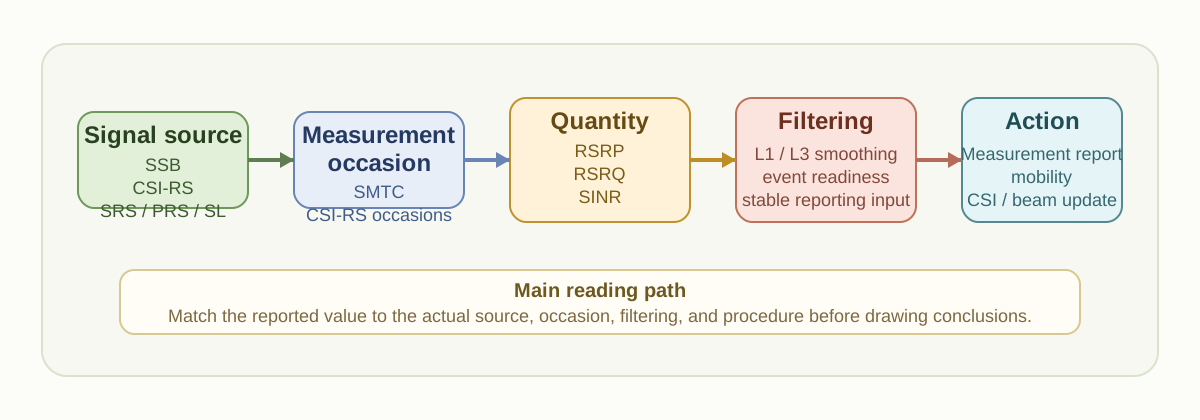
Physical-layer measurements are defined from concrete resource elements and configured measurement occasions. The quantity is first computed from the selected signal source, then filtered and reported through the RRC measurement framework.
signal source
-> measurement occasion or configured resource
-> quantity calculation
-> L1 or L3 filtering
-> report trigger or CSI use
-> mobility, beam, or adaptation decision| Stage | Purpose | Reading notes |
|---|---|---|
| Signal source | Select the physical signal used for the measurement | This is usually SSB, CSI-RS, SRS, or a positioning reference signal |
| Measurement occasion | Restrict when the signal may be measured | SSB measurements are tied to SMTC context, while CSI-RS measurements depend on configured CSI-RS occasions |
| Quantity calculation | Calculate power, quality, timing, or angle value | The result depends on the signal source, measurement bandwidth, and branch behavior |
| Filtering | Smooth short-term variation before reporting or use | Strong instant values can still lead to slow reporting if filtering is long or event conditions are not met |
| Reporting or CSI use | Turn the value into a report, event decision, or adaptation input | Read the L1 quantity together with QuantityConfig, report config, and the active procedure |
Main NR quantities
The most-used NR measurement quantities are the SSB-based and CSI-RS-based power and quality values. These are the values most often seen in mobility, beam, and neighbor analysis.
| Quantity | Source | Main meaning | Typical use |
|---|---|---|---|
| SS-RSRP | SSB | Received power of the SSB-based reference resource | Cell search, beam visibility, cell selection, mobility ranking, and coverage reading |
| CSI-RSRP | CSI-RS | Received power of configured CSI-RS resources | Connected-mode quality reading, beam refinement, and CSI-oriented measurement work |
| SS-RSRQ | SSB plus NR carrier RSSI | Signal quality using SSB-based RSRP and carrier RSSI | Interference-aware mobility reading and neighbor comparison |
| CSI-RSRQ | CSI-RS plus NR carrier RSSI | Quality of configured CSI-RS measurement resources | Connected-mode quality reading where CSI-RS is the active source |
| SS-SINR | SSB | Signal-to-noise-and-interference ratio for the SSB-based source | Beam and cell quality interpretation beyond plain received power |
| CSI-SINR | CSI-RS | Signal-to-noise-and-interference ratio for CSI-RS measurement resources | Link adaptation, beam refinement, and CSI interpretation |
| SS-RSRPB | SSB per branch | Branch-specific SSB received power | Receiver-branch-aware reading where branch behavior matters |
Most useful formulas
SS-RSRQ = N × SS-RSRP / NR carrier RSSI
CSI-RSRQ = N × CSI-RSRP / NR carrier RSSI
SINR = signal / (noise + interference)
N is the number of resource blocks in the measurement bandwidth. The practical reading point is
simple: RSRP is strength, RSRQ mixes strength with carrier occupancy and
interference context, and SINR is the cleanest view of usable signal quality.
Extended Release 18 measurement families
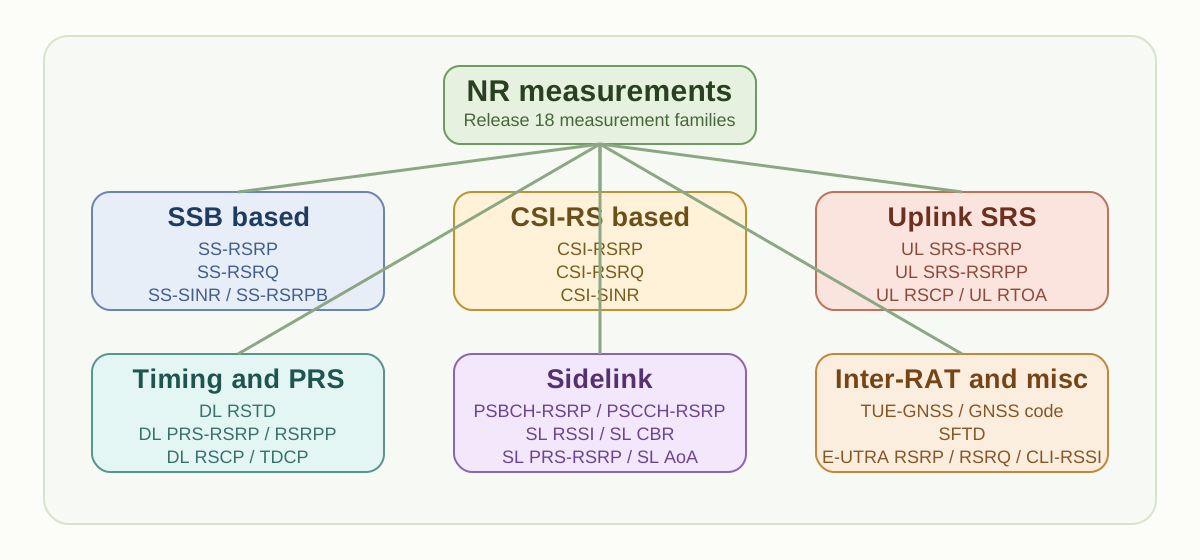
Release 18 measurement coverage is broader than the common SS-RSRP and CSI-RSRP view. The measurement library also includes uplink, sidelink, timing, positioning, and inter-RAT quantities.
| Family | Representative quantities | Why it matters |
|---|---|---|
| Uplink quality at gNB | UL SRS-RSRP, UL SRS-RSRPP, UL RSCP | Read uplink coverage, timing, and sounding quality from the network side |
| Uplink timing and angle | UL RTOA, gNB Rx-Tx time difference, UL AoA | Important for timing alignment, location, and advanced uplink observation |
| Positioning-related downlink | DL RSTD, DL PRS-RSRP, DL PRS-RSRPP, DL RSCP, TDCP | Add delay, path, and phase insight for positioning-oriented procedures |
| Sidelink | PSBCH-RSRP, PSCCH-RSRP, SL RSSI, SL CBR, SL PRS-RSRP, SL AoA | Support sidelink quality, congestion, and sidelink positioning work |
| Interference and coexistence | CLI-RSSI and related cross-link reading | Useful when interference from neighboring links affects reception quality |
| Inter-RAT and timing alignment | TUE-GNSS, GNSS code measurements, SFTD, E-UTRA RSRP, E-UTRA RSRQ | Used when NR measurement work must align with GNSS or E-UTRA timing and mobility context |
Most daily NR mobility work still starts with SSB and CSI-RS. The wider measurement family becomes important when the problem moves into sidelink, uplink sounding, positioning, or timing alignment.
RRC reporting path
Physical-layer measurements do not report themselves. The RRC measurement framework selects what is measured, how it is filtered, and when it turns into an event or periodic report.
| RRC area | Role for PHY measurements |
|---|---|
| MeasObjectNR | Select the target frequency and measurement source context, including neighbor and carrier setup |
| ReportConfigNR | Define event-based or periodic reporting behavior |
| QuantityConfig | Choose which quantity is used and how filtering is applied |
| MeasId | Bind the measurement object to a report configuration |
| SMTC and CSI-RS mobility resources | Control when SSB or CSI-RS measurements can be taken |
| Measurement gaps | Enable measurements that cannot be completed inside current active transmission activity |
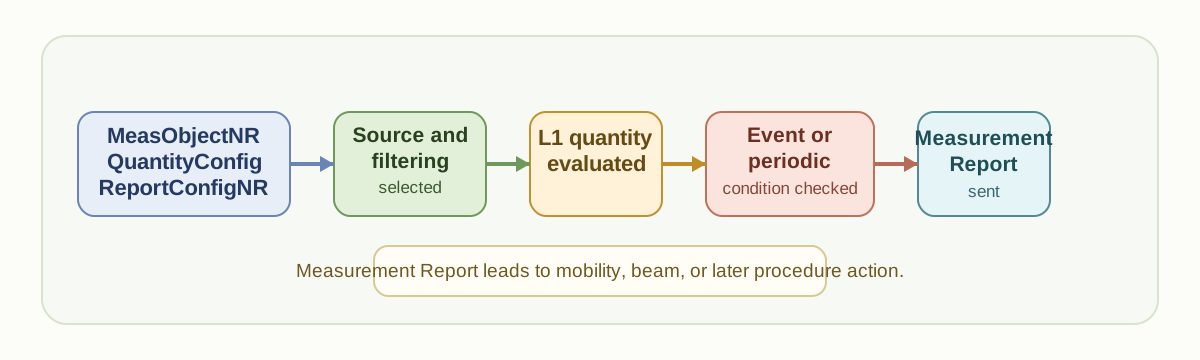
This is why a strong measurement value alone is never the whole story. Reporting depends on configured source, filtering, gap behavior, event thresholds, and the active procedure, as seen in the measurement reporting flow.
Reading notes
| Reading point | What to remember |
|---|---|
| SSB vs CSI-RS | Do not compare them blindly. They may come from different signal structures, occasions, beams, and measurement bandwidth assumptions. |
| Power vs quality | A strong RSRP value can still come with weak RSRQ or SINR if interference and occupancy are high. |
| Filtering | Filtered values can lag behind fast beam or fading changes. Instant trace impressions can differ from reported values. |
| Measurement source timing | SSB values are tied to SMTC-style windows, while CSI-RS values depend on configured CSI-RS occasions and resources. |
| Bandwidth and BWP context | Measurement frequency bandwidth and active BWP context affect what is actually observed at a given time. |
| Beam behavior | Weak mobility or unstable throughput often reflects beam changes, not only raw received power problems. |
Troubleshooting
Start by matching the reported quantity to the actual configured source and procedure. Many measurement misunderstandings come from reading an SSB-based value as if it were CSI-RS-based, or from ignoring filtering and gap context.
| Symptom | What to inspect first |
|---|---|
| Neighbor handover does not trigger even though one cell looks stronger | Confirm the configured quantity, event thresholds, filtering, measurement gaps, and whether the value is SSB-based or CSI-RS-based |
| Beam quality looks unstable | Check beam behavior, SS-SINR or CSI-SINR trend, CSI-RS configuration, and whether the signal source changes over time |
| CSI reports do not match expected throughput | Read CSI-RSRP and CSI-SINR together with link adaptation, CQI reporting, and actual scheduling behavior |
| Values look good but uplink still struggles | Check uplink-side observations such as SRS-based measurements, power control, and PUSCH quality |
| Inter-frequency measurements are missing or stale | Check gap configuration, active procedure load, ARFCN targeting, and carrier definition |
| Positioning or delay results look inconsistent | Check whether the active quantity is DL PRS, SRS-based, or timing-based, and match the result to the correct reference point and resource family |
References
- 3GPP TS 38.215 Release 18 - main NR physical-layer measurement definitions covering SS-based, CSI-RS-based, uplink, sidelink, timing, and positioning quantities
- 3GPP TS 38.331 Release 18 - RRC measurement configuration and reporting, including measurement objects, quantity configuration, and reporting rules
- 3GPP TS 38.133 Release 18 - requirements for support of radio resource management and measurement accuracy behavior
- 3GPP TS 38.211 Release 18 - physical signals and reference resources that the measurements are taken from
FAQ
What are physical-layer measurements in 5G NR?
They are the signal, quality, timing, and positioning quantities measured from NR physical signals and related resources, including SSB, CSI-RS, and SRS.
What is the difference between SS-RSRP and CSI-RSRP?
SS-RSRP comes from SSB resources and is widely used for
mobility and beam visibility. CSI-RSRP comes from configured
CSI-RS resources and is used when the network wants a more targeted
connected-mode measurement source.
What is RSRQ in NR?
It is a quality quantity that combines received signal power with carrier RSSI. NR uses both
SS-RSRQ and CSI-RSRQ.
Which spec defines NR physical-layer measurements?
The main measurement definitions are in 3GPP TS 38.215. Reporting and configuration context is in
3GPP TS 38.331.
Why can a strong RSRP still lead to weak behavior?
Because strong received power does not guarantee good quality. Read RSRP together with
RSRQ, SINR, beam behavior, filtering, and the actual
reporting configuration.