5G NR Polar Coding
Polar coding is the main control and broadcast coding family in 5G NR. It is used for key control and broadcast paths such as PDCCH DCI, PBCH payload, and selected UCI cases on PUCCH.
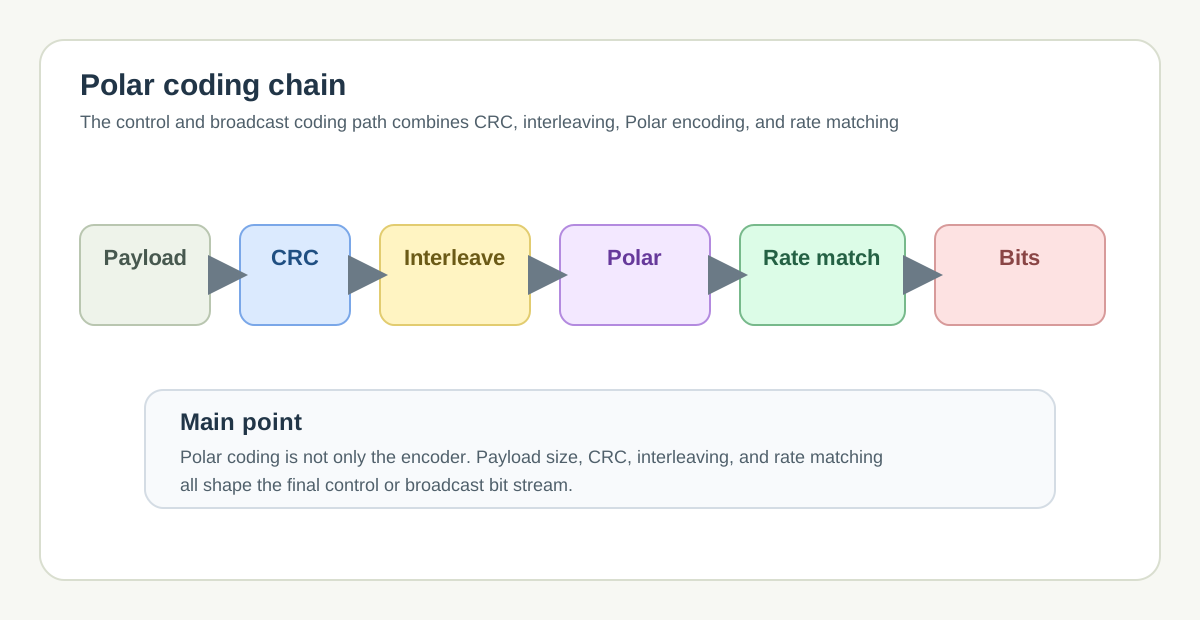
Read Polar coding as the control-side counterpart to LDPC. It works with CRC attachment, payload interleaving, Polar encoding, and rate matching, then feeds the final coded bit stream into the physical-channel mapping path.
| Technology | 5G NR |
|---|---|
| Main spec | 3GPP TS 38.212 |
| Main use | Control and broadcast coding for PDCCH, PBCH, and selected UCI paths |
| Release | Release 18 |
| Main steps | CRC attachment, interleaving, Polar encoding, rate matching, concatenation |
| Main sizing idea | Polar encoder length is a power of two chosen from the payload and transmission-length context |
| Why it matters | Polar coding protects critical control and broadcast bits, so it directly affects early decode success, scheduling continuity, and control reliability |
Contents
Overview
Polar coding is used where the transmitted bits are control-critical or broadcast-critical rather than large shared-data payloads.
- Polar coding is a control and broadcast coding family in NR.
- It is used on PDCCH DCI, PBCH payload, and selected UCI paths.
- It is not the main coding path for shared data on PDSCH or PUSCH.
- Its encoder length is chosen as a power of two based on payload and transmission context.
Quick interpretation
| Role | Main control and broadcast coding family in NR |
|---|---|
| Main channels | PDCCH, PBCH, and selected PUCCH UCI paths |
| Main steps | CRC attachment, interleaving, Polar encoding, rate matching, and concatenation |
| Main sizing idea | Polar encoder length N is selected as a power of two from the payload and coded-length context |
| Main contrast | LDPC is the shared-data coding path, while Polar coding is the main control and broadcast path |
How the Polar model works
Polar coding starts from the control or broadcast payload after CRC attachment. The payload is then prepared through interleaving and Polar encoding, followed by rate matching to the available transmission length.
payload
-> CRC attachment
-> payload interleaving
-> Polar encoding
-> rate matching
-> coded-bit interleaving
-> transmission-ready bits| Step | Purpose | Reading notes |
|---|---|---|
| CRC attachment | Add error-detection bits to the control or broadcast payload | The CRC-appended size becomes the input to the later Polar encoder sizing path |
| Interleaving | Prepare the payload before encoding | Polar coding has its own interleaving path, different from the LDPC data path |
| Polar encoding | Encode the prepared payload using a Polar encoder length chosen for the current context | The encoder length is selected as a power of two |
| Rate matching | Adapt the encoded output to the final transmission length | Read it with channel-specific context such as PDCCH, PBCH, or PUCCH |
| Coded-bit interleaving | Prepare the rate-matched bits for later mapping and modulation | This is part of the final control-channel bit stream preparation |
Main Polar-coded paths
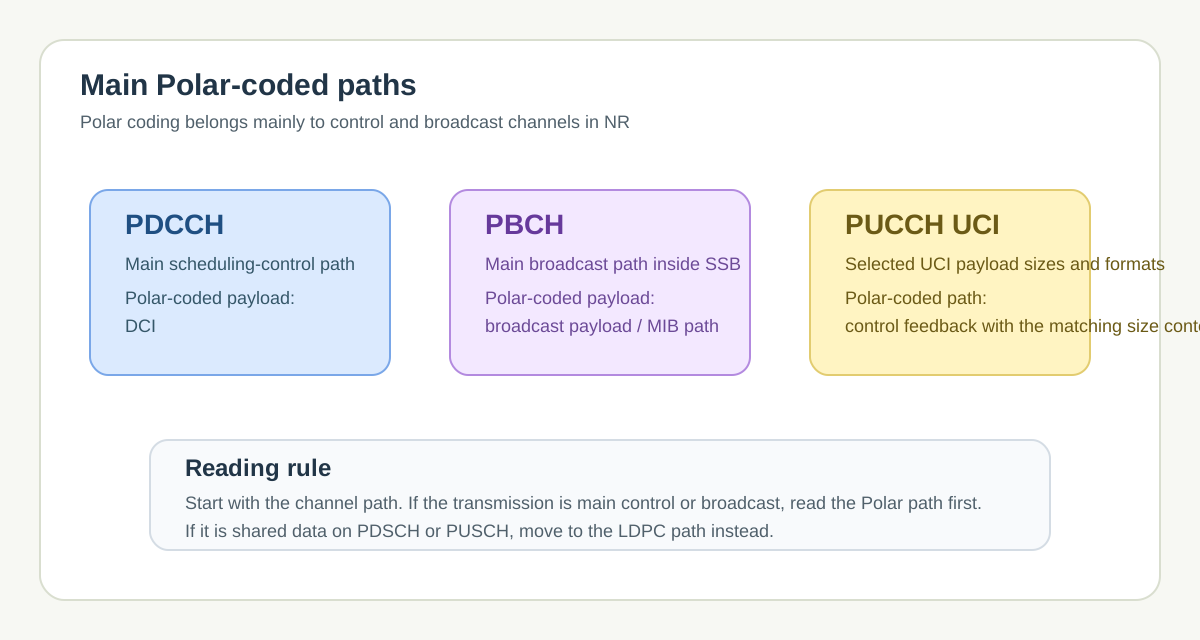
Polar coding belongs mainly to the paths that carry early, critical, or compact control information.
| Path | Why Polar coding is used here | What to read with it |
|---|---|---|
| PDCCH DCI | DCI is compact, control-critical, and part of the main scheduling path | Search Space, CORESET, blind decoding, and control reliability |
| PBCH payload | The broadcast payload is part of the early cell-detection and access chain | SSB, MIB delivery, and initial access |
| Selected UCI on PUCCH | Some UCI payload sizes and formats use Polar coding rather than small-block coding | PUCCH format, payload size, and UCI type |
Polar coding is not the main path for shared data on PDSCH or PUSCH. Those belong to the LDPC side of the NR coding model.
Important formulas
These are the most useful Polar-coding formulas for reading the control and broadcast coding path.
Payload after CRC
K = A + L A is the original payload size. L is the CRC length. K is the payload
size after CRC attachment and becomes the main input to the Polar encoder sizing path.
Polar encoder length
N = 2^n
The Polar encoder length N is chosen as a power of two. The exponent n is selected
from the payload and transmission-length context defined by the applicable Polar-coding procedure.
Practical encoder-sizing view
n is chosen so that N = 2^n is large enough for the CRC-appended payload K
while still matching the transmission-length and path-specific constraints
In practical reading, the important point is not memorizing every path-specific branch but recognizing that the
control path first builds K, then selects a power-of-two encoder length N, then
rate-matches to the transmitted length.
Rate-matched output length
E = number of bits selected by Polar rate matching for the transmission E depends on the final transmission length required by the channel path. For example, the PDCCH
case is read with control-resource context, while PBCH and PUCCH use their own transmission-length context.
Rate matching
Rate matching follows Polar encoding and adapts the encoded output to the final transmission length. This step is not identical across all Polar-coded paths because each path has its own transmission-length context.
| Area | Why it matters |
|---|---|
| Sub-block interleaving | Reorders encoded bits before selection |
| Bit selection | Chooses the part of the encoded output that will actually be transmitted |
| Coded-bit interleaving | Prepares the final bit stream for mapping and modulation |
| Path-specific transmission length | Changes the final output size according to whether the transmission is on PDCCH, PBCH, or PUCCH |
Troubleshooting
Start by confirming that the path is actually Polar-coded, then check the payload size, CRC assumptions, encoder-length context, and rate-matched output length.
| Symptom | What to inspect first |
|---|---|
| Control decode fails on PDCCH | DCI payload size, CRC assumptions, Polar-coded length, rate matching, and control-resource context |
| Broadcast decode fails on PBCH | PBCH payload assumptions, Polar path sizing, SSB context, and rate-matching output length |
| Short UCI behaves differently from another UCI case | Whether the UCI path is Polar-coded or using small-block coding, plus the payload-size difference |
| Wrong coding family assumption | Confirm that the path is not shared data on PDSCH or PUSCH, which should be read through LDPC |
Common mistakes
- reading a control or broadcast path as if it were an LDPC-coded shared-data path
- ignoring the CRC-appended payload size before encoder sizing
- treating Polar encoder length like a free variable instead of a power-of-two selection
- forgetting that rate matching is path-specific for control and broadcast transmissions
References
- 3GPP TS 38.212 Release 18 - main NR Polar-coding specification covering CRC, interleaving, Polar encoding, and rate matching
- 3GPP TS 38.213 Release 18 - physical-layer control procedures that shape PDCCH and related control-path interpretation
- 3GPP TS 38.331 Release 18 - RRC configuration that affects control-path context around Polar-coded transmissions
FAQ
What is Polar coding in 5G NR?
It is the main control and broadcast coding family used on paths such as PDCCH, PBCH, and selected PUCCH UCI.
Is Polar coding used for shared data on PDSCH or PUSCH?
No. Shared data belongs on the LDPC side of the NR coding model.
Why is the Polar encoder length a power of two?
Because the Polar encoder structure is built around an encoder length N selected as
2^n.
Which paths use Polar coding most often?
The main ones are PDCCH DCI, PBCH, and selected UCI on PUCCH.
What should I inspect first when Polar-coded decode behavior looks wrong?
Check the payload size, CRC assumptions, Polar encoder-length context, rate matching, and the surrounding control or broadcast path.