5G NR Power Control
5G NR power control is the uplink transmit-power framework used to keep PUSCH, PUCCH, PRACH, and SRS strong enough for reliable reception without wasting UE power or creating unnecessary interference.
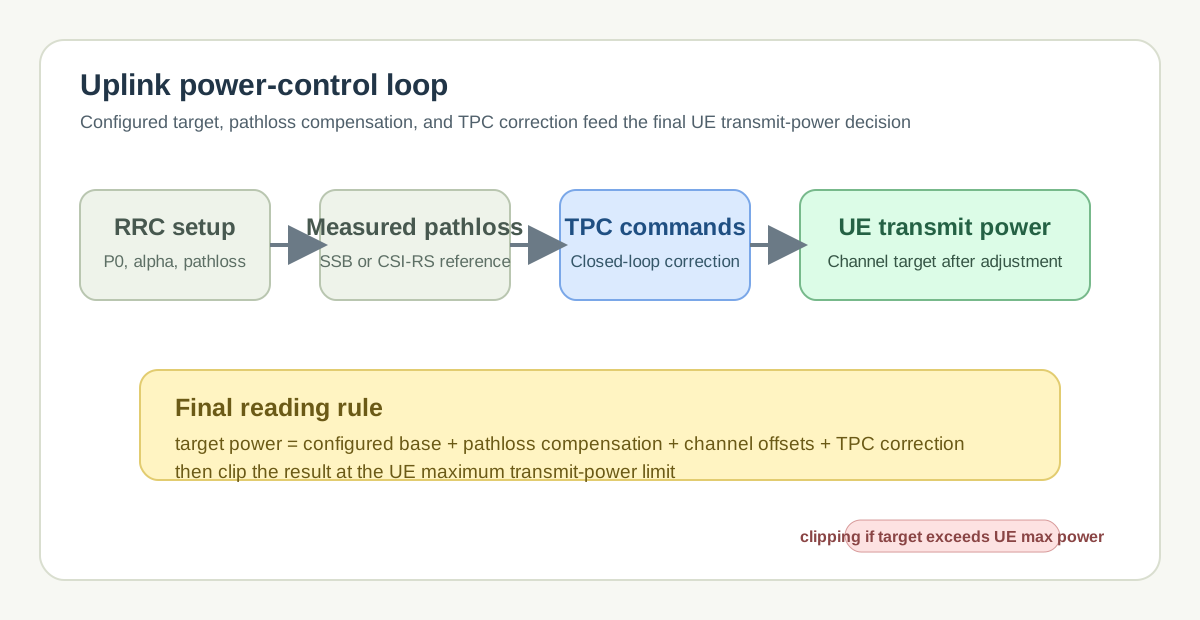
Read it as a combination of configured base power, pathloss compensation, channel-specific offsets, closed-loop correction through TPC commands, and final clipping at the UE maximum transmit power. When uplink performance looks unstable, power control is often one of the first places to check alongside PUSCH, PUCCH, and Power Headroom Report.
| Technology | 5G NR |
|---|---|
| Scope | Uplink transmit power on PUSCH, PUCCH, PRACH, and SRS |
| Main specs | 3GPP TS 38.213, 38.331, 38.214, 38.211 |
| Release | Release 18 |
| Main concepts | Open-loop power control, closed-loop TPC, pathloss compensation, UE maximum-power clipping, target-power setting |
| Main inputs | RRC configuration, pathloss reference RS, DCI TPC commands, channel format and allocation, UE power capability |
| Why it matters | Uplink power directly affects access success, control reliability, throughput, BLER, coverage, and scheduler behavior |
Contents
Overview
NR uplink power is not a single fixed value. It changes with configuration, measured pathloss, the active uplink channel, the current allocation, and command-based correction from the network.
- Open-loop power control sets the main target using configured values and pathloss compensation.
- Closed-loop power control adds correction through TPC commands sent on downlink control.
- The final transmit value is limited by the UE maximum power, so clipping is part of real behavior.
- Different channels use different target-power inputs and procedure rules.
Quick interpretation
| Role | Control uplink transmit power so reception is reliable and interference stays manageable |
|---|---|
| Main channels | PUSCH, PUCCH, PRACH, and SRS |
| Main inputs | Configured P0 values, alpha, pathloss reference RS, channel-specific offsets, allocation context, and TPC commands |
| Main limiting factor | UE maximum transmit power and the resulting clipping behavior |
| Main visible symptoms | Weak uplink control, poor uplink throughput, repeated retransmissions, PRACH failures, and low power headroom |
How the power-control model works
A practical reading model is: target power equals a configured base term plus pathloss compensation plus channel-specific adjustments plus any TPC correction, with the result limited by the UE power ceiling. The exact formulas differ by channel, but the same pattern appears throughout NR uplink control.
| Component | Purpose | What to read in traces |
|---|---|---|
| Configured base power | Sets the nominal target level for a channel or resource set | Look for P0-related RRC configuration such as nominal values and per-resource-set values |
| Pathloss compensation | Raises or lowers transmit power according to the measured downlink pathloss | Check the selected pathloss reference RS and the compensation factor alpha |
| Channel or format offset | Adjusts power by channel type, format, allocation, or reporting case | Check whether the issue appears only on one channel, one PUCCH format, or one PRACH setup |
| TPC correction | Applies command-based closed-loop adjustment | Read the TPC history from the relevant DCI path and see whether commands are accumulating or offsetting the target |
| Maximum-power clipping | Prevents the UE from transmitting above its capability | Check low PHR, reduced uplink robustness, or one uplink channel suppressing another |
Open-loop behavior
Open-loop power control comes from configuration and measured pathloss. For scheduled uplink channels, this normally means a configured base power plus partial or full pathloss compensation using the selected reference-signal source. If pathloss changes and there is no compensating correction, the UE transmit power changes with it. Read that reference together with SSB or CSI-RS depending on which downlink signal is being used.
Closed-loop behavior
Closed-loop control adds command-driven correction. The gNB sends TPC commands on control signaling, and the UE applies them according to the active power-control state and channel rules. This is why DCI reading and uplink-power reading belong together. Use PDCCH and DCI Formats when tracing where those commands came from.
Pathloss reference
Pathloss is not an abstract number. It depends on the chosen reference downlink signal, such as an SSB or CSI-RS-based reference path, and the active BWP context. If the wrong reference assumption is used in analysis, the transmit-power result can look wrong even when the UE behavior is correct. This is also why numerology and active-bandwidth context sometimes matter more than expected in uplink-power analysis.
Power clipping
The UE cannot always reach the requested target because the final result is bounded by its maximum transmit power. When clipping happens, one or more uplink channels can become weaker than intended. This often shows up as low power headroom, reduced uplink throughput, weak PUCCH, or unstable sounding on SRS.
Channel-specific behavior
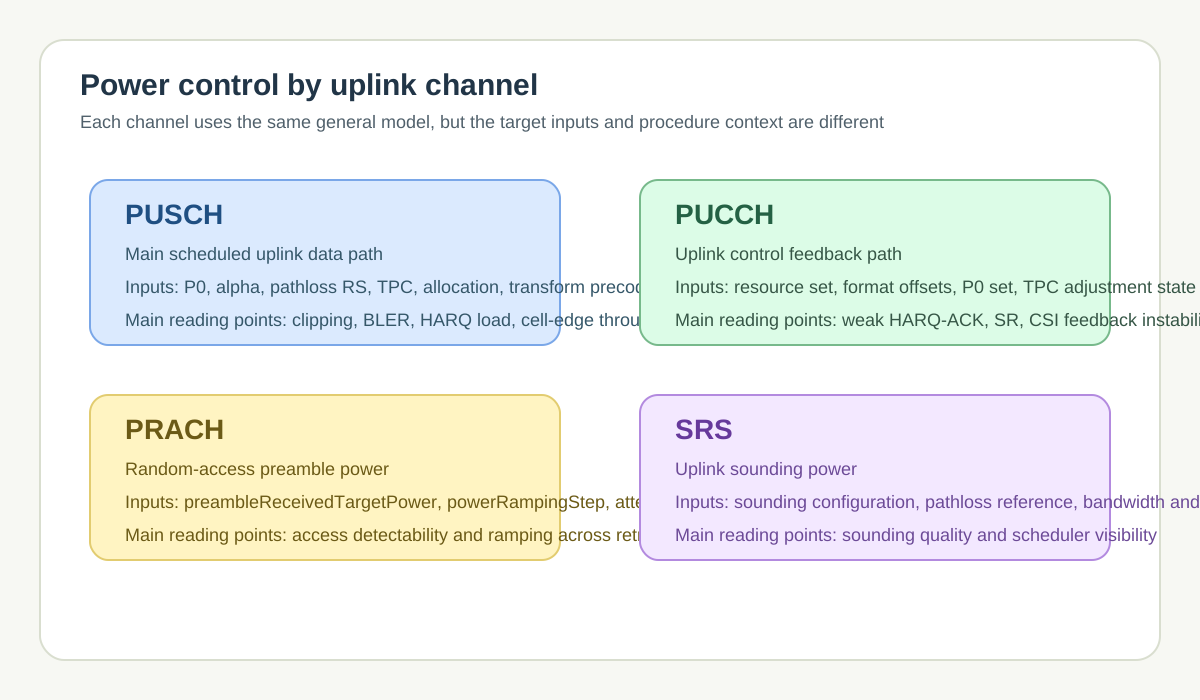
The same overall logic applies across uplink channels, but the details are not identical. PRACH entry power is not read the same way as steady-state PUSCH power, and PUCCH format-specific behavior is not the same as SRS sounding power.
| Channel | Main power-control view | What matters most |
|---|---|---|
| PUSCH | Scheduled or configured uplink data power with open-loop and closed-loop control | P0 values, alpha, pathloss reference, grant context, transform precoding, TPC history, and clipping |
| PUCCH | Uplink control power with format and resource dependent behavior | Format, resource set, P0 set, format offsets, TPC state, and whether weak control feedback explains later procedure issues |
| PRACH | Access preamble target power with ramping over repeated attempts | preambleReceivedTargetPower, powerRampingStep, pathloss context, preamble format, and access-attempt history |
| SRS | Sounding power for uplink channel estimation and scheduler visibility | Configured sounding power, pathloss reference, bandwidth and comb context, and clipping when multiple uplink activities compete |
PUSCH power control
PUSCH uses the richest steady-state power-control model. Read it with the active grant or configured-grant context, the selected pathloss reference, the applicable P0 and alpha set, any TPC correction, and whether the UE is already near maximum power. Msg3-related uplink behavior also has its own random-access-related adjustments, so do not read early access transmissions the same way as normal scheduled uplink.
PUCCH power control
PUCCH power depends on the resource set, the configured control-power settings, the format in use, and closed-loop adjustment state. Small changes here can have large procedural impact because weak HARQ-ACK or Scheduling Request often shows up later as retransmission or grant anomalies.
PRACH power control
PRACH uses target-power and ramping behavior rather than normal steady-state scheduling logic. Each failed access attempt can raise the preamble power according to the configured ramping step until the response is received or the procedure stops. Access failure analysis should always include this power-ramping history together with Initial Access and Random Access.
SRS power control
SRS needs enough power to produce usable sounding quality without creating avoidable uplink stress. Weak sounding can mislead later scheduling and link adaptation because the network may be making decisions from poor uplink channel visibility. Read it with Link Adaptation when uplink MCS behavior looks unstable.
RRC and DCI inputs
Most of the lasting power-control behavior comes from RRC configuration, while short-term correction comes from DCI commands. Read them together rather than treating them as separate stories. The lasting setup comes from RRC, while short-term action usually appears first on PDCCH.
| Input group | Common fields or examples | Reading notes |
|---|---|---|
| PUSCH nominal and pathloss settings | p0-NominalWithGrant, p0-AlphaSets, pathlossReferenceRSToAddModList, sri-PUSCH-PowerControl | These define the basic target-power behavior for scheduled uplink and which pathloss reference can be used |
| Msg3-related settings | msg3-Alpha, msg3-DeltaPreamble | These apply to random-access-related uplink transmission and should be read separately from normal steady-state PUSCH assumptions |
| PUCCH power settings | p0-Set, format-dependent offsets, twoPUCCH-PC-AdjustmentStates | Weak or unstable UCI often needs a resource-set and format-aware power-control check |
| PRACH target-power settings | preambleReceivedTargetPower, powerRampingStep | These define how access preamble power starts and how it rises across attempts |
| Closed-loop commands | TPC commands carried in DCI | Read the command history together with the active channel and adjustment state, not as isolated single commands |
The most common reading mistake here is to check only one layer. If RRC configuration is correct but DCI TPC commands are not being applied as expected, or if DCI commands are fine but the wrong pathloss reference is in use, the resulting transmit-power behavior can still look wrong.
Where power control appears in real procedures
| Procedure area | Why power control matters |
|---|---|
| Random access | PRACH target power and ramping affect preamble detectability; Msg3-related uplink power also affects access completion |
| Uplink data transfer | PUSCH power shapes decode reliability, BLER, retransmission load, and achievable uplink throughput |
| HARQ feedback and SR | Weak PUCCH power can make control loops unstable even when shared-data allocations look reasonable |
| CSI and sounding | SRS and uplink control power affect the quality of scheduler inputs and later adaptation decisions |
| TDD operation | Limited uplink opportunities can combine with power limitation and make uplink problems look worse in certain slot patterns |
| Coverage edge behavior | Low power headroom, clipping, and partial pathloss compensation often show up first at the cell edge |
RRC power-control setup -> pathloss measurement -> DCI TPC correction -> UE transmit power -> gNB receive quality -> later scheduling and HARQ behaviorTroubleshooting
Start by deciding whether the issue is a target-power problem, a clipping problem, a wrong reference problem, or a procedure-specific problem. That keeps power-control analysis focused instead of treating every weak uplink symptom as the same kind of failure.
| Symptom | What to inspect first |
|---|---|
| Repeated uplink HARQ retransmissions | PUSCH pathloss compensation, TPC history, MCS pressure, DMRS support, and whether the UE is near maximum power |
| Weak or missing HARQ-ACK / SR | PUCCH format, resource set, P0 settings, closed-loop state, and uplink coverage |
| Random-access failure | PRACH target power, ramping step, preamble attempt history, beam context, and Msg3 power assumptions |
| Poor uplink throughput at cell edge | Low power headroom, clipping, high pathloss, transform-precoding context, and persistent retransmissions |
| Scheduler decisions look unstable | Whether weak SRS or weak uplink control is degrading the scheduler view of the uplink channel |
| Behavior changes after reconfiguration | New P0 values, alpha sets, pathloss reference RS selection, BWP change, and resource-set changes |
Common mistakes
- checking MCS first when the UE is already clipping at maximum power
- treating PRACH power ramping like normal scheduled-uplink power control
- ignoring the selected pathloss reference signal
- reading one TPC command in isolation instead of the full adjustment history
- assuming weak uplink data means PUSCH only, when the first failure is actually on PUCCH or SRS
References
- 3GPP TS 38.213 Release 18 - physical-layer control procedures including uplink power control for PUSCH, PUCCH, PRACH, and SRS
- 3GPP TS 38.331 Release 18 - RRC configuration for uplink power-control parameters and reference-signal selection
- 3GPP TS 38.214 Release 18 - physical-layer data procedures and the uplink scheduling context that interacts with transmit power
- 3GPP TS 38.211 Release 18 - uplink physical-channel and signal structures used with power-controlled transmission
FAQ
What is power control in 5G NR?
It is the uplink transmit-power framework used for channels such as PUSCH, PUCCH, PRACH, and SRS.
What is the difference between open-loop and closed-loop power control?
Open-loop control follows configured targets and pathloss compensation. Closed-loop control adds correction through TPC commands signaled on downlink control.
Why is pathloss compensation important?
Because it ties transmit power to the measured radio path. Without it, uplink power would not track changes in propagation loss in a useful way.
Can power clipping affect more than one uplink channel?
Yes. When the UE reaches its transmit-power limit, weak uplink behavior can appear on shared data, control, sounding, or access-related transmissions.
Why should power control be checked when throughput is poor?
Because repeated retransmissions, low uplink MCS stability, and weak decode quality can all come from power limitation rather than from scheduling alone.