5G NR Search Space
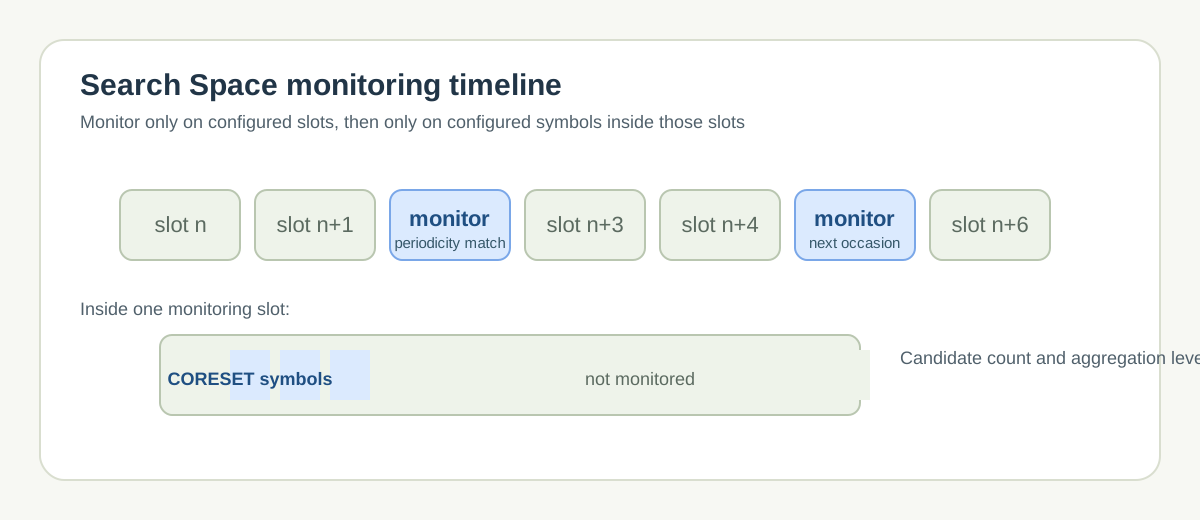
Search Space in 5G NR defines the monitoring rule for PDCCH. It tells the UE when to monitor, which symbols within a slot can carry control, which CORESET is being monitored, and how many candidates may exist at each aggregation level.
Read Search Space as the monitoring layer on top of CORESET. CORESET defines the physical control region. Search Space defines the monitoring schedule and candidate pattern inside that region.
| Technology | 5G NR |
|---|---|
| Area | PHY control monitoring |
| Main specs | 3GPP TS 38.213, 38.331, 38.211 |
| Release | Release 18 |
| Main use | Defines when and where the UE monitors for PDCCH candidates |
| Main building blocks | CORESET association, periodicity and offset, monitoring symbols, type, and candidate counts |
| Main types | Common Search Space and UE-specific Search Space |
| Related pages | CORESET, PDCCH, DCI Formats, BWP, Frame Structure |
Contents
Overview
Search Space is not the same thing as CORESET and not the same thing as PDCCH. It is the monitoring rule the UE applies when deciding whether to look for PDCCH candidates in a given slot and symbol set.
- Each search space is associated with one CORESET.
- It defines periodicity and offset in slots.
- It defines monitored symbols within a slot using a symbol bitmap.
- It defines monitored candidate counts per aggregation level.
- It defines whether the monitoring is common or UE-specific.
Quick interpretation
| Role | PDCCH monitoring rule inside an associated CORESET |
|---|---|
| Configured by | SearchSpace RRC signaling, or common initial-access control context |
| Time control | monitoringSlotPeriodicityAndOffset, duration, and monitoringSymbolsWithinSlot |
| Candidate control | nrofCandidates per aggregation level |
| Type control | searchSpaceType common or UE-specific, with procedure-specific common-control flavors |
| Main impact | Grant visibility, paging detection, random-access control, common-control reach, and blind decoding load |
How the Search Space model works
The SearchSpace configuration binds monitoring behavior to an associated CORESET through
controlResourceSetId. That link tells the UE which control region to monitor. The rest of the
fields define when monitoring happens, which symbols can carry candidates, and how many candidates are checked
at each aggregation level.
Periodicity and offset
monitoringSlotPeriodicityAndOffset defines the slot periodicity and slot offset. This is the
first timing filter. If the slot is not a monitoring occasion, the UE does not search for PDCCH candidates
even if the CORESET exists.
Monitoring symbols within a slot
monitoringSymbolsWithinSlot is a 14-bit bitmap that marks which OFDM symbols in the monitoring
slot can carry PDCCH candidates for that search space. This is why two search spaces can point to the same
CORESET but still monitor different symbol patterns.
Duration
duration sets how many consecutive slots are part of one monitoring occasion. This is separate
from the symbol-level CORESET duration and matters for how long the monitoring window stays active.
Candidate counts and aggregation levels
nrofCandidates gives the number of monitored candidates at aggregation levels 1, 2, 4, 8, and
16. Those values drive monitoring effort, blind decoding load, and how likely it is that a valid PDCCH
candidate exists at a given robustness level.
Search-space type
searchSpaceType distinguishes common and UE-specific
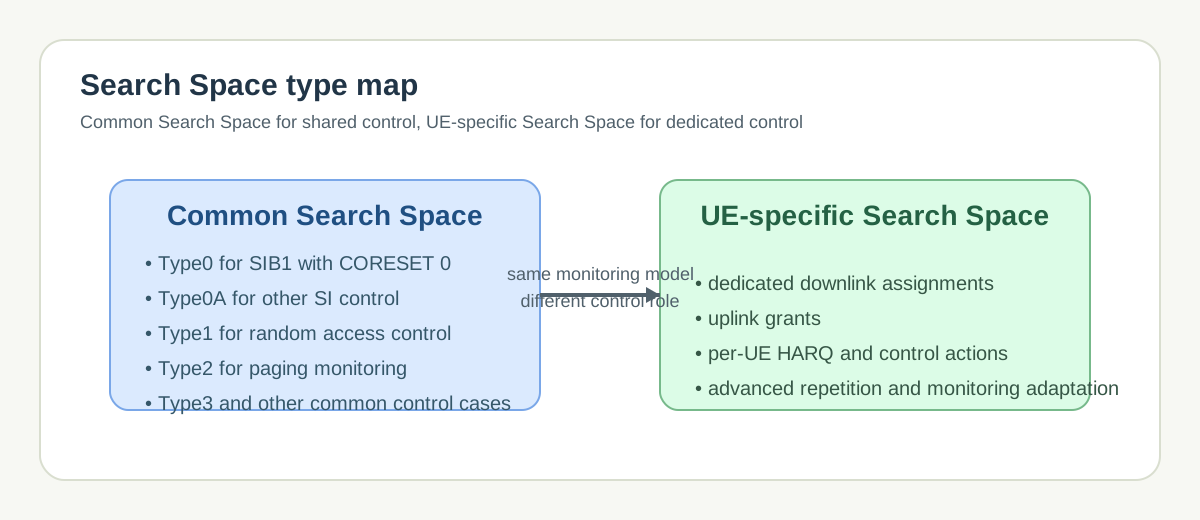
monitoring. Common search spaces support shared control procedures such as SIB1, other SI, paging, random
access, MCCH, MTCH, PEI, and small-data or other common-control cases. UE-specific search spaces support
dedicated control delivery for one UE.
| Field or concept | Purpose |
|---|---|
searchSpaceId | Identifies the search space instance |
controlResourceSetId | Points the search space to the monitored CORESET |
monitoringSlotPeriodicityAndOffset | Defines which slots are monitoring occasions |
monitoringSymbolsWithinSlot | Defines which OFDM symbols within the slot can carry monitored candidates |
duration | Defines how many consecutive slots belong to one monitoring occasion |
nrofCandidates | Defines monitored candidate counts for aggregation levels 1, 2, 4, 8, and 16 |
searchSpaceType | Declares common or UE-specific monitoring and the allowed DCI-format family |
searchSpaceLinkingId | Links search spaces for PDCCH repetition-related monitoring behavior in advanced configurations |
Operational view
Read Search Space as a live monitoring schedule. The important question is not only which search spaces are configured, but which one is active for the current procedure, BWP, and DCI format family.
Common Search Space
Common search spaces support shared control procedures. The main practical groups are:
- Type0 common search space for the initial SIB1 control path with CORESET 0
- Type0A common search space for other SI-related common control
- Type1 common search space for random-access related control
- Type2 common search space for paging-related monitoring
- Type3 common search space for additional common-control and broadcast-DCI cases
UE-specific Search Space
UE-specific search spaces are used after dedicated control configuration is in place. They are the normal path for per-UE scheduling, uplink grants, downlink assignments, and richer control behavior.
Release 18 reading
Release 18 search-space reading is broader than basic CSS vs USS. It also includes linked search spaces for PDCCH repetition, search-space groups and monitoring adaptation fields, multicast-related DCI-format choices, and the way advanced common-control cases reuse the same monitoring model.
| Reading area | Why it matters |
|---|---|
| Associated CORESET | Defines which physical control region is actually monitored |
| Periodicity and offset | Defines when the UE expects control opportunities |
| Monitoring symbols bitmap | Defines where inside the slot control can appear |
| Type and DCI family | Defines whether monitoring is for common or dedicated control and which DCI formats matter |
| Candidate counts | Defines monitoring load and practical detection opportunities per aggregation level |
Where Search Space appears in real procedures
Initial access and SIB1
SSB -> PBCH / MIB -> CORESET 0 -> Type0 common search space -> PDCCH -> SIB1This is the main early search-space path. If the Type0 common search space is wrong or not monitored as expected, the UE may find the cell but still miss the first control step after PBCH.
Paging
Paging occasion -> paging search space -> PDCCH -> paging message pathPaging failures are often monitoring failures. The UE may have coverage and a valid cell but still miss paging if the paging search-space assumptions are wrong.
Dedicated scheduling
Active BWP -> UE-specific search space -> PDCCH candidate -> DCI -> PDSCH or PUSCH actionThis is the normal scheduled-control path after dedicated configuration.
Troubleshooting
Start with Search Space when PDCCH seems absent only at certain slots, when control works for one procedure but not another, or when the CORESET exists but candidate monitoring still looks empty.
- Check whether the search space points to the intended CORESET.
- Check whether periodicity and offset match the expected monitoring slots.
- Check whether the symbol bitmap matches the CORESET duration and the slot structure.
- Check whether the right common or UE-specific search-space type is active for the procedure.
- Check whether candidate counts and aggregation assumptions are realistic for the observed control coverage.
| Symptom | What to inspect first |
|---|---|
| Cell found but SIB1 not decoded | Type0 common search space, CORESET 0, monitoring symbols, and common-control timing |
| Paging misses | Paging search space, paging occasion timing, active BWP, and monitored symbols |
| Dedicated grants missed | UE-specific search space, periodicity and offset, candidate counts, and the associated CORESET |
| Control appears only on some slots | Monitoring periodicity, slot offset, duration, and whether the slot is actually a monitoring occasion |
| PDCCH repetition behavior looks inconsistent | Linked search spaces, group IDs, monitoring adaptation, and advanced repetition-related settings |
Common reading mistakes
- Treating Search Space as the same thing as CORESET.
- Looking only at candidate counts while ignoring monitoring slot timing.
- Ignoring the symbol bitmap and assuming the whole CORESET duration is always monitored the same way.
- Using the wrong common search-space type when reading SIB1, paging, or random-access control.
- Explaining missing grants as a data problem before checking whether the UE was monitoring the right search space.
References
- 3GPP TS 38.213 Release 18 - search-space monitoring procedures, candidate behavior, CSS and USS operation, and advanced monitoring adaptation
- 3GPP TS 38.331 Release 18 -
SearchSpaceconfiguration, linked search spaces, and control-related RRC signaling - 3GPP TS 38.211 Release 18 - physical PDCCH and CORESET mapping context used by search-space monitoring
FAQ
What is Search Space in 5G NR?
Search Space defines when and where the UE monitors for PDCCH candidates inside an associated CORESET.
What is the difference between CORESET and Search Space?
CORESET defines the physical control region. Search Space defines the monitoring rule inside that region.
What is the difference between common and UE-specific Search Space?
Common Search Space is used for shared control procedures such as SIB1, paging, and random access. UE-specific Search Space is used for dedicated per-UE control delivery.
What controls how many candidates are monitored?
Candidate counts are configured through nrofCandidates for aggregation levels 1, 2, 4, 8, and 16.
Why does Search Space matter in troubleshooting?
Because the UE may be looking at the wrong slots, symbols, or candidate set even when the CORESET and radio quality look fine.