5G NR TDD UL/DL Configuration
TDD UL/DL configuration in 5G NR defines which time resources are downlink, which are uplink, and which remain flexible on a TDD carrier. It is the timing map that many other PHY procedures assume before control, data, or random-access behavior can be interpreted correctly.
Read this topic as the direction layer on top of the frame structure. Once the slot and symbol timing is known, the TDD configuration tells the UE and gNB where downlink reception, uplink transmission, and flexible behavior are allowed.
| Technology | 5G NR |
|---|---|
| Area | PHY timing and duplexing |
| Main specs | 3GPP TS 38.213, 38.331, 38.211 |
| Release | Release 18 |
| Main use | Defines downlink, uplink, and flexible slot and symbol direction in TDD operation |
| Main fields | referenceSubcarrierSpacing, pattern1, pattern2, nrofDownlinkSlots, nrofDownlinkSymbols, nrofUplinkSlots, nrofUplinkSymbols |
| Main variants | Common TDD pattern plus dedicated slot-specific overrides where configured |
| Related pages | Frame Structure, Numerology, PDCCH, PDSCH, PUSCH, PRACH |
Contents
Overview
TDD configuration is the time-direction definition for an NR TDD carrier. It decides whether a given slot or a symbol range inside a slot is reserved for downlink, uplink, or flexible use.
- It is carried mainly through
TDD-UL-DL-ConfigCommon. - It is built from one or two repeating patterns.
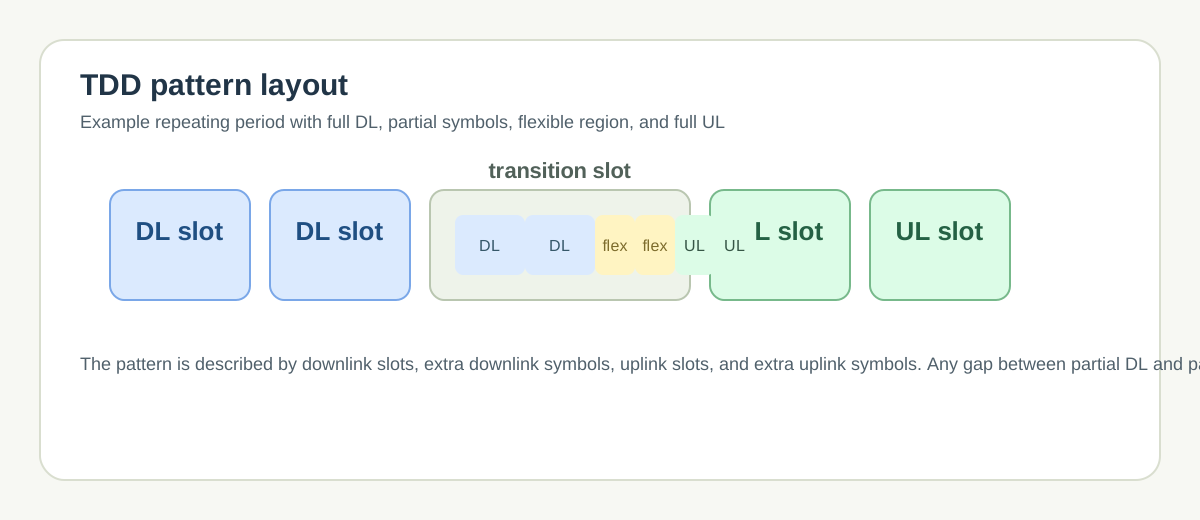
- Each pattern combines full downlink slots, partial downlink symbols, full uplink slots, and partial uplink symbols.
- Dedicated slot-specific configuration can override the common pattern in configured cases.
- Control, data, PRACH, and monitoring behavior all depend on this direction map.
Quick interpretation
| Role | Defines the downlink, uplink, and flexible time resources of a TDD carrier |
|---|---|
| Configured by | TDD-UL-DL-ConfigCommon and, when applicable, dedicated slot-specific overrides |
| Main timing anchor | referenceSubcarrierSpacing plus one or two repeating DL/UL patterns |
| Pattern fields | dl-UL-TransmissionPeriodicity, nrofDownlinkSlots, nrofDownlinkSymbols, nrofUplinkSlots, and nrofUplinkSymbols |
| Main impact | Control timing, downlink scheduling, uplink opportunities, PRACH timing, guard behavior, and latency balance |
How the TDD UL/DL model works
The common TDD configuration is defined by referenceSubcarrierSpacing and at least one
TDD-UL-DL-Pattern. A pattern contains a repetition period plus counts for full downlink slots,
partial downlink symbols, full uplink slots, and partial uplink symbols.
Reference subcarrier spacing
referenceSubcarrierSpacing gives the SCS basis used to interpret the TDD pattern. Because slot
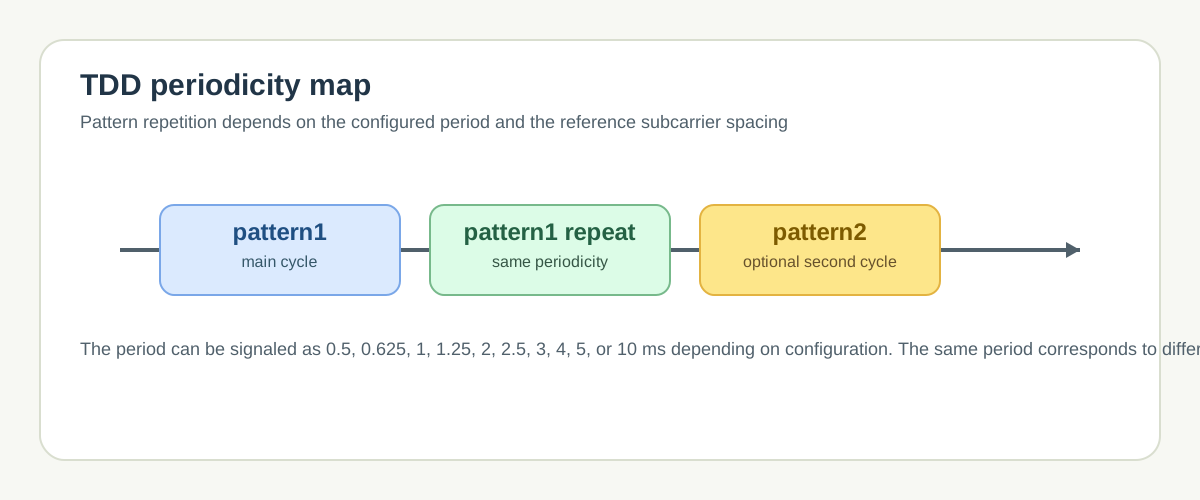
duration changes with numerology, the same periodicity value means a different slot count at different SCS
settings.
Pattern structure
Each TDD-UL-DL-Pattern contains:
dl-UL-TransmissionPeriodicityfor the repetition periodnrofDownlinkSlotsfor full downlink slotsnrofDownlinkSymbolsfor additional downlink-only symbols in the transition slotnrofUplinkSlotsfor full uplink slotsnrofUplinkSymbolsfor additional uplink-only symbols in the transition slot
What remains between the partial downlink and partial uplink symbol groups is the flexible region. That region is where later control procedures and scheduling can create more adaptable behavior.
Pattern1 and Pattern2
pattern1 is mandatory and defines the main TDD cycle. pattern2 is optional and can
extend the direction model when a second repeating pattern is needed. In practical reading, many deployments
use only one pattern, but the page should always be read with the possibility of two configured patterns.
Dedicated overrides
Dedicated TDD configuration does not replace the full common pattern. It overrides specific slots through
TDD-UL-DL-SlotConfig style configuration. This is most important when one slot must behave
differently from the common cycle instead of redesigning the whole repeating pattern.
| Field or concept | Purpose |
|---|---|
referenceSubcarrierSpacing | Defines the SCS basis for the pattern timing interpretation |
pattern1 | Main repeating TDD pattern |
pattern2 | Optional second TDD pattern |
dl-UL-TransmissionPeriodicity | Defines how often the pattern repeats |
nrofDownlinkSlots | Number of full downlink slots in the pattern |
nrofDownlinkSymbols | Number of extra downlink-only symbols in the transition slot |
nrofUplinkSlots | Number of full uplink slots in the pattern |
nrofUplinkSymbols | Number of extra uplink-only symbols in the transition slot |
| Flexible symbols | Symbols not fixed as purely downlink or uplink by the common pattern |
| Dedicated slot config | Overrides selected slots without replacing the entire common pattern |
Operational view
Read TDD configuration as the timing constraint behind control and data procedures. Many apparent scheduling or radio issues are simply direction-map issues once the configured pattern is examined.
Control and monitoring
PDCCH monitoring and search-space behavior make sense only on symbols that can be used as downlink or flexible for control. The UE does not read control as if every slot were symmetric.
Shared-channel scheduling
PDSCH needs downlink direction. PUSCH needs uplink direction. A pattern that favors one side heavily changes throughput balance, latency, and grant availability even when the radio conditions are unchanged.
Flexible-symbol reading
Flexible symbols are the most commonly misunderstood part of the TDD pattern. They are not simply "free" symbols. They are adaptable symbols that must still follow the higher-layer and DCI-driven interpretation rules used by the UE and gNB.
Release 18 reading
Release 18 TDD reading is broader than a static DL/UL ratio view. It includes common-pattern interpretation, slot-specific dedicated overrides, multi-cell directional-collision handling, and interactions with special control such as DCI format 2_0 and other procedure-specific control behavior.
| Reading area | Why it matters |
|---|---|
| Pattern periodicity | Defines the repeating timing window for DL and UL opportunities |
| DL slot and symbol counts | Defines when downlink control and data can be scheduled |
| UL slot and symbol counts | Defines when uplink control, data, and random access can occur |
| Flexible symbols | Defines where more adaptable scheduling behavior may exist |
| Dedicated overrides | Defines whether one slot behaves differently from the common pattern |
Where TDD configuration appears in real procedures
Initial access
SSB / PBCH -> PRACH opportunity in UL symbols -> access response in DL symbols -> setup pathRandom access depends on having the right uplink opportunity in the configured TDD pattern. A cell can be visible while access still fails because the expected PRACH timing is misread or too sparse.
Control and grant delivery
DL or flexible control symbols -> PDCCH -> DCI -> PDSCH or PUSCH action in allowed symbolsControl and data are both constrained by TDD direction. A valid DCI still needs usable DL or UL symbols for the scheduled action.
Throughput balance
DL-heavy pattern -> more downlink capacity | UL-heavy pattern -> more uplink opportunity | flexible region -> adaptation marginThis is why throughput and latency must be read together with the TDD pattern, not only with channel quality.
Troubleshooting
Start with TDD configuration when uplink and downlink behavior look asymmetric, when PRACH timing seems inconsistent, or when control and data appear to vanish only on specific slots or symbol groups.
- Check the configured
referenceSubcarrierSpacingand pattern periodicity first. - Check whether the expected slot is truly DL, UL, or flexible.
- Check whether a dedicated slot-specific override is active.
- Check whether PRACH, PUCCH, PUSCH, PDCCH, or PDSCH are being expected on the wrong symbol direction.
- Check whether the symptom is really a scheduling issue or simply a direction-map issue.
| Symptom | What to inspect first |
|---|---|
| PRACH never appears when expected | UL slot and symbol availability in the TDD pattern and the configured PRACH timing relation |
| PDCCH seems missing on some slots | Whether the monitored slot and symbols are downlink or flexible in the current pattern |
| Strong downlink but weak uplink opportunity | UL slot count, UL symbol count, and whether the pattern is DL-heavy by design |
| Latency spikes at regular intervals | Pattern periodicity and whether grants must wait for the next allowed direction window |
| One slot behaves differently from the rest | Dedicated slot-specific configuration overriding the common TDD pattern |
Common reading mistakes
- Reading TDD only as a DL/UL ratio instead of as a slot and symbol direction map.
- Ignoring the role of
referenceSubcarrierSpacingin pattern timing interpretation. - Assuming flexible symbols behave as permanently downlink or permanently uplink.
- Ignoring dedicated slot overrides and reading only the common pattern.
- Explaining throughput or access issues without first checking whether the needed direction actually exists at that time.
References
- 3GPP TS 38.213 Release 18 - UE interpretation of TDD direction, control procedures, and TDD-related scheduling behavior
- 3GPP TS 38.331 Release 18 -
TDD-UL-DL-ConfigCommon,TDD-UL-DL-Pattern, and dedicated slot-configuration signaling - 3GPP TS 38.211 Release 18 - physical timing framework used by slot and symbol direction interpretation
FAQ
What is TDD UL/DL configuration in 5G NR?
It is the configuration that defines which slots and symbols are downlink, uplink, or flexible in a TDD carrier.
What do pattern1 and pattern2 mean?
Pattern1 is the main repeating TDD pattern. Pattern2 is an optional second pattern that can also be configured.
What are flexible symbols?
Flexible symbols are symbols not fixed as fully downlink or fully uplink by the common pattern. They allow more adaptable control and scheduling behavior.
What is the difference between common and dedicated TDD configuration?
The common configuration defines the main repeating pattern. Dedicated configuration overrides selected slots instead of replacing the whole pattern.
Why does TDD configuration matter in troubleshooting?
Because a procedure can fail simply because the expected uplink or downlink direction is not available in that slot or symbol range.