5G Beam Failure Recovery Procedure Call Flow
5G Beam Failure Recovery is the radio-continuity procedure that tries to save a connected session when the current beam set is no longer reliable.
It sits between ordinary connected-mode optimization and full radio link failure, making it a high-value troubleshooting checkpoint in beam-based NR deployments.
Introduction
In beam-based operation, a connection can degrade sharply even when the cell itself is still present and broadly usable.
This procedure is about recovering continuity early enough that the session does not have to escalate immediately into Radio Link Failure Recovery or RRC Reestablishment.
What Is Beam Failure Recovery in Simple Terms?
- What starts the procedure: Serving beam quality drops enough to threaten connected-mode continuity.
- What the UE and network want to achieve: Recover a usable beam path before full radio failure occurs.
- What success looks like: The UE stabilizes on a usable beam and service continues.
- What failure means: Local beam recovery is not enough and broader radio recovery is needed.
Why this procedure matters
Beam failure recovery is where many fast 5G radio problems become visible before they turn into full connection loss. It is often the missing link between clean connected-mode traces and sudden later reestablishment.
Quick Fact Sheet
| Procedure name | 5G Beam Failure Recovery Procedure |
|---|---|
| Domain | 5G NR beam management and radio continuity |
| Main trigger | The UE can no longer maintain reliable communication on the configured serving beam set |
| Start state | UE is connected but beam quality has degraded enough to threaten continuity |
| End state | The UE recovers radio usability on a suitable beam or escalates toward broader radio recovery |
| Main nodes | UE, gNB |
| Main protocols | RRC, MAC, PHY, beam management signaling |
| Main success outcome | A usable beam or beam-related control path is recovered before full connection loss |
| Main failure outcome | Beam recovery fails and the situation degrades into radio link failure or reestablishment |
| Most important messages | Measurement Report, RRC Reconfiguration, later recovery signaling |
| Main specs | TS 38.331, TS 38.300 |
Preconditions
- The UE is connected and using beam-dependent NR radio operation.
- Beam quality has degraded but full radio failure has not yet completely taken over.
- The UE can still provide useful measurements or receive recovery-related control behavior.
- The network has a recovery or fallback strategy for the beam problem.
Nodes and Interfaces
Nodes involved
| Node | Role in this procedure |
|---|---|
| UE | Detects deteriorating beam conditions, attempts recovery, and provides the network with the radio evidence needed for action. |
| gNB | Maintains beam management policy and provides the updated beam-related configuration or fallback control path. |
Interfaces used
| Interface | Path | Role |
|---|---|---|
| NR-Uu | UE <-> gNB | Carries beam-related measurement and recovery behavior over the radio interface. |
End-to-End Call Flow
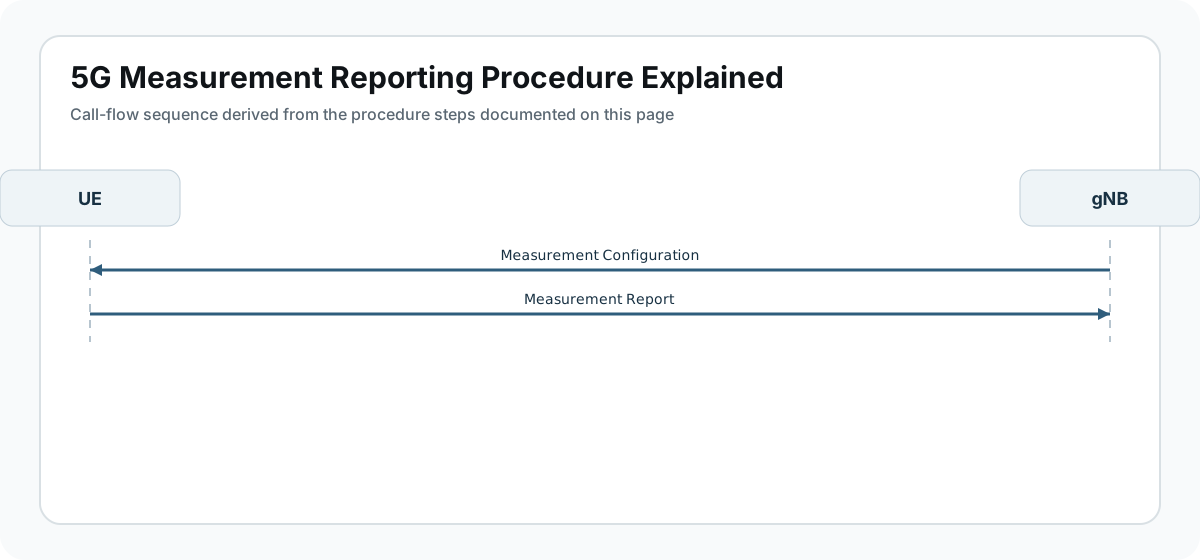
UE                    gNB
|-- beam quality drops ->|
|-- Measurement Report -->|
|<- recovery / reconfig --|
|==== either beam stabilizes or RLF escalates ====|
Major Phases
| Phase | What happens |
|---|---|
| 1. Beam degradation detection | The UE or network observes that the current serving beam set is no longer healthy enough. |
| 2. Recovery search or evaluation | The UE and network evaluate whether another beam can maintain the connection without full failure escalation. |
| 3. Beam-related recovery action | The network may refresh configuration or the UE may realign to a usable beam opportunity. |
| 4. Continuation or escalation | Service continues if a viable beam is restored, otherwise the problem escalates toward broader RLF handling. |
Step-by-Step Breakdown
Serving beam quality degrades
Sender -> receiver: UE and gNB radio behavior
Message(s): Beam measurement deterioration and continuity risk
Purpose: Expose that the current beam path is no longer reliable enough for stable service.
State or context change: The connection is still alive, but a beam-level crisis is developing.
Note: This is a pre-RLF stage where fast radio action can still save the session.
UE and network look for a usable beam alternative
Sender -> receiver: UE measurements and gNB beam management logic
Message(s): Measurement Report and beam-management behavior
Purpose: Determine whether the issue can be solved through beam recovery rather than full session rebuild.
State or context change: The procedure is still local to radio continuity and has not yet escalated to full failure recovery.
Note: Engineers should inspect whether the network gave the UE realistic beam options before the failure window closed.
Network refreshes or confirms recovery configuration
Sender -> receiver: gNB -> UE
Message(s): RRC Reconfiguration or beam-related control behavior
Purpose: Steer the UE toward a viable beam or update the configuration supporting recovery.
State or context change: The system attempts to keep the UE connected without escalating to reestablishment.
Note: If reconfiguration appears too late, beam recovery may already be beyond rescue.
Connection either stabilizes or degrades into broader failure
Sender -> receiver: UE <-> gNB
Message(s): Recovered beam continuity or later Radio Link Failure Recovery
Purpose: Decide whether beam recovery was enough to preserve service.
State or context change: The flow either returns to stable connected mode or escalates to more disruptive recovery.
Note: A failed beam recovery often explains why later reestablishment or handover seems sudden.
Important Messages in This Flow
| Message | Protocol | Direction | Purpose in this procedure | What to inspect briefly |
|---|---|---|---|---|
| Measurement Report | RRC | UE -> gNB | Provides radio evidence that beam quality is degrading or an alternative beam is stronger. | Inspect beam-related quality trends and candidate viability. |
| RRC Reconfiguration | RRC | gNB -> UE | Can carry updated radio settings that help beam continuity or later mobility action. | Inspect whether recovery-related updates arrived in time. |
Important Parameters to Inspect
| Parameter | What it is | Where it appears | Why it matters | Common issues |
|---|---|---|---|---|
| Beam quality trend | How rapidly the serving beam quality is collapsing. | Measurements and radio logs | Explains whether the network had time to recover locally. | Fast collapse can outrun normal control reactions. |
| Candidate beam availability | Whether the UE actually has a viable alternative beam to use. | Measurement context | Separates recoverable degradation from unavoidable failure. | No viable beam means escalation is likely. |
| Recovery timing | How quickly the network reacts to beam deterioration. | Measurement-to-action timeline | Determines whether recovery arrives before the link is effectively lost. | Late action is a common reason beam recovery fails. |
| Mobility versus beam-recovery boundary | Whether the problem should stay local or become handover or reestablishment. | Operational interpretation | Helps classify the trace correctly. | Wrong classification leads to wrong optimization work. |
| Post-recovery stability | Whether service really stabilizes after the chosen beam action. | Later radio and traffic behavior | Shows if the beam recovery truly solved the problem. | Short-lived recovery often means the RF environment still needs a bigger move. |
Success Criteria
- The beam problem is detected before full connection loss.
- A viable candidate beam or configuration exists.
- Recovery action arrives quickly enough to matter.
- The post-recovery session remains stable rather than only briefly surviving.
Common Failures and Troubleshooting
| Symptom | Likely cause | Where to inspect | Relevant message(s) | Relevant interface(s) | Likely next step |
|---|---|---|---|---|---|
| Beam recovery never stabilizes | The radio environment no longer offers a viable serving beam set. | Candidate beams and post-action quality trend. | Measurement Report and later control behavior | NR-Uu | This usually escalates into broader mobility or RLF handling. |
| Recovery actions arrive too late | The beam quality collapsed faster than the network reacted. | Measurement-to-action timing. | Measurement Report, RRC Reconfiguration | NR-Uu | Late reaction is a major tuning clue. |
| Beam issue is misread as generic handover trouble | The real root cause was local beam deterioration before mobility logic caught up. | Beam trend before later handover or reestablishment. | Measurement Report | NR-Uu | Classify the failure window carefully. |
| Beam recovery works briefly but service remains unstable | The recovered beam was only marginally better and the UE still needed a larger mobility move. | Post-recovery stability and neighbor-cell opportunity. | Later measurements and reconfiguration | NR-Uu | This often signals that mobility policy should take over sooner. |
What to Check in Logs and Traces
- Plot the beam quality trend before the visible failure point.
- Check whether any candidate beam was actually viable at the time.
- Measure the delay between detection and network action.
- If recovery fails, follow the escalation into RLF or reestablishment immediately after.
Related Pages
Related sub-procedures
Related message reference pages
Related troubleshooting pages
FAQ
What is 5G Beam Failure Recovery?
It is the radio-recovery process used when the current serving beam becomes unreliable and the network tries to restore continuity before full link failure.
Is it the same as handover?
No. Beam failure recovery is usually a more local radio continuity action, though it can lead into mobility if local recovery is not enough.
Why is it important in 5G?
Because beam-based operation makes directional radio quality a major part of continuity and failure behavior.
What should I inspect first?
Start with beam quality trend, candidate beam availability, and whether the network reacted in time.
What often follows failed beam recovery?
Radio Link Failure Recovery or RRC Reestablishment may follow if the connection cannot be preserved locally.