5G Conditional Handover Procedure Call Flow
5G conditional handover is a proactive mobility procedure where the network prepares a handover in advance but lets the UE execute it only if specific radio conditions are met.
It combines target preparation, conditional RRC configuration, and UE-side execution logic into a mobility strategy designed for difficult or fast-changing radio conditions.
Introduction
This procedure is best understood as a prepared but not immediately executed handover.
The network decides a target early, gives the UE the rules for when to move, and then relies on the UE to execute only if the serving-cell conditions actually justify it. That makes the condition itself one of the most important troubleshooting objects in the whole trace.
What Is Conditional Handover in Simple Terms?
- What starts the procedure: The network predicts that proactive handover preparation is safer than a late reactive move.
- What the UE and network want to achieve: Prepare a target in advance and execute only under the right radio condition.
- What success looks like: The UE receives the conditional configuration, the trigger condition is met, and the handover completes quickly.
- What failure means: The condition never matched, the target was not really ready, or execution happened too late for a clean move.
Why this procedure matters
Conditional handover sits at the intersection of measurement quality, mobility policy, and target preparation. Without a structured view, engineers can mistake a valid non-execution for a failure or blame radio conditions when the real issue was stale target preparation.
Quick Fact Sheet
| Procedure name | 5G Conditional Handover Procedure |
|---|---|
| Domain | 5G NR radio mobility with pre-configured execution conditions |
| Main trigger | Network prepares a handover in advance and lets the UE execute it only if configured radio conditions are met |
| Start state | UE is connected and under serving-cell control, with mobility risk or prediction that justifies conditional preparation |
| End state | UE either executes the prepared handover under the configured condition or stays on the serving cell until the configuration expires or is replaced |
| Main nodes | UE, source gNB, target gNB, AMF |
| Main protocols | RRC, NGAP, Xn or N2 mobility coordination |
| Main success outcome | UE receives conditional reconfiguration, meets the condition, and completes the handover without waiting for a last-second command |
| Main failure outcome | Conditions never match, execution happens too late, or the prepared target or context is no longer usable |
| Most important messages | RRC Reconfiguration with conditional reconfiguration, Measurement Report, RRC Reconfiguration Complete |
| Main specs | TS 38.300, TS 38.331, TS 23.502 |
Preconditions
- The UE is in connected state and under source-cell control.
- The network has at least one candidate target cell worth preparing in advance.
- Measurement configuration is active and meaningful for the intended mobility event.
- Source and target coordination path is available over Xn or N2.
Nodes and Interfaces
Nodes involved
| Node | Role in this procedure |
|---|---|
| UE | Measures configured candidate cells, stores the conditional handover configuration, and executes the handover only when the triggering condition is satisfied. |
| Source gNB | Prepares the conditional mobility configuration, selects targets, and keeps serving-cell control until execution. |
| Target gNB | Provides prepared target context so the UE can move quickly when the execution condition is met. |
| AMF | Supports mobility anchoring and control-plane continuity when the chosen handover path uses N2 coordination. |
Interfaces used
| Interface | Path | Role |
|---|---|---|
| NR-Uu | UE <-> source or target gNB | Carries measurements, RRC Reconfiguration, and execution completion. |
| N2 | gNB <-> AMF | Carries mobility coordination when the handover uses AMF-involved preparation. |
| Xn | source gNB <-> target gNB | Carries target preparation and mobility context exchange when direct gNB coordination is available. |
End-to-End Call Flow
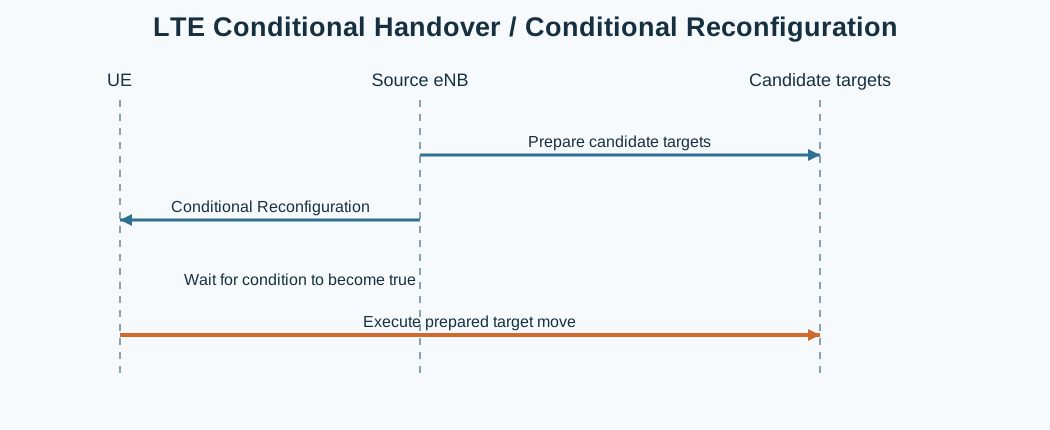
UE             Source gNB          Target gNB             AMF
|                  |                  |                    |
|<- Measurement cfg|                  |                    |
|-- reports ------>|                  |                    |
|                  |-- target prep -->|------------------->|
|<- RRC Reconfiguration (conditional) |                    |
|-- monitor condition locally --------|                    |
|== condition met ==> target access ======================>|
|-- RRC Reconfiguration Complete ------------------------->|
Major Phases
| Phase | What happens |
|---|---|
| 1. Mobility prediction | The source gNB decides that a normal reactive handover may be too slow or risky and prepares a conditional handover strategy. |
| 2. Target preparation and condition definition | Candidate target cells are prepared and the UE is told exactly which radio condition should trigger execution. |
| 3. Conditional configuration delivery | The UE receives RRC Reconfiguration containing the candidate and the execution rules. |
| 4. UE monitoring | The UE keeps measuring and only executes the handover if the configured condition is met within the validity window. |
| 5. Execution or discard | The UE completes handover to the prepared target or keeps the old serving cell if the condition never becomes true. |
Step-by-Step Breakdown
Source gNB identifies a conditional mobility need
Sender -> receiver: Source gNB internal mobility logic
Message(s): Mobility decision and target evaluation
Purpose: Decide that pre-armed mobility is safer than waiting for a late reactive handover command.
State or context change: The network shifts from ordinary monitoring into proactive mobility preparation.
Note: This often appears in edge-of-coverage or fast-moving scenarios where last-moment handover is risky.
Source prepares candidate target context
Sender -> receiver: Source gNB <-> target gNB and optionally source gNB <-> AMF
Message(s): Target preparation signaling
Purpose: Ensure the chosen target can accept the UE quickly if the condition is triggered.
State or context change: The target side has enough prepared context to support rapid execution.
Note: If the target preparation is weak, the UE may satisfy the condition but still fail later during execution.
UE receives conditional handover configuration
Sender -> receiver: Source gNB -> UE
Message(s): RRC Reconfiguration
Purpose: Tell the UE which target to use and what measurement condition should trigger the move.
State or context change: The UE stores a future mobility action rather than executing immediately.
Note: Read the condition and validity details carefully. They explain why some prepared handovers never fire.
UE measures and decides whether to execute
Sender -> receiver: UE internal measurement logic
Message(s): Measurement Report and local condition evaluation
Purpose: Monitor the radio environment until the configured execution rule is satisfied.
State or context change: The UE remains on the source cell while armed for rapid mobility.
Note: A good conditional configuration does not guarantee execution. The condition may simply never become true.
UE executes handover and confirms completion
Sender -> receiver: UE -> target gNB and target gNB -> source/AMF
Message(s): RRC Reconfiguration Complete and mobility completion signaling
Purpose: Finish the prepared handover once the trigger condition is met.
State or context change: The UE leaves the source cell and continues under the prepared target.
Note: If the UE moves too fast or the target context aged out, the execution can still fail even after good preparation.
Important Messages in This Flow
| Message | Protocol | Direction | Purpose in this procedure | What to inspect briefly |
|---|---|---|---|---|
| RRC Reconfiguration | RRC | Source gNB -> UE | Delivers the conditional handover configuration and trigger details. | Inspect candidate cell details, execution conditions, and validity behavior. |
| Measurement Report | RRC | UE -> source gNB | Provides the measurement basis for mobility planning and monitoring. | Use it to confirm whether the later execution condition was actually realistic. |
| RRC Reconfiguration Complete | RRC | UE -> target or network | Confirms successful execution of the configured mobility action. | Check whether it appears after condition satisfaction and on the expected target. |
Important Parameters to Inspect
| Parameter | What it is | Where it appears | Why it matters | Common issues |
|---|---|---|---|---|
| Conditional execution rule | The measurement condition that triggers the handover. | RRC Reconfiguration | This is the heart of the procedure because it defines when the UE is allowed to move. | If misunderstood, engineers can misclassify a non-executed handover as failure. |
| Candidate target cell | Prepared target identity and mobility details. | RRC Reconfiguration and target prep | Shows where the UE was supposed to move when conditions matched. | Wrong target or stale preparation causes execution failure. |
| Validity timer or condition lifetime | How long the conditional setup remains usable. | RRC configuration | Explains why prepared mobility can silently expire. | Expired preparation can look like missed execution. |
| Measurement events and thresholds | Radio conditions used to arm or trigger the move. | Measurement configuration and reports | Needed to understand whether the UE had any reason to execute. | Thresholds too strict or inconsistent with RF reality. |
| Mobility path type | Whether the prepared handover uses Xn-like or N2-assisted coordination. | Source/target preparation path | Explains what backhaul dependencies can break the prepared move. | Wrong assumption about the mobility path sends troubleshooting to the wrong interface. |
Success Criteria
- The source prepares a valid target and sends a realistic conditional configuration.
- The UE measures the environment and executes only when the configured condition is truly met.
- The target context is still valid at execution time.
- The handover completes with clean continuation on the target cell.
Common Failures and Troubleshooting
| Symptom | Likely cause | Where to inspect | Relevant message(s) | Relevant interface(s) | Likely next step |
|---|---|---|---|---|---|
| Conditional handover never executes | The condition never became true or the configuration expired first. | Measurement reports, thresholds, and validity timers. | Measurement Report, RRC Reconfiguration | NR-Uu | This is not automatically a failure. Sometimes the right result is to stay on the source cell. |
| UE triggers execution but target handover fails | Prepared target context was stale, incomplete, or unreachable. | Target preparation, execution timing, and target-cell readiness. | RRC Reconfiguration Complete or missing completion | Xn, N2, NR-Uu | Treat this as preparation or target-readiness failure, not just RF deterioration. |
| Source keeps reconfiguring but mobility stays unstable | The predictive mobility strategy is not matching the real radio dynamics. | Repeated reconfigurations and measurement history. | RRC Reconfiguration, Measurement Report | NR-Uu | You may need a different mobility policy rather than another threshold tweak. |
| Execution appears too late | The UE met the condition only after radio quality had already collapsed. | Condition thresholds and timing relative to signal drop. | Measurement Report, RRC Reconfiguration Complete | NR-Uu | This is a classic sign that the trigger logic is correct in principle but too slow in practice. |
Related Pages
Related sub-procedures
Related message reference pages
Related troubleshooting pages
FAQ
What is conditional handover in 5G?
It is a mobility technique where the network prepares a handover in advance and lets the UE execute it only when configured conditions are satisfied.
How is it different from normal handover?
A normal handover is usually commanded reactively at the moment of move. Conditional handover is prepared earlier and executed later under a UE-observed rule.
Does the UE always execute a conditional handover once configured?
No. The UE executes only if the configured condition becomes true while the configuration remains valid.
Why is this useful?
It can reduce late handover risk for fast movement or unstable radio scenarios.
What should I inspect first in a failing case?
Start with the configured condition, target preparation quality, and whether the measurement reports ever justified execution.