5G IMS Registration Refresh / Re-registration
IMS Registration Refresh / Re-registration is the maintenance procedure that keeps a VoNR-ready UE reachable over time.
If this procedure is weak, everything can look healthy right after initial registration but later mobile-terminated calls and service continuity will fail.
Introduction
This page focuses on the maintenance side of IMS rather than the first-time VoNR onboarding path.
The core question is simple: does the UE keep its IMS binding fresh and usable as timers expire or service context changes?
What Is IMS Registration Refresh / Re-registration in Simple Terms?
- What starts the procedure: The current IMS registration is nearing expiry or must be rebuilt after a context change.
- What the UE and network want to achieve: Keep the subscriber reachable for later voice service without losing IMS continuity.
- What success looks like: A fresh valid registration exists and later voice service still works.
- What failure means: The IMS binding ages out, loops, or looks fresh without restoring real reachability.
Why this procedure matters
Many “intermittent” VoNR problems are really registration-maintenance problems. The first registration succeeds, but the next refresh or re-registration quietly fails.
Quick Fact Sheet
| Procedure name | 5G IMS Registration Refresh / Re-registration |
|---|---|
| Domain | IMS maintenance signaling for VoNR service continuity |
| Main trigger | Registration expiry is approaching or IMS registration must be rebuilt after service-state change |
| Start state | The UE was previously IMS-registered and must maintain or restore that state |
| End state | A fresh IMS registration binding exists and the UE remains reachable for voice service |
| Main nodes | UE, P-CSCF, S-CSCF, IMS core, 5G access path |
| Main protocols | SIP REGISTER, expiry handling, 401 challenge, 200 OK |
| Main success outcome | The UE stays voice-ready without losing IMS reachability |
| Main failure outcome | The IMS binding expires or is rebuilt badly, causing MT call or service-continuity problems |
| Most important messages | REGISTER, Expires, 401 Unauthorized, 200 OK |
| Main specs | TS 24.229, TS 23.228, TS 23.502 |
Preconditions
- The UE was already IMS-registered at least once.
- The IMS-capable packet path remains available or can be rebuilt.
- IMS subscriber data and authentication context remain valid.
- Later voice reachability can be validated after refresh.
Nodes and Interfaces
Nodes involved
| Node | Role in this procedure |
|---|---|
| UE | Tracks IMS registration lifetime and refreshes or rebuilds the registration when needed. |
| P-CSCF and S-CSCF | Anchor the registration state and validate refresh or re-registration attempts. |
| 5G access path | Keeps the IMS-capable packet service available during the maintenance exchange. |
Interfaces used
| Interface | Path | Role |
|---|---|---|
| IMS SIP path | UE <-> IMS core | Carries the refresh REGISTER or full re-registration transaction. |
| NR-Uu and packet service path | UE <-> 5G access <-> IMS | Provide the transport continuity that IMS refresh depends on. |
End-to-End Call Flow
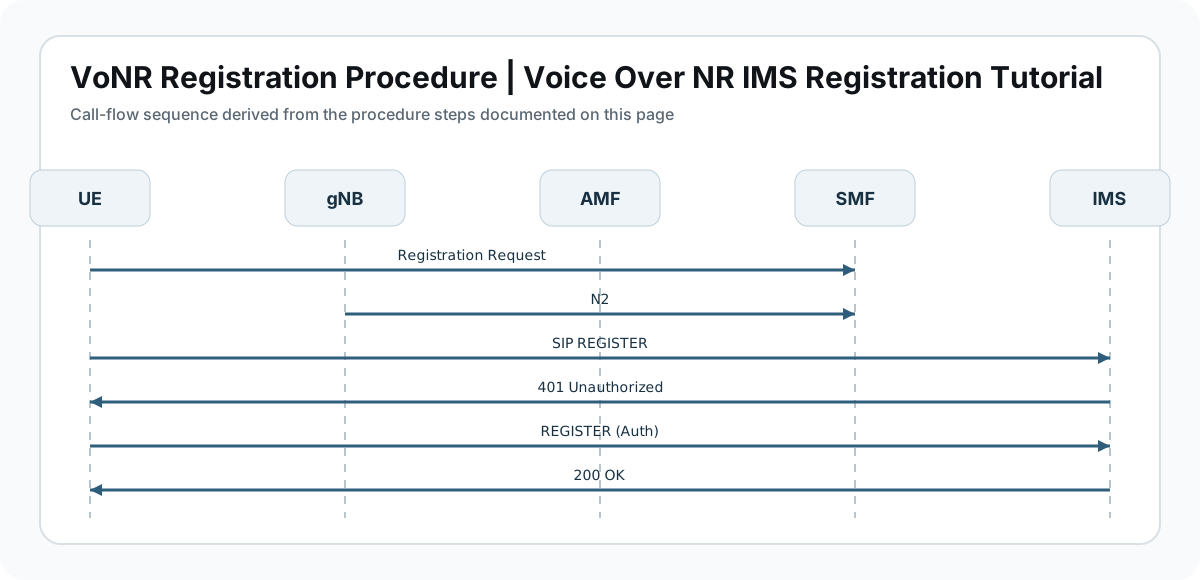
UE                 IMS core
|-- REGISTER ------->|
|<-- 401 (if needed)-|
|-- REGISTER + auth >|
|<-- 200 OK ---------|
|==== registration binding stays fresh ====|
Major Phases
| Phase | What happens |
|---|---|
| 1. Registration-lifetime monitoring | The UE tracks when the current IMS binding must be refreshed. |
| 2. Refresh or re-registration trigger | A timer, service-state change, or context loss causes a new REGISTER exchange. |
| 3. IMS authentication and acceptance | IMS challenges the request if needed and returns success. |
| 4. Reachability continuity | The UE stays reachable for later MT calls and voice procedures. |
Step-by-Step Breakdown
The UE detects that the current IMS registration must be maintained
Sender -> receiver: UE IMS client
Message(s): Registration-expiry tracking or context-recovery trigger
Purpose: Prevent voice reachability from being lost silently over time.
State or context change: The UE moves from passive registered state into active registration maintenance.
Note: Refresh and re-registration issues often hide behind “registration was fine earlier” user reports.
The UE sends REGISTER to refresh or rebuild the IMS binding
Sender -> receiver: UE -> P-CSCF -> S-CSCF
Message(s): REGISTER with updated Expires context
Purpose: Extend the current binding or rebuild it after a context change.
State or context change: IMS evaluates whether the old registration can be refreshed cleanly or must be re-authenticated.
Note: Use the surrounding context to decide whether this is a lightweight refresh or a true re-registration event.
IMS challenges or accepts the registration maintenance request
Sender -> receiver: IMS -> UE
Message(s): 401 Unauthorized when needed, then 200 OK
Purpose: Validate the subscriber and confirm the fresh binding.
State or context change: The old registration state is replaced or extended with a new valid lifetime.
Note: Repeated challenge loops here often show profile or credential drift rather than transport failure.
The UE remains reachable for future voice service
Sender -> receiver: Post-registration service state
Message(s): Fresh registration binding in IMS
Purpose: Keep VoNR MT reachability and voice continuity intact across time and service-state changes.
State or context change: The UE stays ready for MT calls, re-entry into service, and other IMS procedures.
Note: Success here is measured by later service continuity, not only by the immediate 200 OK.
Important Messages in This Flow
| Message | Protocol | Direction | Purpose in this procedure | What to inspect briefly |
|---|---|---|---|---|
| REGISTER | SIP | UE -> IMS | Refreshes or rebuilds the IMS registration state. | Inspect Expires handling and whether this is full re-registration or simple refresh. |
| 401 Unauthorized | SIP | IMS -> UE | Challenges the refresh when authentication is needed. | A normal step in many healthy traces. Repeated loops are the real problem. |
| 200 OK | SIP | IMS -> UE | Confirms the fresh registration binding. | Check the returned registration lifetime and whether the binding looks current. |
Important Parameters to Inspect
| Parameter | What it is | Where it appears | Why it matters | Common issues |
|---|---|---|---|---|
| Expires / lifetime | How long the IMS registration remains valid. | REGISTER and 200 OK | Explains why refresh happens now and how long the new binding will last. | Bad lifetime handling causes silent reachability loss later. |
| Refresh versus re-registration context | Whether the UE is extending or rebuilding the binding. | Whole transaction context | Useful for deciding whether mobility or context loss was involved. | Treating re-registration as simple refresh hides the real cause. |
| IMS challenge continuity | Whether authentication works cleanly on maintenance exchanges. | 401 and second REGISTER | Needed when the network revalidates the subscriber. | Repeated 401 loops are a common failure signature. |
| Post-refresh reachability | Whether MT service still works after the refresh. | After 200 OK | The final proof that maintenance succeeded. | A cosmetic 200 OK without real reachability is not enough. |
| Packet-service continuity | Whether the IMS-capable session stayed usable during the refresh. | Transport path during REGISTER | Separates IMS maintenance trouble from generic packet-path trouble. | A broken packet path makes the refresh failure look like pure SIP trouble. |
Success Criteria
- The UE refreshes or rebuilds the IMS binding before it becomes stale.
- Any challenge handling completes cleanly.
- The new registration lifetime is valid and current.
- Later MT call and voice procedures still work after the maintenance event.
Common Failures and Troubleshooting
| Symptom | Likely cause | Where to inspect | Relevant message(s) | Relevant interface(s) | Likely next step |
|---|---|---|---|---|---|
| The registration expires silently | The refresh never happened or happened too late. | Refresh timing and registration lifetime handling. | REGISTER timing, Expires | IMS client behavior | This commonly causes later MT-call failures that look unrelated. |
| Refresh enters repeated challenge loops | IMS authentication or subscriber context is inconsistent. | 401 handling and second REGISTER behavior. | REGISTER, 401 | IMS core | Do not misdiagnose this as radio trouble. |
| 200 OK appears but reachability is still broken | The binding looks fresh but operational service continuity is incomplete. | Post-refresh MT behavior and registration state. | 200 OK and later MT trace | IMS reachability | This is a maintenance-success illusion. |
| Mobility or inactivity transitions break re-registration | Context change altered the assumptions behind the old binding. | Service-state change and packet continuity. | Full transaction context | Cross-layer state | This is especially relevant after idle or inactive return. |
What to Check in Logs and Traces
- Check the registration lifetime and timer behavior first.
- Decide whether the case is refresh or full re-registration.
- Watch for repeated 401 loops rather than treating a single 401 as failure.
- Validate post-refresh reachability with later service behavior, not just 200 OK.
Related Pages
Related sub-procedures
Related message reference pages
Related troubleshooting pages
FAQ
What is IMS Registration Refresh / Re-registration?
It is the periodic or context-driven maintenance of the IMS binding that keeps a UE reachable for voice service.
Why is it important for VoNR?
Because a stale or expired IMS registration breaks MT calls and later voice procedures even if basic 5G access still works.
What proves success?
The REGISTER maintenance exchange completes and the UE remains operationally reachable for later voice service.
What should I inspect first?
Start with the registration lifetime, then decide whether the case is simple refresh or true re-registration, and then inspect the challenge sequence.
Why can later MT calls fail even after a 200 OK refresh?
Because the new binding may look valid in signaling while real reachability or service continuity is still incomplete.