5G NTN Handover / Mobility Handling Call Flow
5G NTN Handover / Mobility Handling explains how service is preserved when an NTN-served UE changes serving context.
It combines NTN-aware mobility preparation, execution signaling, and post-move service validation into one continuity procedure.
Introduction
This page picks up after NTN registration and focuses on what happens when the UE must keep service across a non-terrestrial mobility event.
The winning troubleshooting pattern is to follow the move from source context to target context, then verify that the session path and first packets really converged afterward.
What Is NTN Handover / Mobility Handling in Simple Terms?
- What starts the procedure: The UE needs to move between NTN serving contexts while keeping service alive.
- What the UE and network want to achieve: Preserve continuity across the NTN mobility transition.
- What success looks like: The UE moves cleanly and service works in the new context.
- What failure means: Execution appears fine but post-mobility service does not recover correctly.
Why this procedure matters
In NTN, mobility success is not just about access movement. It is about whether the new context can actually carry service under unusual timing and path constraints.
Quick Fact Sheet
| Procedure name | 5G NTN Handover / Mobility Handling |
|---|---|
| Domain | 5G non-terrestrial mobility continuity and service preservation |
| Main trigger | A UE on NTN service experiences movement, beam change, satellite coverage transition, or access-context change that requires mobility handling |
| Start state | UE is already registered and in service over an NTN-aware access path |
| End state | Service continuity is preserved or cleanly re-established under the new NTN mobility context |
| Main nodes | UE, NTN access node, source and target access context, AMF, SMF, UPF |
| Main protocols | RRC-like mobility control, NGAP-like access coordination, NAS service continuity signaling, PFCP as needed |
| Main success outcome | The UE keeps or restores service while the network updates the NTN mobility context cleanly |
| Main failure outcome | Mobility control appears to progress, but timing, path state, or service continuity fails during the NTN transition |
| Most important messages | Mobility preparation and execution signaling, path update handling, Service Request or recovery signaling when needed |
| Main specs | TS 23.501, TS 23.502, NTN mobility adaptations, TS 38.300 family |
Preconditions
- The UE already has active NTN service.
- A viable target NTN context can be prepared.
- The network can update session continuity after the move.
- Post-mobility traffic is available to validate the result.
Nodes and Interfaces
Nodes involved
| Node | Role in this procedure |
|---|---|
| UE | Experiences NTN coverage or mobility changes and must preserve service under non-terrestrial timing and continuity assumptions. |
| Source NTN access context | Holds the pre-mobility service path and related access state. |
| Target NTN access context | Becomes the new service anchor after the mobility event. |
| AMF | Coordinates control-plane continuity for the mobility transition. |
| SMF | Ensures the session path still matches the new access state after mobility. |
| UPF | Supports the continued or recovered data path after NTN mobility handling. |
Interfaces used
| Interface | Path | Role |
|---|---|---|
| NTN radio access path | UE <-> source/target NTN access | Carries the mobility-sensitive access behavior. |
| N2-like access coordination | Access context <-> AMF | Coordinates mobility-control and continuity updates. |
| N11 | AMF <-> SMF | Connects mobility outcome to session continuity decisions. |
| N4 / user-plane path | SMF <-> UPF and access <-> UPF | Update or validate the active session path after the NTN movement. |
| N1 | UE <-> AMF | May carry service-recovery or continuation signaling if the mobility event needs higher-layer help. |
End-to-End Call Flow
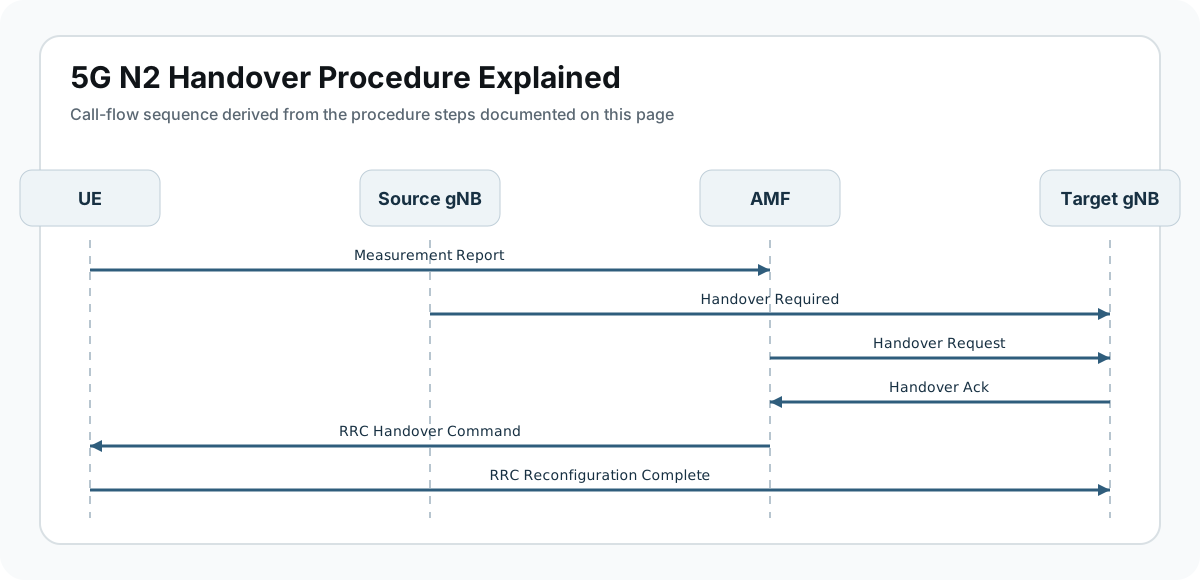
UE            source NTN         target NTN           AMF / SMF / UPF
|                  |                  |                    |
|==== active service on source context ====================>|
|---- mobility trigger ------------------------------------>|
|                  |---- prepare ------>|                    |
|                  |<--- execute ------>|                    |
|==== service should continue on target NTN context ======>|
Major Phases
| Phase | What happens |
|---|---|
| 1. NTN mobility trigger | Coverage movement, beam change, orbital geometry, or service-area change pushes the UE toward a new access context. |
| 2. Mobility preparation | The network prepares the target context and continuity expectations. |
| 3. Mobility execution | The UE transitions toward the new NTN serving context. |
| 4. Path and service validation | The network checks that session continuity still works after the move. |
| 5. Stable post-mobility NTN service | The UE continues service or uses follow-up recovery procedures where needed. |
Step-by-Step Breakdown
The UE reaches an NTN mobility boundary
Sender -> receiver: UE with source NTN access context
Message(s): Mobility trigger based on coverage or service movement
Purpose: Identify that the current NTN context is no longer ideal for continued service.
State or context change: The UE moves from stable NTN service toward a mobility transition window.
Note: In NTN, timing and geometry-related movement can matter as much as conventional cell change.
The target access context is prepared
Sender -> receiver: Source / target NTN context <-> AMF
Message(s): Mobility preparation signaling
Purpose: Create the next serving context before the UE commits to the change.
State or context change: The network has a candidate target context ready for service continuation.
Note: A weak target preparation stage often explains why later continuity fails even if the move itself seems clean.
The UE executes the mobility transition
Sender -> receiver: Source NTN context -> target NTN context
Message(s): Mobility command, execution, and access reattachment behavior
Purpose: Move the UE to the new serving context while minimizing service disruption.
State or context change: The pre-mobility service path is replaced or reanchored toward the target context.
Note: Do not judge success only by execution signaling. Post-mobility service is the real checkpoint.
The network validates path continuity
Sender -> receiver: AMF <-> SMF <-> UPF and UE traffic
Message(s): Path updates, PFCP changes, or service recovery signaling
Purpose: Make sure the session path and access path still agree after the move.
State or context change: Service becomes either healthy again or clearly degraded after mobility.
Note: This is where many NTN mobility failures hide, especially when timing and path convergence are tight.
Later service is monitored under the new NTN context
Sender -> receiver: UE <-> target access <-> UPF
Message(s): Post-mobility packets and ongoing service observation
Purpose: Confirm that the move delivered not only signaling success but lasting service continuity.
State or context change: The NTN mobility event settles into normal service or escalates into a recovery procedure.
Note: A trace that ends at handover execution misses the most important part of the procedure.
Important Messages in This Flow
| Message | Protocol | Direction | Purpose in this procedure | What to inspect briefly |
|---|---|---|---|---|
| Mobility preparation signaling | Access / control | Source and target context <-> AMF | Builds the new NTN serving context before execution. | Anchor the transition timing here. |
| Mobility execution signaling | Access / control | Network -> UE | Moves the UE to the new NTN service context. | Useful for separating preparation failure from execution failure. |
| Path update or PFCP change | Control / PFCP | AMF/SMF/UPF | Aligns the session path with the new access-side reality. | Best proof that service continuity was addressed, not only access movement. |
| First post-mobility packets | User plane | UE <-> target access <-> UPF | Prove whether the new NTN context actually carries service. | This is the final success checkpoint. |
Important Parameters to Inspect
| Parameter | What it is | Where it appears | Why it matters | Common issues |
|---|---|---|---|---|
| Source and target NTN context | Serving access state before and after the move. | Mobility preparation and execution | Needed to prove what changed during the event. | Weak correlation makes the trace unreadable. |
| Mobility trigger reason | Why the NTN transition happened. | Preparation context | Explains whether the move was expected or reactive. | Missing trigger context leads to wrong assumptions. |
| Session continuity state | How the active session should survive the transition. | AMF / SMF / UPF updates | Core test of success after NTN mobility. | Service continuity is often the real failure domain. |
| Post-mobility timing | Delay between move and restored service. | Execution and first packets | Important in NTN where propagation and access timing are already unusual. | Long gaps may still be unacceptable even if service returns. |
| Residual old-path state | Any source-side context still carrying traffic after the move. | Post-mobility observation | Shows whether cleanup and reanchoring were complete. | Residual state can create ghost failures. |
Success Criteria
- The target NTN context is prepared with the right continuity assumptions.
- The UE completes the serving-context change cleanly.
- Session and path state converge after the move.
- Post-mobility packets confirm stable service in the target context.
Common Failures and Troubleshooting
| Symptom | Likely cause | Where to inspect | Relevant message(s) | Relevant interface(s) | Likely next step |
|---|---|---|---|---|---|
| Mobility control completes but service is lost | The access move happened, but session continuity or path validation failed afterward. | Path updates and first post-mobility packets. | Execution plus post-mobility validation | N4, user plane | This is the classic hidden mobility-continuity failure. |
| The UE oscillates between NTN contexts | Target stability or mobility policy is too weak for a clean transition. | Repeated preparation and execution cycles. | Mobility preparation / execution | Access path | Repeated movement is a real service-quality issue. |
| Old path remains active after the move | Cleanup of the source context is incomplete. | Residual source traffic and path state. | Post-mobility observation | User plane | This can cause duplicate or stale service behavior. |
| Mobility delay is technically successful but operationally poor | The procedure converged, but too slowly for the service profile carried over NTN. | Move timing, service interruption, and packet gap. | End-to-end timing | Access path, user plane | Success needs to be measured against service continuity, not only protocol completion. |
Related Pages
Related sub-procedures
- 5G NTN Registration
- 5G Session Recovery after Mobility / Path Switch
- 5G NTN Timing Advance / Access Timing Handling
- 5G User Plane Establishment
Related message reference pages
Related troubleshooting pages
FAQ
What is NTN Handover / Mobility Handling?
It is the set of procedures that preserve or restore service when an NTN-served UE changes serving context.
Is it just normal handover with a different radio?
No. The core mobility logic is familiar, but NTN timing, coverage geometry, and path convergence make the operational behavior different.
What proves success?
The new NTN context carries stable service after the move, not just a clean execution message.
What should I inspect first?
Start with the source and target context, the mobility trigger, and the first packets after the transition.
Why is this page separate from NTN registration?
Because registration proves access entry, while this page focuses on preserving continuity after the UE is already in service.