5G QoS Flow Modification Procedure Call Flow
5G QoS Flow Modification is the procedure used when an existing session must change how traffic is prioritized, filtered, or treated.
It joins policy-driven session modification, NAS rule delivery, and live bearer or user-plane behavior changes into one operational workflow.
Introduction
This procedure matters because most real 5G services do not stay static for their entire lifetime.
A session may need better priority, a different rule set, or changed handling after application behavior, policy decisions, or mobility events. The trace becomes meaningful only when you compare the intended rule change with the traffic that follows it.
What Is QoS Flow Modification in Simple Terms?
- What starts the procedure: The network decides an active session needs a QoS update.
- What the UE and network want to achieve: Change flow treatment without tearing down the whole session.
- What success looks like: The UE applies the new QoS rules and real traffic shows the intended new behavior.
- What failure means: The rule set is rejected, only partly applied, or not reflected in real packet handling.
Why this procedure matters
QoS modification is where control-plane policy and user-perceived performance meet directly. If you only inspect the NAS outcome, you can miss the real service problem entirely.
Quick Fact Sheet
| Procedure name | 5G QoS Flow Modification Procedure |
|---|---|
| Domain | 5G NR + 5GC session QoS update for an existing PDU session |
| Main trigger | Network or service conditions require changing QoS rules, reflective handling, or flow-to-bearer treatment on an active session |
| Start state | UE already has an established PDU session and at least one active QoS flow context |
| End state | QoS rules and flow treatment are updated on UE, gNB, and core-side session functions |
| Main nodes | UE, gNB, AMF, SMF, UPF, policy functions |
| Main protocols | NAS, NGAP, PFCP, QoS rule control |
| Main success outcome | UE applies the new QoS rule set and traffic follows the updated priority or handling model |
| Main failure outcome | QoS update is rejected, only partly applied, or accepted in signaling but not reflected in live traffic treatment |
| Most important messages | PDU Session Modification Command, PDU Session Modification Complete, PDU Session Modification Reject |
| Main specs | TS 23.501, TS 23.502, TS 24.501, TS 29.244 |
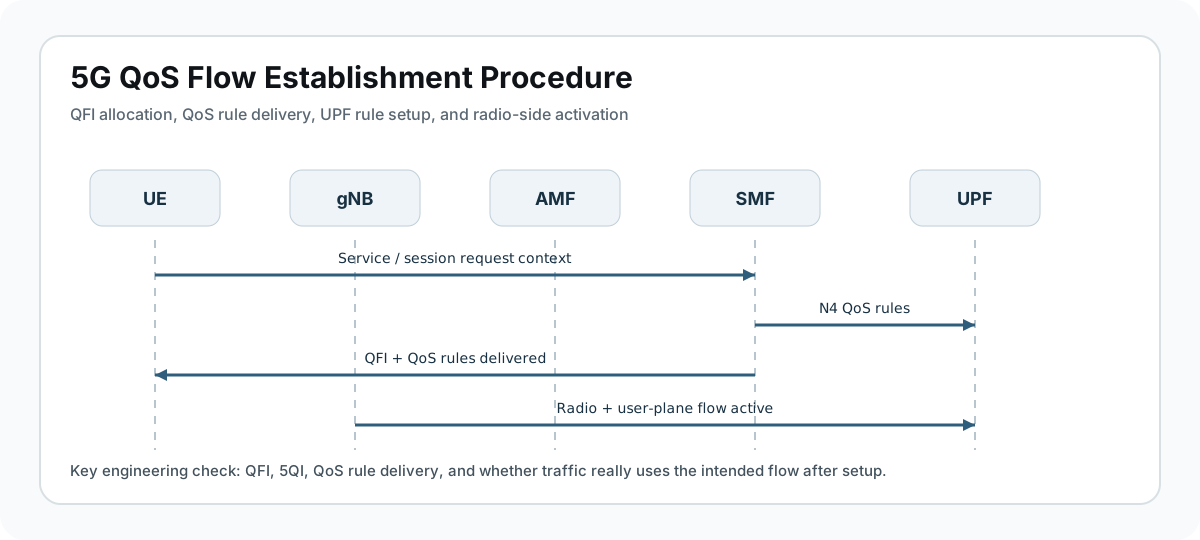
Preconditions
- A PDU session is already active.
- At least one QoS flow or QoS rule set exists on that session.
- The network has a valid reason to update QoS behavior.
- UE, gNB, and UPF can all converge to the new rule set after modification.
Nodes and Interfaces
Nodes involved
| Node | Role in this procedure |
|---|---|
| UE | Receives updated QoS rules for an existing PDU session, applies them locally, and confirms or rejects the change. |
| gNB | Translates the updated QoS treatment into radio-side bearer behavior and forwarding policy. |
| AMF | Relays NAS session-modification signaling between the UE and SMF. |
| SMF | Owns the QoS rule update, policy enforcement, and session-level modification logic. |
| UPF | Applies the updated forwarding and QoS enforcement behavior in the user plane. |
| Policy functions | Influence why the QoS update was triggered and what treatment is expected after modification. |
Interfaces used
| Interface | Path | Role |
|---|---|---|
| N1 | UE <-> AMF | Carries the NAS session modification exchange. |
| N2 | gNB <-> AMF | Carries access-side context updates associated with the changed session behavior. |
| N11 | AMF <-> SMF | Coordinates the SMF-driven session modification action. |
| N4 / N3 | SMF <-> UPF and gNB <-> UPF | Apply updated user-plane treatment once the new QoS rules are installed. |
| NR-Uu | UE <-> gNB | Carries the traffic that should reflect the changed QoS behavior after the update. |
End-to-End Call Flow
UE                gNB                AMF                SMF / UPF
|                  |                  |                    |
|                  |                  |-- QoS change prep ->|
|<-- Modification Command ------------|                    |
|-- Complete / Reject --------------->|                    |
|                  |                  |-- apply updates --->|
|==== traffic now follows modified QoS treatment =========>|
Major Phases
| Phase | What happens |
|---|---|
| 1. QoS change trigger | A service event, application need, policy decision, or network optimization requires QoS changes on an existing session. |
| 2. Session modification decision | The SMF computes the required QoS updates and prepares the new rules for the UE and user plane. |
| 3. NAS command delivery | The network sends PDU Session Modification Command to the UE. |
| 4. UE applies or rejects the update | The UE accepts the rule change and replies with PDU Session Modification Complete, or rejects it. |
| 5. Live traffic reflects the new QoS model | The modified rules become visible in bearer mapping, priority treatment, and real packet behavior. |
Step-by-Step Breakdown
Network decides that session QoS must change
Sender -> receiver: Policy or service logic -> SMF
Message(s): Internal policy trigger or service event
Purpose: Start the modification workflow for a session that already exists.
State or context change: The session moves from stable operation into a controlled QoS update path.
Note: Without the trigger context, later analysis can confuse expected QoS change with random session instability.
SMF prepares the new rule set
Sender -> receiver: SMF <-> policy and UPF
Message(s): QoS rule recalculation and session update preparation
Purpose: Build the exact change the UE and user plane must apply.
State or context change: The network has a target QoS state ready for installation.
Note: This is where priority, GBR behavior, and flow mapping logic should be understood before reading the UE response.
UE receives PDU Session Modification Command
Sender -> receiver: SMF -> AMF -> UE
Message(s): PDU Session Modification Command
Purpose: Tell the UE which QoS rules or flow behavior must change on the active session.
State or context change: The UE moves from old QoS rules toward a new session treatment model.
Note: Inspect which rules were added, removed, or changed before concluding that the QoS update is harmless or major.
UE confirms or rejects the update
Sender -> receiver: UE -> AMF -> SMF
Message(s): PDU Session Modification Complete or PDU Session Modification Reject
Purpose: Finalize the QoS update or signal that the new rule set could not be applied.
State or context change: The session either converges to the new QoS model or remains on the old one with failure noted.
Note: A Complete message is necessary but not sufficient. Live traffic still needs to reflect the intended treatment.
Traffic behavior changes under the new QoS rules
Sender -> receiver: UE <-> gNB <-> UPF
Message(s): Live packet flow under updated session treatment
Purpose: Validate that the configured QoS change became operational, not just signaled.
State or context change: The existing PDU session continues with new priority or resource handling.
Note: This last step is where many field issues hide because control-plane success can mask user-plane misapplication.
Important Messages in This Flow
| Message | Protocol | Direction | Purpose in this procedure | What to inspect briefly |
|---|---|---|---|---|
| PDU Session Modification Command | NAS | SMF -> UE via AMF | Carries the new QoS rules and session modifications. | Inspect rule additions, deletions, QoS parameters, and affected session ID. |
| PDU Session Modification Complete | NAS | UE -> SMF via AMF | Confirms that the UE applied the requested modification. | Check timing and whether later traffic actually matches the intended behavior. |
| PDU Session Modification Reject | NAS | UE -> SMF via AMF | Shows that the UE could not apply the requested modification. | Use the reject context to identify capability or rule-consistency problems. |
Important Parameters to Inspect
| Parameter | What it is | Where it appears | Why it matters | Common issues |
|---|---|---|---|---|
| PDU Session ID | Identifier of the session being modified. | Command, Complete, Reject | Prevents confusion when multiple sessions are active. | Wrong session correlation makes the wrong QoS flow look broken. |
| QoS rule set | The full or partial set of updated flow rules. | Modification Command | Defines what traffic classification and treatment should change. | Small rule changes can have large service impact if they affect the dominant flow. |
| 5QI / GBR / priority behavior | Key service characteristics linked to each QoS flow. | Rule payload and policy context | Explains how latency, priority, or bandwidth handling should change. | Unexpected values often explain post-update user complaints. |
| Mapped traffic filters | How packets are matched to the modified QoS behavior. | Session modification payload | Shows which application traffic is really affected by the update. | Filter mismatch can make traffic ignore the new QoS. |
| Reflective or policy-linked indicators | Control bits that influence how the UE should treat the modified flow set. | Modification Command | Useful when the update relies on more than a plain numeric QoS change. | Overlooking them can make the modification seem inconsistent. |
Success Criteria
- The network sends a coherent modification command for the intended session.
- The UE applies the update and confirms with PDU Session Modification Complete.
- gNB and UPF enforcement align with the new rule set.
- Real traffic behavior matches the intended QoS change.
Common Failures and Troubleshooting
| Symptom | Likely cause | Where to inspect | Relevant message(s) | Relevant interface(s) | Likely next step |
|---|---|---|---|---|---|
| Command is accepted but traffic behavior does not change | The QoS update was signaled but not applied consistently in gNB or UPF treatment. | Live packet traces, DRB mapping, and UPF enforcement state. | Modification Command, Complete | NR-Uu, N3, N4 | This is the classic control-plane success but data-plane failure case. |
| UE rejects the modification | The new rule set is unsupported, inconsistent, or malformed for the UE context. | Reject context and rule payload. | Modification Command, Reject | N1 | Focus on rule validity and UE capability alignment. |
| Only some applications improve or degrade | The updated filters affected only part of the traffic mix. | Traffic filters and actual application packet match. | Modification Command | N1, N3 | You may have a classification problem rather than a generic QoS problem. |
| Session instability starts after QoS change | The modified session profile does not match service expectations or resource availability. | QoS values, policy trigger, and radio-side resource behavior. | Modification Command, Complete | NR-Uu, policy | Correlate the service complaint timing directly with the modification event. |
Related Pages
Related sub-procedures
Related message reference pages
Related troubleshooting pages
FAQ
What is 5G QoS Flow Modification?
It is the procedure used to change QoS treatment on an already established PDU session.
How is it different from QoS Flow Establishment?
Establishment creates a new flow or rule context, while modification changes the behavior of one that already exists.
What confirms success?
A good PDU Session Modification Complete followed by live traffic matching the intended new QoS treatment.
Why can users still complain after a successful Complete?
Because the update may have been accepted in signaling but not enforced correctly in the radio or user-plane path.
What should I inspect first?
Start with the exact QoS rule delta, then verify PDU session ID, traffic filters, and real packet treatment after the change.