5G QoS Flow Release Call Flow
5G QoS Flow Release removes a dedicated QoS treatment from an active PDU session when that service-specific behavior is no longer needed.
The important distinction is that the session may survive even though one of its dedicated flows is withdrawn.
Introduction
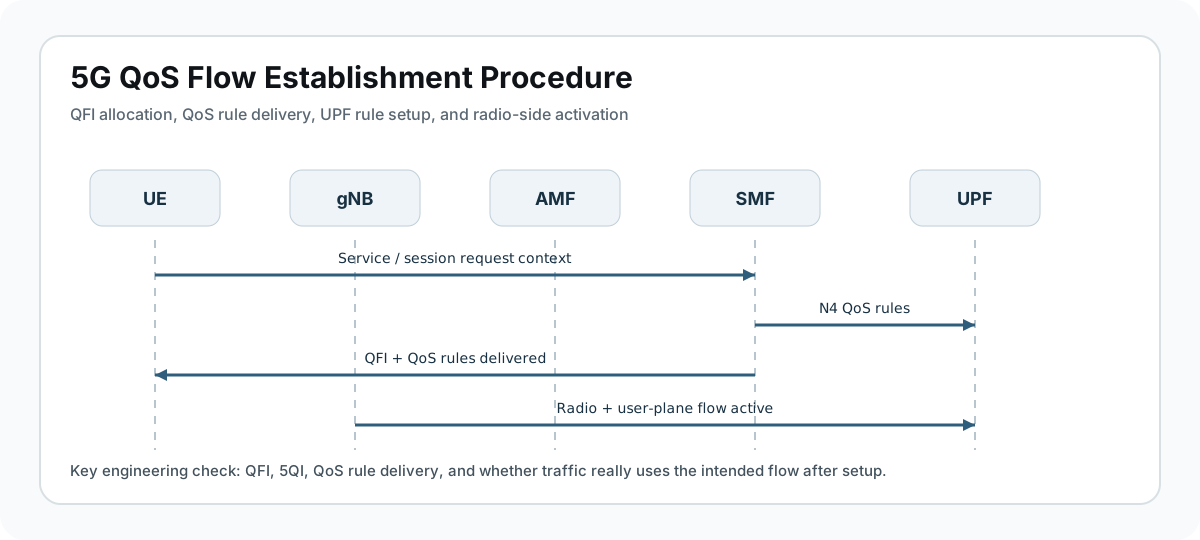
This procedure is best understood as the cleanup counterpart to QoS Flow Establishment and QoS Flow Modification.
In practical traces, the engineer needs to prove three things: which QFI was removed, whether fallback traffic behavior is correct, and whether the gNB plus UPF truly deleted the old state.
What Is QoS Flow Release in Simple Terms?
- What starts the procedure: The network decides a dedicated QoS flow should be removed.
- What the UE and network want to achieve: Withdraw one flow cleanly while preserving the intended remaining session behavior.
- What success looks like: The released QFI disappears and packets follow the updated policy correctly.
- What failure means: Old flow state survives or post-release traffic behaves incorrectly.
Why this procedure matters
QoS flow cleanup is easy to underestimate. Many service issues after policy changes come from half-removed dedicated flows that still influence packet treatment somewhere in the path.
Quick Fact Sheet
| Procedure name | 5G QoS Flow Release |
|---|---|
| Domain | 5G NR + 5GC QoS cleanup within an active PDU session |
| Main trigger | A dedicated QoS flow is no longer needed or is withdrawn by network policy |
| Start state | A PDU session has one or more active QoS flows beyond the default behavior |
| End state | The targeted QoS flow is removed while the parent PDU session may remain active |
| Main nodes | UE, gNB, AMF, SMF, UPF, PCF |
| Main protocols | NAS, NGAP, PFCP, policy control |
| Main success outcome | The flow disappears cleanly and packets stop using the released QFI |
| Main failure outcome | The flow appears removed in signaling but residual classification or enforcement state survives |
| Most important messages | PDU Session Modification Command/Complete, PFCP update, resource update |
| Main specs | TS 23.501, TS 23.502, TS 24.501, TS 29.244 |
Preconditions
- A PDU session with an active dedicated QoS flow already exists.
- The network has identified the exact QFI or rule set to remove.
- The UE can accept an updated QoS rule set.
- The gNB and UPF can delete flow-specific state without destabilizing the remaining session.
Nodes and Interfaces
Nodes involved
| Node | Role in this procedure |
|---|---|
| UE | Removes the released QoS flow from its local rule set and stops mapping traffic to that QFI. |
| gNB | Updates radio-side treatment so the released flow no longer consumes dedicated handling. |
| AMF | Relays the session modification that removes the QoS flow. |
| SMF | Owns the decision to withdraw the QoS flow and coordinates cleanup. |
| UPF | Deletes the forwarding and enforcement state tied to the released flow. |
| PCF | May trigger withdrawal when policy conditions or service needs change. |
Interfaces used
| Interface | Path | Role |
|---|---|---|
| N1 | UE <-> AMF | Carries the session modification that removes the flow. |
| N2 | gNB <-> AMF | Aligns the access-side context with the reduced QoS model. |
| N11 | AMF <-> SMF | Coordinates the removal decision. |
| N4 | SMF <-> UPF | Deletes flow-specific enforcement state. |
| NR-Uu / N3 | UE <-> gNB and gNB <-> UPF | Show whether traffic really stopped using the released flow. |
End-to-End Call Flow
UE                gNB                AMF                SMF / PCF           UPF
|                  |                  |                    |                  |
|                  |                  |<-- flow withdrawal decision ----------|
|<-- Modification Command ------------|------------------->|-- delete rules -->|
|-- Modification Complete ----------->|                    |<-- PFCP ack ------|
|==== packets should stop using released QFI and follow new rules ==========>|
Major Phases
| Phase | What happens |
|---|---|
| 1. Flow withdrawal trigger | Policy or service logic decides the dedicated QoS flow should be removed. |
| 2. Session modification signaling | The UE is told the flow or its rules are being withdrawn. |
| 3. User-plane cleanup | UPF and gNB remove flow-specific treatment. |
| 4. UE confirmation | The UE confirms the update and stops using the flow. |
| 5. Post-release validation | Traffic proves the released flow is gone and the remaining session is stable. |
Step-by-Step Breakdown
The network decides the QoS flow is no longer needed
Sender -> receiver: Service logic / PCF -> SMF
Message(s): Internal policy trigger or service-end condition
Purpose: Select the exact flow that should be removed while leaving the PDU session intact if appropriate.
State or context change: The session enters a targeted QoS cleanup path rather than full session release.
Note: It is important to separate dedicated-flow removal from full PDU session teardown.
SMF prepares the updated rule set
Sender -> receiver: SMF <-> UPF / AMF context
Message(s): QoS rule withdrawal and session modification preparation
Purpose: Define how the UE, gNB, and UPF should behave once the flow disappears.
State or context change: The network now has an updated session model without the released flow.
Note: This is the moment to verify which QFI is being removed and what traffic should fall back to afterward.
UE receives the release through session modification
Sender -> receiver: SMF -> AMF -> UE
Message(s): PDU Session Modification Command
Purpose: Deliver the new rule set with the targeted flow removed.
State or context change: The UE starts moving from the old flow layout to the reduced one.
Note: The command should make it clear whether the traffic now maps to a default flow or simply stops flowing.
UPF and gNB clean up the dedicated treatment
Sender -> receiver: SMF <-> UPF and AMF <-> gNB
Message(s): PFCP update and access-side resource adjustment
Purpose: Remove residual user-plane and radio-side state tied to the released flow.
State or context change: The dedicated QoS behavior should now disappear end to end.
Note: Residual enforcement is the most common reason these procedures look successful but behave badly later.
Traffic is validated after the release
Sender -> receiver: UE <-> gNB <-> UPF
Message(s): PDU Session Modification Complete and post-update packets
Purpose: Confirm that the released flow is gone and the remaining session behavior is correct.
State or context change: The session stabilizes with a reduced QoS configuration.
Note: Look for packets that still use the old QFI or appear with the wrong fallback treatment.
Important Messages in This Flow
| Message | Protocol | Direction | Purpose in this procedure | What to inspect briefly |
|---|---|---|---|---|
| PDU Session Modification Command | NAS | SMF -> UE via AMF | Carries the removal of the dedicated QoS flow. | Inspect which QFI or QoS rule was deleted. |
| PDU Session Modification Complete | NAS | UE -> SMF via AMF | Confirms the UE applied the updated rule set. | Check whether the UE acknowledged the intended flow removal. |
| PFCP session update | PFCP | SMF <-> UPF | Removes forwarding or enforcement state tied to the flow. | Best proof of data-plane cleanup. |
| PDU Session Resource Modify Request | NGAP | AMF -> gNB | Adjusts access-side resources after flow removal. | Shows whether the RAN was told to reduce dedicated handling. |
Important Parameters to Inspect
| Parameter | What it is | Where it appears | Why it matters | Common issues |
|---|---|---|---|---|
| Released QFI | Identifier of the QoS flow being removed. | Modification command and traces | Main anchor for correlating cleanup. | Wrong QFI interpretation breaks the whole analysis. |
| Updated QoS rules | Rule set after removal. | Modification command | Shows where traffic should go after the release. | Missing fallback understanding causes false alarms. |
| PDU Session ID | Parent session that remains active. | All related messages | Distinguishes flow release from full session release. | Easy to confuse when many sessions are active. |
| PFCP cleanup state | UPF-side removal of flow-specific logic. | N4 trace | Confirms the flow really disappeared in the user plane. | Residual state creates phantom QoS behavior. |
| Post-release traffic mapping | Where the application packets go after cleanup. | Live traffic traces | Validates the operational outcome of the release. | Traffic may fall back incorrectly or stop entirely. |
Success Criteria
- The correct QoS flow is selected for removal.
- The UE applies the reduced rule set successfully.
- gNB and UPF delete the dedicated treatment tied to the flow.
- Live traffic no longer uses the released QFI and shows the intended fallback behavior.
Common Failures and Troubleshooting
| Symptom | Likely cause | Where to inspect | Relevant message(s) | Relevant interface(s) | Likely next step |
|---|---|---|---|---|---|
| The released flow still appears in packet traces | The UE, gNB, or UPF kept stale state after the control-plane update. | Released QFI and PFCP cleanup. | Modification Command / Complete | N1, N4, N3 | Residual QFI use is the clearest sign of incomplete release. |
| Traffic falls back to the wrong QoS treatment | Rule recalculation after release does not match the intended service behavior. | Updated rule set and packet classification. | Modification Command | N1, packet trace | This is often a design or filter problem rather than a signaling failure. |
| The whole PDU session becomes unstable after flow release | The removed dedicated flow was carrying more critical traffic than expected, or cleanup touched the wrong context. | PDU Session ID, filters, and live service behavior. | Modification flow | N1, N3 | Verify the parent session was not damaged accidentally. |
| UE confirms release but gNB or UPF still enforces old behavior | The NAS path succeeded but access or user-plane cleanup lagged behind. | NGAP and PFCP updates after Complete. | Modification Complete | N2, N4 | Treat this as incomplete convergence, not success. |
Related Pages
Related sub-procedures
- 5G QoS Flow Establishment
- 5G QoS Flow Modification
- 5G PDU Session Modification
- 5G PCC Policy Enforcement
Related message reference pages
- PDU Session Modification Command
- PDU Session Modification Complete
- PDU Session Resource Modify Request
Related troubleshooting pages
FAQ
What is QoS Flow Release?
It is the targeted removal of a dedicated QoS flow while the parent PDU session may continue running.
How is it different from PDU Session Release?
QoS Flow Release removes one service treatment inside the session, while PDU Session Release tears down the entire session.
What proves success?
The released QFI disappears from rules and live traffic, and the remaining session behaves as expected.
What should I inspect first?
Start with the released QFI, updated QoS rules, and PFCP cleanup state.
Why is fallback behavior important?
Because traffic often moves to another flow after release, and that new behavior must still be correct.