5G Session Recovery after Mobility / Path Switch Call Flow
5G Session Recovery after Mobility / Path Switch focuses on what happens to an active data session after a mobility event changes the serving access path.
The key engineering job is to prove that traffic moved to the new path correctly and that stale state did not survive on the old one.
Introduction
This page is for the post-handover part of the story: the session may have existed before the move, but it still needs recovery or validation afterward.
In practical troubleshooting, the strongest checkpoints are the affected PDU Session ID, the old and new path state, PFCP updates, and the first real packets after mobility.
What Is Session Recovery after Mobility / Path Switch in Simple Terms?
- What starts the procedure: A mobility event changes the serving path of an active session.
- What the UE and network want to achieve: Restore or validate the session on the new path without losing service.
- What success looks like: Traffic continues on the target path and the source path is cleaned up.
- What failure means: The path switch is stale, broken, partial, or applied to the wrong session.
Why this procedure matters
Many mobility incidents are really session-recovery incidents. A successful handover headline can hide a completely broken post-move data path.
Quick Fact Sheet
| Procedure name | 5G Session Recovery after Mobility / Path Switch |
|---|---|
| Domain | 5G NR + 5GC post-mobility session recovery and path repair |
| Main trigger | Mobility or path switch leaves an active session needing validation or repair |
| Start state | UE had an active session before mobility, but post-handover continuity is uncertain or degraded |
| End state | The session is validated or repaired and the post-mobility path carries traffic correctly |
| Main nodes | UE, source and target gNB, AMF, SMF, UPF |
| Main protocols | Mobility signaling, NGAP, NAS as needed, PFCP, user-plane validation |
| Main success outcome | The session survives the mobility event and traffic continues over the correct new path |
| Main failure outcome | The handover succeeds, but the session path is stale, broken, or inconsistently updated |
| Most important messages | Handover-related signaling, path-switch updates, PFCP changes, Service Request or session updates when needed |
| Main specs | TS 23.502, TS 23.501, TS 38.300 |
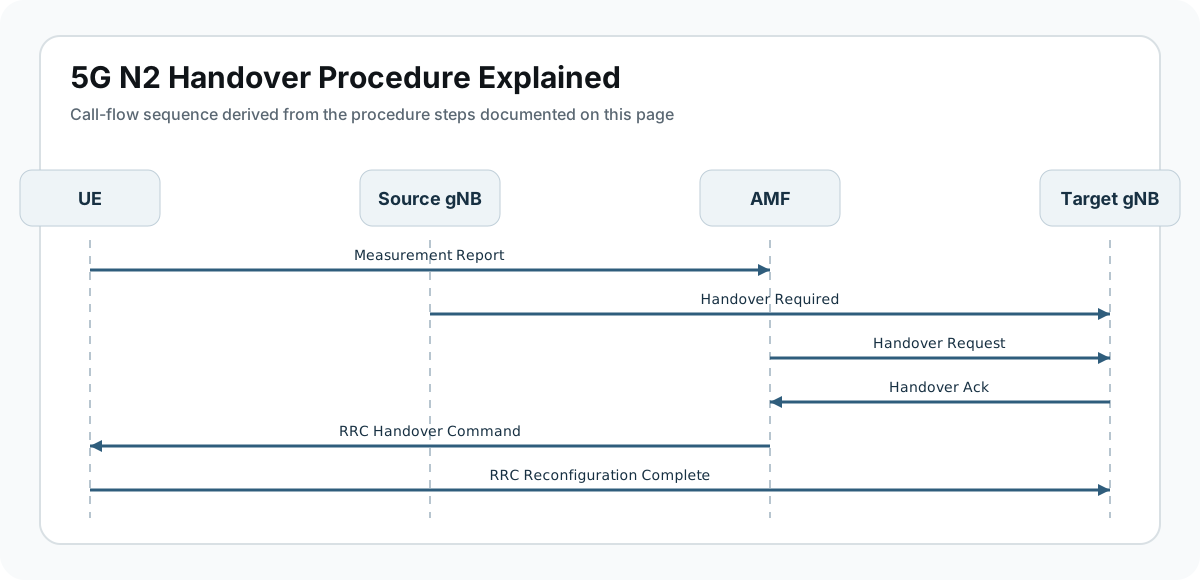
Preconditions
- A valid active PDU session existed before mobility.
- A mobility event or handover changed the serving access path.
- The network can update the session path toward the new serving node.
- Traffic checks are available to validate the recovered path.
Nodes and Interfaces
Nodes involved
| Node | Role in this procedure |
|---|---|
| UE | Keeps service active while the network repairs or validates the moved session path. |
| Source gNB | Participates in the mobility transition and hands context away. |
| Target gNB | Becomes the serving access node and depends on correct path-switch completion. |
| AMF | Coordinates mobility control and any related session recovery signaling. |
| SMF | Repairs or confirms the post-mobility session path. |
| UPF | Must forward traffic toward the correct new access-side anchor after mobility. |
Interfaces used
| Interface | Path | Role |
|---|---|---|
| NR-Uu | UE <-> target gNB | Carries the recovered service after mobility. |
| N2 | gNB <-> AMF | Carries mobility and path-switch coordination. |
| N11 | AMF <-> SMF | Connects mobility outcome to session recovery logic. |
| N4 / N3 | SMF <-> UPF and target gNB <-> UPF | Re-anchor or validate the user-plane path after mobility. |
| N1 | UE <-> AMF | May be used if additional recovery signaling is needed from the UE side. |
End-to-End Call Flow
UE          source gNB        target gNB           AMF / SMF / UPF
|                |                  |                    |
|==== active traffic on source path ====================>|
|---- mobility / handover ------------------------------>|
|                |----------------->|                    |
|                |                  |<-- path switch ----|
|==== traffic should continue on target path ==========>|
Major Phases
| Phase | What happens |
|---|---|
| 1. Mobility event completes | The UE moves, but continuity of the session still needs validation. |
| 2. Path-switch or recovery decision | The network determines whether the session path is healthy after the move. |
| 3. Session path repair | SMF and UPF update the forwarding state toward the new serving access path. |
| 4. UE/service validation | Traffic checks whether the recovered path is operational. |
| 5. Stable post-mobility service | The session continues correctly after the transition. |
Step-by-Step Breakdown
A mobility event changes the serving access path
Sender -> receiver: Source gNB -> target gNB with AMF coordination
Message(s): Handover and path-switch-related signaling
Purpose: Move the UE while preserving or later restoring the active session.
State or context change: The session enters a post-mobility validation phase.
Note: A successful handover does not automatically prove a healthy data session afterward.
The network checks whether the old path is still valid
Sender -> receiver: AMF <-> SMF <-> UPF
Message(s): Post-mobility session evaluation
Purpose: Identify whether the pre-mobility user-plane path must be changed or repaired.
State or context change: The core decides if the session is healthy, stale, or partially updated.
Note: This is the step that separates clean continuity from hidden stale-path failures.
The path switch or recovery update is applied
Sender -> receiver: SMF <-> UPF and target gNB
Message(s): PFCP update and path-switch-related transport update
Purpose: Point the session toward the correct post-mobility access anchor.
State or context change: The moved session becomes aligned to the new access side.
Note: Look for old and new path identifiers side by side whenever possible.
The UE or network validates recovered traffic
Sender -> receiver: UE <-> target gNB <-> UPF
Message(s): First packets after mobility and any related recovery signaling
Purpose: Prove the session is usable on the new path.
State or context change: The session becomes either healthy again or clearly broken.
Note: Post-handover packets are often more revealing than the control-plane success message.
Residual stale state is checked
Sender -> receiver: Source and target path monitoring
Message(s): Old-path and new-path observation
Purpose: Confirm that the source path is cleaned up and the target path owns the service.
State or context change: The network reaches a stable post-mobility state.
Note: Residual source-path traffic is a strong sign of incomplete session recovery.
Important Messages in This Flow
| Message | Protocol | Direction | Purpose in this procedure | What to inspect briefly |
|---|---|---|---|---|
| Handover-related signaling | NGAP / RAN | Source gNB, target gNB, AMF | Explains why the session path needed recovery or validation. | Use it to anchor the timing of the event. |
| Path-switch update | Control / transport | AMF, SMF, target gNB | Moves the session toward the new access side. | Critical for understanding the transition. |
| PFCP session update | PFCP | SMF <-> UPF | Repairs the user-plane anchor after mobility. | Best view of whether the data path was actually updated. |
| First post-mobility packets | User plane | UE <-> target path | Validate service continuity after the move. | This is the real success measure. |
Important Parameters to Inspect
| Parameter | What it is | Where it appears | Why it matters | Common issues |
|---|---|---|---|---|
| Affected PDU Session ID | Session being recovered after mobility. | All related traces | Keeps the analysis tied to the correct session. | Wrong session correlation is common in mobility cases. |
| Source and target path identifiers | Old and new access anchors for the session. | Mobility and PFCP updates | Reveal whether the path really moved. | Without them, stale-path issues are hard to prove. |
| Recovery timing | Delay between mobility event and restored traffic. | Post-handover observation | Important for judging service continuity quality. | Long gaps are operationally significant. |
| QoS after mobility | Service treatment after the path switch. | Post-recovery state | Shows whether continuity is not only alive but correct. | Changed QoS can masquerade as path failure. |
| Residual source-path traffic | Any traffic still using the old path. | After recovery | Strong indicator of incomplete cleanup. | Should not be ignored. |
Success Criteria
- The correct active session is recovered after mobility.
- The user-plane path is updated toward the target serving access side.
- Traffic continues over the target path with acceptable quality.
- Residual source-path state is removed cleanly.
Common Failures and Troubleshooting
| Symptom | Likely cause | Where to inspect | Relevant message(s) | Relevant interface(s) | Likely next step |
|---|---|---|---|---|---|
| Handover succeeds but data stops | The mobility control plane completed, but session recovery failed. | Post-handover PFCP state and first packets. | Path-switch updates | N3, N4, N2 | This is the classic post-handover session failure. |
| Traffic partially works with high loss or delay | Recovery is incomplete or QoS changed unexpectedly during the move. | Timing, QoS, and transport state after mobility. | Post-recovery traffic | NR-Uu, N3 | Treat degraded continuity as a real failure case. |
| Source path remains active | Old forwarding state was not cleaned up fully. | Residual source-path traffic and PFCP cleanup. | Post-recovery observation | N4, source path | This can create duplicated or misrouted traffic. |
| The wrong session is repaired | Recovery actions were applied to a different active session. | PDU Session ID correlation across mobility and PFCP traces. | All related signaling | N11, N4 | Always verify this early in multi-session traces. |
What to Check in Logs and Traces
- Anchor everything on the affected PDU Session ID.
- Record the mobility event timing before reading post-event traffic behavior.
- Inspect PFCP updates to see whether the user-plane anchor really moved.
- Compare source-path vs target-path traffic after the event.
- Treat degraded continuity, not only total outage, as a real recovery problem.
Related Pages
Related sub-procedures
- 5G N2 Handover
- 5G Xn Handover
- 5G SSC Mode Change / Session Continuity Handling
- 5G Session Reactivation after Idle/Inactive Return
Related message reference pages
Related troubleshooting pages
Notes
Post-handover traffic is the truth source. If the session does not behave correctly on the target path, the recovery is not complete no matter how clean the control plane looks.
FAQ
What is Session Recovery after Mobility / Path Switch?
It is the set of actions that validate or repair a PDU session after the UE moves and the serving path changes.
Is this just handover?
No. Handover moves the UE, but session recovery proves the data path still works afterward.
What proves success?
Traffic moves to the new path, the old path is cleaned up, and service continues correctly.
What should I inspect first?
Start with the affected session ID, the path-switch timing, and the first packets after mobility.
Why can the session fail after a successful handover?
Because control-plane mobility completion does not guarantee user-plane path recovery.