EPS Fallback Procedure Call Flow
EPS Fallback is the voice continuity procedure that moves a UE from 5G SA to LTE/EPS when voice service cannot remain on native NR.
The real target is not only a successful inter-RAT move, but a usable voice session on LTE through VoLTE / IMS.
Introduction
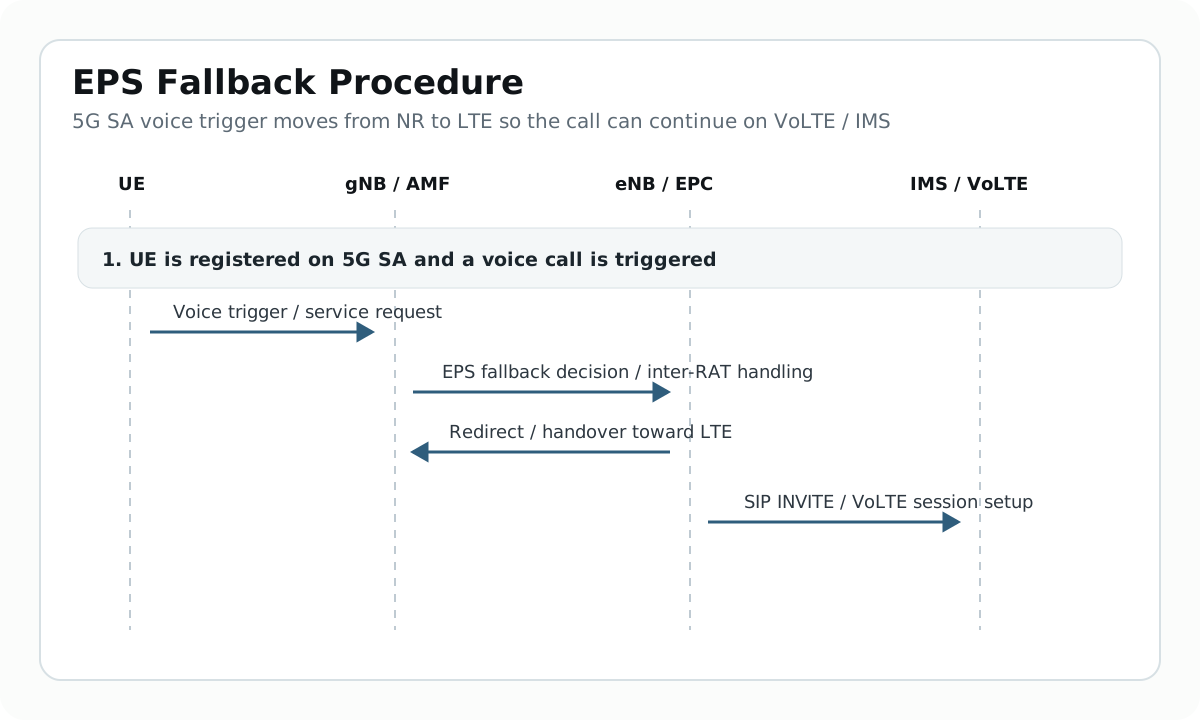
This page explains EPS fallback as a complete end-to-end branch: voice trigger on NR, fallback decision, move to LTE, LTE/EPS readiness, and final SIP call continuity.
In troubleshooting, always separate why fallback started, whether the UE reached LTE, and whether voice actually continued after LTE landing.
What Is EPS Fallback Procedure in Simple Terms?
- What starts the procedure: A voice event appears on 5G SA and native NR voice is not the right path.
- What the UE and network want to achieve: Move the UE to LTE quickly enough for stable VoLTE / IMS voice continuity.
- What success looks like: The UE reaches LTE and the voice call continues successfully.
- What failure means: Fallback starts late, mobility fails, or LTE / IMS voice continuity does not come up.
Why this procedure matters
EPS fallback issues are highly visible to users because they affect live call setup and voice continuity. The wrong diagnosis can easily send engineers to the wrong layer.
Quick Fact Sheet
| Procedure name | EPS Fallback Procedure |
|---|---|
| Domain | 5G SA voice continuity fallback from NR to LTE/EPS |
| Main trigger | Voice service cannot stay on native NR and must continue through LTE/VoLTE |
| Start state | UE is active on 5G SA and a voice event requires LTE/EPS fallback handling |
| End state | UE reaches LTE and the voice service continues through VoLTE / IMS on EPS |
| Main nodes | UE, gNB, AMF, eNB, MME/EPC, IMS core |
| Main protocols | NR mobility signaling, inter-RAT fallback handling, LTE access, IMS / SIP continuity |
| Main success outcome | The UE leaves NR, reaches LTE, and the voice call continues through VoLTE successfully |
| Main failure outcome | Fallback is late, mobility fails, or LTE / IMS voice continuity is not established |
| Most important messages | Voice trigger, fallback decision, NR release or inter-RAT move, LTE access, IMS SIP call setup |
| Main specs | TS 23.502, TS 23.501, TS 38.300, TS 38.331, TS 23.401, TS 24.229 |
Preconditions
- The UE is already on 5G SA with a voice-related event in progress or about to begin.
- The network has a valid reason to prefer LTE/EPS for voice continuity.
- An LTE target and EPS voice environment are available.
- IMS / VoLTE service can be used after the UE reaches LTE.
Nodes and Interfaces
Nodes involved
| Node | Role in this procedure |
|---|---|
| UE | Starts or receives the voice event and executes the move from NR toward LTE/EPS. |
| gNB | Serves the UE on NR before fallback and participates in the release or inter-RAT move. |
| AMF | Controls the 5G-side mobility and fallback decision path. |
| eNB | Becomes the serving radio node after fallback to LTE. |
| MME / EPC | Provide the EPS mobility and bearer environment needed once the UE lands on LTE. |
| IMS core | Carries the VoLTE SIP call setup or continuation after fallback completes. |
Interfaces used
| Interface | Path | Role |
|---|---|---|
| NR-Uu | UE <-> gNB | Carries the voice-trigger context and the last NR-side mobility branch. |
| LTE-Uu | UE <-> eNB | Carries the LTE-side access and later VoLTE radio service. |
| N2 | gNB <-> AMF | Supports fallback decision and NR-side coordination. |
| Inter-RAT mobility interfaces | 5G side <-> LTE/EPS side | Coordinate the move toward LTE and bearer continuity. |
| IMS / SIP signaling path | UE <-> IMS core over LTE | Carries the actual voice session once fallback succeeds. |
End-to-End Call Flow
UE                gNB / AMF              eNB / EPC              IMS
|                     |                        |                    |
|-- voice trigger --->|                        |                    |
|                     |-- fallback decision -->|                    |
|<==== NR to LTE move / redirection / HO =========================>|
|                     |                        |-- voice ready ---->|
|================ VoLTE / IMS call continuity on LTE ============>|
Major Phases
| Phase | What happens |
|---|---|
| 1. Voice trigger on NR | A mobile-originated, mobile-terminated, or emergency voice event appears while the UE is on 5G SA. |
| 2. Fallback decision | The network decides that voice should continue through LTE/EPS instead of native NR voice. |
| 3. Move to LTE | The UE is redirected or handed over from NR toward LTE. |
| 4. LTE voice readiness | The UE becomes active on LTE and the EPS / IMS environment is ready for voice service. |
| 5. VoLTE / IMS call continuity | The voice call proceeds through LTE and IMS after fallback. |
Step-by-Step Breakdown
A voice event starts while the UE is on 5G SA
Sender -> receiver: UE <-> AMF / IMS context
Message(s): Voice trigger, paging, or service-originating event
Purpose: Start the voice branch that will either stay on NR or fall back to LTE.
State or context change: The network must decide whether native NR voice is usable for this case.
Note: Always classify whether the case is MO, MT, or emergency voice before reading the fallback branch.
The network decides EPS fallback is required
Sender -> receiver: AMF / gNB policy and capability logic
Message(s): Fallback decision and mobility preparation
Purpose: Choose LTE/EPS as the voice-serving environment.
State or context change: The voice branch becomes a specific inter-RAT mobility case with voice continuity intent.
Note: Fallback can be driven by VoNR support, policy, roaming, coverage, or service constraints.
The UE leaves NR and moves to LTE
Sender -> receiver: gNB -> UE -> eNB
Message(s): NR release, redirection, or inter-RAT handover toward LTE
Purpose: Move the UE to the RAT that will actually carry the voice service.
State or context change: The UE transitions from NR service toward LTE/EPS reachability.
Note: Many EPS fallback failures are actually mobility failures before SIP even starts.
LTE and EPS voice context become ready
Sender -> receiver: UE <-> eNB <-> EPC
Message(s): LTE access and EPS service continuity
Purpose: Provide the bearer and access environment needed for VoLTE / IMS.
State or context change: The UE is now positioned to continue the voice call over LTE.
Note: Do not treat LTE landing as equivalent to voice success. IMS still must work afterward.
VoLTE / IMS signaling confirms voice continuity
Sender -> receiver: UE <-> IMS core over LTE
Message(s): SIP INVITE and related IMS call-control messages
Purpose: Prove the fallback achieved its real goal: usable voice service.
State or context change: The EPS fallback branch ends in voice continuity on LTE.
Note: The final proof is SIP and voice continuity, not just the radio move to LTE.
Important Messages in This Flow
| Message | Protocol | Direction | Purpose in this procedure | What to inspect briefly |
|---|---|---|---|---|
| Voice trigger context | Service / NAS | UE or network | Explains why the fallback branch started. | Classify whether the case was MO, MT, or emergency voice. |
| Inter-RAT move toward LTE | RRC / mobility | NR side -> UE -> LTE side | Actually moves the UE off NR and onto LTE. | This is where many fallback failures begin. |
| LTE access and EPS readiness | LTE / EPC control | UE <-> LTE/EPS | Provide the bearer environment needed for voice over LTE. | Needed before IMS can really help. |
| IMS SIP call setup | SIP | UE <-> IMS core | Proves the fallback achieved actual voice continuity. | Final voice-success checkpoint. |
Important Parameters to Inspect
| Parameter | What it is | Where it appears | Why it matters | Common issues |
|---|---|---|---|---|
| Voice trigger type | Why voice service started on NR. | Before fallback decision | Explains the specific service branch the network is handling. | Important for correct troubleshooting context. |
| VoNR support and policy state | Why fallback was allowed or required. | Fallback decision stage | Separates capability-driven fallback from policy-driven fallback. | This is often the first root-cause checkpoint. |
| NR-to-LTE mobility outcome | Whether the UE really reached LTE cleanly. | Inter-RAT move stage | Primary split between mobility failure and later voice failure. | Do not skip this distinction. |
| LTE voice readiness | Whether the LTE / EPS environment is prepared for VoLTE. | Post-move stage | Needed before SIP call continuity can succeed. | Many failures hide here. |
| SIP call outcome | Actual result of the voice service after fallback. | Final validation stage | Best proof that EPS fallback delivered the expected service. | This is the user-visible truth source. |
Success Criteria
- The fallback decision is taken for the right capability, policy, or coverage reason.
- The UE moves from NR to LTE cleanly enough for voice continuity.
- LTE / EPS voice context is ready after landing.
- IMS SIP signaling confirms actual voice continuity on LTE.
Common Failures and Troubleshooting
| Symptom | Likely cause | Where to inspect | Relevant message(s) | Relevant interface(s) | Likely next step |
|---|---|---|---|---|---|
| Fallback is triggered too late | The network waits too long before moving the UE to LTE for voice. | Trigger timing and early call-control timing. | Decision stage | Cross-layer timing | Usually shows up as long setup delay or call failure. |
| NR-to-LTE move fails | The UE cannot complete the inter-RAT mobility needed for fallback. | Fallback move and LTE access behavior. | Inter-RAT move stage | Radio / mobility | If this fails, IMS often never gets a fair chance. |
| LTE landing succeeds but voice still fails | The UE reached LTE, but VoLTE / IMS continuity is not ready or aligned. | LTE/EPS readiness and SIP outcome. | Post-move and SIP stage | LTE / IMS | This is a voice continuity failure after mobility success. |
| Capability or policy logic is wrong | The network chose a voice path that does not match the device or service policy. | Capability, subscription, and policy handling. | Decision stage | 5G core / subscriber logic | Often misread as radio trouble later. |
What to Check in Logs and Traces
- Classify the voice trigger type before reading the fallback trace.
- Inspect VoNR support and policy to understand why fallback was chosen.
- Separate NR-to-LTE mobility success from later voice success.
- Check LTE / EPS readiness before blaming IMS alone.
- Use SIP outcome as the final proof of successful fallback.
Related Pages
Related sub-procedures
- Inter-RAT Handover
- LTE to 5G Inter-RAT Handover / Redirection
- VoNR Mobile Originated Call
- VoNR Mobile Terminated Call
Related message reference pages
Related troubleshooting pages
FAQ
What is EPS Fallback?
It is the procedure that moves a 5G SA UE to LTE/EPS so voice can continue through VoLTE when native NR voice cannot be used.
Is it just generic inter-RAT handover?
No. It is a specific inter-RAT mobility branch whose goal is voice continuity through LTE/IMS.
What proves success?
The UE reaches LTE and the voice call continues successfully through VoLTE / IMS.
What should I inspect first?
Start with why fallback was triggered, then the NR-to-LTE move, then LTE / IMS voice continuity.
Why can the call still fail after reaching LTE?
Because mobility success does not automatically mean EPS readiness, IMS readiness, or correct SIP continuity.