5G IMS PDU Session Establishment for Voice
IMS PDU Session Establishment for Voice is the 5G session-management flow that prepares the packet path used by VoNR registration and later voice service.
The goal is not only to get an IP session. The goal is to get the right IMS voice-support session with the policy and QoS that real voice service expects.
Introduction
This page treats the session as a voice-readiness procedure rather than as generic connectivity.
If the session is wrong, later IMS registration, call setup, or voice quality problems will often be blamed on SIP even though the real issue started here.
What Is IMS PDU Session Establishment for Voice in Simple Terms?
- What starts the procedure: The UE needs the IMS voice-support path required for VoNR service.
- What the UE and network want to achieve: Build a packet session with the right profile, policy, and QoS for voice.
- What success looks like: The session is accepted and later IMS voice procedures work cleanly over it.
- What failure means: The session is missing, rejected, or built with the wrong behavior for voice.
Why this procedure matters
This is one of the earliest places where voice-readiness can fail while everything still looks superficially healthy at the access layer.
Quick Fact Sheet
| Procedure name | 5G IMS PDU Session Establishment for Voice |
|---|---|
| Domain | 5G session management for IMS voice signaling and media readiness |
| Main trigger | The UE needs the IMS service data path required for VoNR registration or voice continuity |
| Start state | UE is on 5GS but the IMS voice-support session is not yet usable |
| End state | An IMS-capable PDU session exists with policy and QoS suitable for voice service |
| Main nodes | UE, gNB, AMF, SMF, UPF, PCF, IMS core |
| Main protocols | PDU Session Establishment, QoS policy, SIP over the new session |
| Main success outcome | The UE can use the session for IMS registration and later voice signaling or media setup |
| Main failure outcome | The session is missing, mis-profiled, or lacks the treatment needed for real voice service |
| Most important messages | PDU Session Establishment Request, Accept, QoS rules, later REGISTER or INVITE |
| Main specs | TS 23.502, TS 24.501, TS 23.501, TS 24.229 |
Preconditions
- The UE is already registered in 5GS.
- The subscription and policy environment allow an IMS voice-support session.
- The target IMS service profile is known and provisioned.
- Later IMS registration or voice procedures can be validated after session setup.
Nodes and Interfaces
Nodes involved
| Node | Role in this procedure |
|---|---|
| UE | Requests the IMS voice-support session that will carry registration and voice-related traffic. |
| gNB | Applies the access-side treatment needed once the session is active. |
| AMF | Relays the session request and coordinates core-side session creation. |
| SMF and UPF | Create the user-plane path and install QoS and policy treatment for IMS voice service. |
| PCF | Provides voice-related policy and QoS decisions that shape how the session behaves. |
| IMS core | Uses the resulting session for SIP registration and later VoNR call control. |
Interfaces used
| Interface | Path | Role |
|---|---|---|
| N1 | UE <-> AMF | Carries the NAS session request and final acceptance. |
| N2 | gNB <-> AMF | Supports access-side setup for the new service path. |
| N11 and N4 | AMF / SMF / UPF | Create the session and install the user-plane handling. |
| NR-Uu and N3 | UE/gNB/UPF | Carry the later IMS signaling and voice-related packet treatment. |
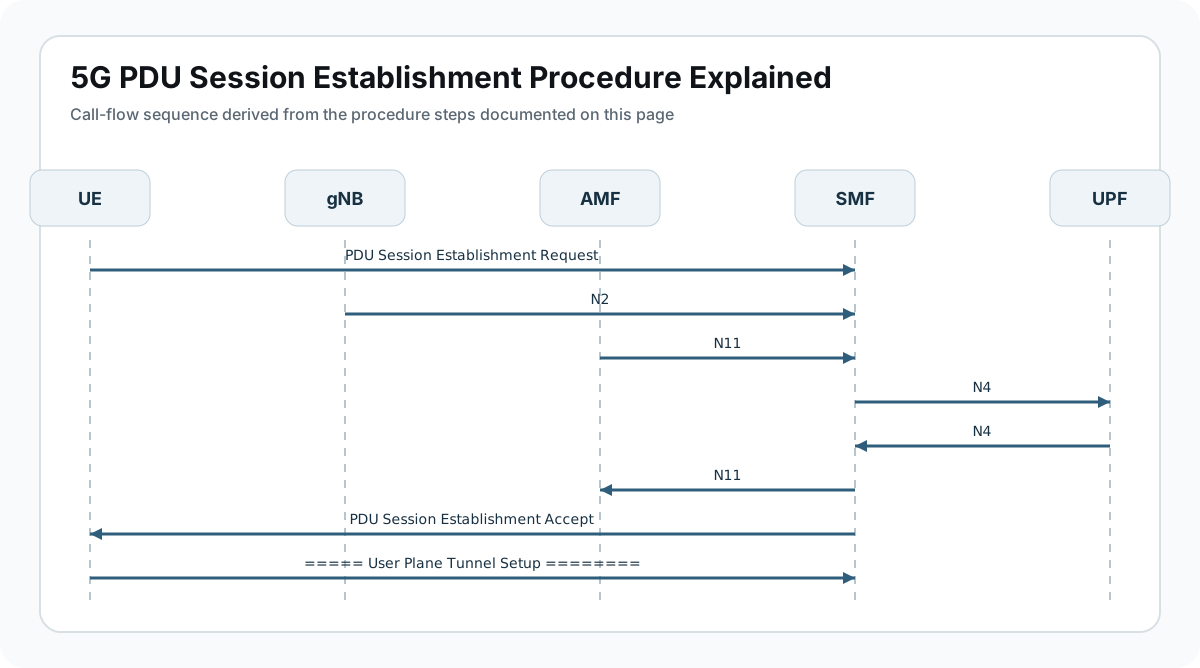
End-to-End Call Flow
UE              gNB / AMF            SMF / UPF / PCF            IMS
|-- PDU Session Establishment Req ------->|                       |
|<-- PDU Session Establishment Accept ----|                       |
|================ REGISTER / INVITE over the new voice session ==>|
Major Phases
| Phase | What happens |
|---|---|
| 1. Voice-service need appears | The UE needs an IMS-capable path specifically suitable for voice service. |
| 2. Session request | The UE requests the voice-support PDU session. |
| 3. Policy and QoS installation | The network creates the session with voice-aware treatment. |
| 4. Voice-service readiness | The UE can now register to IMS or continue with VoNR procedures. |
Step-by-Step Breakdown
The UE decides that voice-capable IMS connectivity is needed
Sender -> receiver: UE service logic -> NAS stack
Message(s): Voice-registration or voice-service trigger
Purpose: Start the session setup path that makes VoNR service possible.
State or context change: The UE leaves generic 5GS access and enters voice-service preparation.
Note: This differs from generic data-session setup because the end goal is voice readiness, not only IP connectivity.
The UE sends the PDU Session Establishment Request
Sender -> receiver: UE -> gNB -> AMF -> SMF
Message(s): PDU Session Establishment Request
Purpose: Request the specific service path that will support IMS voice registration and call control.
State or context change: The core begins creating the session and selecting policy treatment.
Note: DNN, slice, and service intent are the first things to inspect here.
The network creates the session with voice-aware QoS and policy
Sender -> receiver: SMF <-> UPF / PCF
Message(s): Session creation, QoS rules, and policy installation
Purpose: Make sure the resulting session is actually usable for voice and IMS behavior.
State or context change: The packet path becomes service-aware instead of generic best-effort connectivity.
Note: A session can succeed on paper but still be wrong for voice if QoS or policy is weak.
The UE receives Accept and proceeds to IMS voice procedures
Sender -> receiver: SMF -> AMF -> gNB -> UE
Message(s): PDU Session Establishment Accept
Purpose: Confirm the new voice-support session and let the UE continue with registration or call setup.
State or context change: The UE now has the service path required for VoNR registration and later call flows.
Note: The best proof is what happens next: IMS registration and voice signaling should actually work over the new session.
Important Messages in This Flow
| Message | Protocol | Direction | Purpose in this procedure | What to inspect briefly |
|---|---|---|---|---|
| PDU Session Establishment Request | NAS | UE -> core | Starts creation of the voice-support session. | Inspect DNN, slice, and service intent. |
| PDU Session Establishment Accept | NAS | Core -> UE | Confirms the voice-support session parameters. | Check QoS rules, session profile, and address context. |
| REGISTER or INVITE over the new session | SIP | UE -> IMS | Prove that the session is functionally useful for voice service. | This is where the session moves from theoretical to operational success. |
Important Parameters to Inspect
| Parameter | What it is | Where it appears | Why it matters | Common issues |
|---|---|---|---|---|
| DNN / service profile | The network profile used for IMS voice service. | Request and Accept | Shows whether the UE asked for the right service path. | Wrong service profile causes later IMS failure even when session setup succeeds. |
| QoS rules | The treatment applied to the new session. | Accept and policy path | Critical for SIP stability and voice continuity. | Weak QoS creates subtle post-setup voice issues. |
| Slice selection | The slice context used for the service. | Request and network selection | Important when voice behavior depends on slice policy. | Unexpected slice can cause routing or policy mismatch. |
| Post-session IMS behavior | Whether registration or call signaling works afterward. | After Accept | This is the practical proof of success. | A clean Accept without working SIP is still a failed service experience. |
| Voice continuity expectation | Whether the session supports not only registration but later voice procedures. | Whole end-to-end chain | Keeps the analysis focused on voice readiness rather than generic connectivity. | Generic connectivity assumptions often hide the real issue. |
Success Criteria
- The voice-support session is accepted with the expected service profile.
- Policy and QoS treatment are aligned with voice requirements.
- The packet path is usable immediately for IMS voice procedures.
- Later voice-related SIP signaling succeeds over the new session.
Common Failures and Troubleshooting
| Symptom | Likely cause | Where to inspect | Relevant message(s) | Relevant interface(s) | Likely next step |
|---|---|---|---|---|---|
| The session is accepted but voice still does not work | The session exists but is not correct for real IMS voice service. | Accept contents, QoS, and later IMS behavior. | Accept, later REGISTER or INVITE | Session + IMS | This is one of the most common voice-readiness traps. |
| The wrong service profile is built | The UE or network selected a non-voice session profile. | DNN, slice, and policy context. | Request and Accept | N1 / N11 | The session can still look formally successful. |
| The session is rejected | Subscription, policy, or service configuration did not allow the voice-support path. | Reject cause and request contents. | Request, Reject | Core session path | Classify the reject before changing radio assumptions. |
| Voice quality problems start immediately after session creation | QoS or policy treatment is insufficient for voice behavior. | QoS rules and first voice-service use. | Accept and post-setup media | User plane | This is not only a SIP problem. |
What to Check in Logs and Traces
- Check the request intent before assuming generic session setup is enough.
- Inspect DNN, slice, and QoS in the Accept carefully.
- Use later IMS registration or INVITE behavior to prove operational success.
- Do not stop at “session accepted” if the user complaint is really about voice service.
Related Pages
Related sub-procedures
- VoNR Registration
- PDU Session Establishment
- IMS Registration Refresh / Re-registration
- VoNR Mobile Originated Call
Related message reference pages
Related troubleshooting pages
FAQ
What is IMS PDU Session Establishment for Voice?
It is the session-management procedure that creates the specific 5G data path needed for IMS voice registration and later VoNR service.
How is it different from a generic IMS PDU session page?
This page focuses specifically on the voice-readiness outcome, including QoS and operational voice continuity.
What proves success?
The Accept looks correct and IMS voice procedures actually work over the new session.
What should I inspect first?
Start with DNN, slice, and QoS in the request and accept, then validate real SIP voice behavior.
Why can registration still fail after the session is built?
Because packet connectivity alone does not guarantee correct IMS policy, DNS, or voice treatment.