5G Intra-gNB Handover Call Flow
5G Intra-gNB Handover is the radio mobility path where the UE moves between cells or sectors controlled by the same gNB.
It combines measurement reporting, local target preparation, RRC mobility command delivery, and target-cell access without the broader coordination required for inter-gNB mobility.
Introduction
The intra-gNB handover procedure appears when the serving gNB decides that another local cell will provide better radio conditions for the UE.
Because the source and target remain inside the same gNB domain, the execution is usually operationally lighter than Xn Handover or N2 Handover, but it still needs careful radio-side analysis when it fails.
What Is Intra-gNB Handover in Simple Terms?
- What starts the procedure: Measurement results show that another local cell under the same gNB is the better serving choice.
- What the UE and network want to achieve: Move the UE to the better local cell while preserving ongoing service continuity.
- What success looks like: The UE executes the handover command, accesses the target cell, and confirms completion with minimal interruption.
- What failure means: The UE cannot complete the move, falls into recovery, or continues on a degraded path after the attempted handover.
Why this procedure matters
Intra-gNB handover is often assumed to be simple because it stays within one gNB, but many practical mobility problems still hide in measurement logic, target-cell readiness, and post-command radio execution.
Quick Fact Sheet
| Procedure name | 5G Intra-gNB Handover |
|---|---|
| Domain | 5G NR mobility within the same gNB |
| Main trigger | Mobility decision between source and target cells controlled by the same gNB |
| Start state | UE is connected on a source cell and the serving gNB decides to move it to another local cell or sector |
| End state | UE continues service on the target cell without changing serving gNB ownership |
| Main nodes | UE, source cell, target cell, serving gNB, AMF, UPF |
| Main protocols | RRC, internal gNB control, NGAP context continuity, user-plane path continuity |
| Main success outcome | UE moves to the target cell with minimal interruption and keeps the same higher-layer service continuity |
| Main failure outcome | Handover command is not completed, UE falls back to recovery, or service interruption occurs |
| Most important messages | Measurement Report, RRC Reconfiguration, Random Access on target cell, RRC Reconfiguration Complete |
| Main specs | TS 23.502, TS 38.300, TS 38.331 |
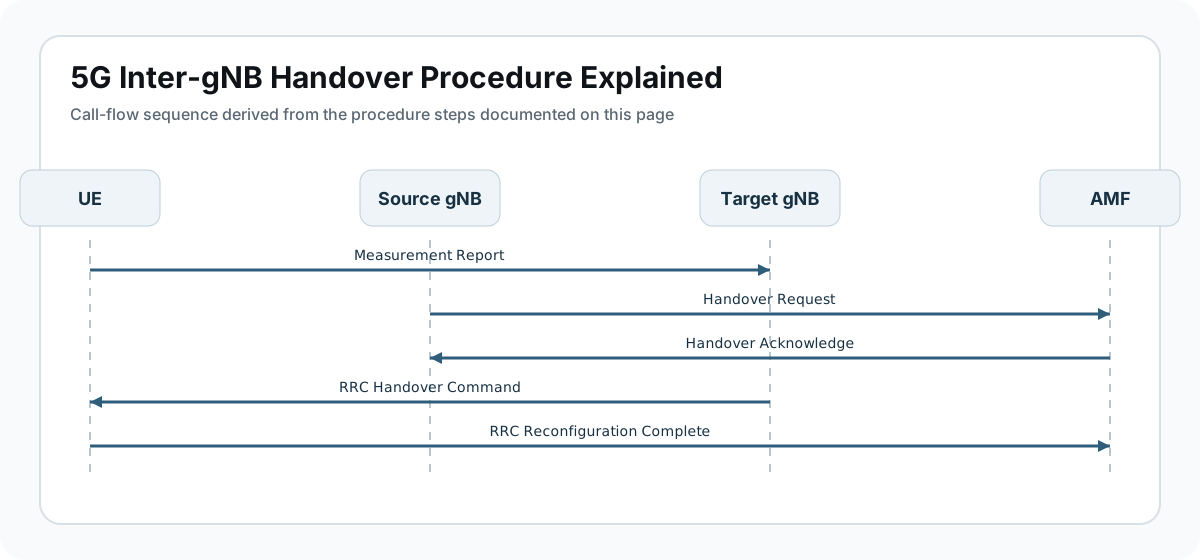
Preconditions
- The UE is already in a connected radio state on the source cell.
- The serving gNB knows a valid target cell inside the same gNB control domain.
- Measurement reporting has provided enough evidence for the mobility decision.
- Target-cell resources can be prepared locally before the command is sent.
Nodes and Interfaces
Nodes involved
| Node | Role in this procedure |
|---|---|
| UE | Reports measurements, executes the handover command, and completes access on the target cell under the same gNB umbrella. |
| Serving gNB | Owns both the source and target radio context and decides how to move the UE between local cells or sectors. |
| Source cell | Carries the UE before mobility execution and provides the measurement history that drives the decision. |
| Target cell | Accepts the UE after the handover command and becomes the new radio serving cell. |
| AMF | Usually does not drive the cell-to-cell execution itself, but continues to anchor the higher-layer connection context. |
| UPF | Typically sees continuity with little or no major core-side mobility change because the serving gNB remains the same. |
Interfaces used
| Interface | Path | Role |
|---|---|---|
| NR-Uu | UE <-> source or target cell | Carries measurement reporting, the handover command, and the target-cell access procedure. |
| Internal gNB control | Source cell logic <-> target cell logic | Lets the same gNB prepare the target resources without a separate inter-gNB exchange. |
| N2 | gNB <-> AMF | Higher-layer context remains anchored, with limited or no major execution change compared with inter-gNB handovers. |
| N3 | gNB <-> UPF | User-plane continuity is maintained while the radio anchor shifts inside the same gNB. |
End-to-End Call Flow
UE             Source Cell / gNB             Target Cell / same gNB
|                     |                                  |
|-- Measurement Report ------------------------------->  |
|                     |-- local target prep -----------> |
|<-- RRC Reconfiguration / HO command ------------------|
|==== move to target cell =============================>|
|-- target access ------------------------------------->|
|-- RRC Reconfiguration Complete ---------------------->|
|==== service continues on target cell ================>
Major Phases
| Phase | What happens |
|---|---|
| 1. Mobility observation | The UE sends measurement information that shows a better local target cell inside the same gNB. |
| 2. Local preparation | The serving gNB prepares target-cell resources internally without the broader exchange needed for inter-gNB mobility. |
| 3. Handover command | The gNB sends the UE the target-cell information inside an RRC reconfiguration or equivalent mobility command. |
| 4. Target-cell access | The UE synchronizes to the target cell and performs the access steps needed to continue service there. |
| 5. Completion and continuity | The UE confirms completion, the source radio leg is released, and the traffic path continues on the target cell. |
Step-by-Step Breakdown
Measurement reporting and local mobility decision
Sender -> receiver: UE -> serving gNB
Message(s): Measurement Report
Purpose: Show that a different local cell inside the same gNB is a better serving candidate.
State or context change: The gNB decides that a cell change is needed without changing overall gNB ownership.
Note: The difference between intra-gNB and inter-gNB handover starts here: the target remains under the same gNB control domain.
Internal target-cell preparation
Sender -> receiver: Serving gNB internal control
Message(s): Local target resource setup and context transfer inside the same gNB
Purpose: Prepare the target cell without the larger cross-node exchange used in inter-gNB or N2-based mobility.
State or context change: The target radio resources are ready before the UE receives the command.
Note: This is why intra-gNB handover is often faster and operationally simpler than inter-gNB mobility.
Handover command delivery
Sender -> receiver: Serving gNB -> UE
Message(s): RRC Reconfiguration with mobility information
Purpose: Tell the UE which target cell to move to and how to perform the change.
State or context change: The UE leaves the source-cell serving state and starts the move toward the target cell.
Note: If the command never reaches the UE cleanly, later failure symptoms can look like generic radio interruption rather than mobility execution failure.
Target-cell random access and synchronization
Sender -> receiver: UE -> target cell
Message(s): Target-cell access sequence and radio synchronization
Purpose: Let the UE enter the target cell and rebuild the immediate air-interface continuity there.
State or context change: The target cell becomes the practical new serving cell for the UE.
Note: Poor RF or timing on the target cell is a common reason for apparent handover failure even when the command logic was fine.
Completion and source release
Sender -> receiver: UE -> serving gNB
Message(s): RRC Reconfiguration Complete
Purpose: Confirm that the UE successfully moved to the target cell and allow cleanup of the old source-cell resources.
State or context change: The handover is complete, and the UE continues service on the target cell under the same gNB.
Note: If the completion is missing, confirm whether the UE failed the target access or whether the completion was lost after success.
Important Messages in This Flow
| Message | Protocol | Direction | Purpose in this procedure | What to inspect briefly |
|---|---|---|---|---|
| Measurement Report | RRC | UE -> gNB | Provides the measurement evidence that drives the cell-change decision. | Inspect event trigger, neighbor measurements, and whether the target really belongs to the same gNB domain. |
| RRC Reconfiguration | RRC | gNB -> UE | Carries the handover command and target-cell parameters. | Confirm that the target-cell information and timing details match the intended execution path. |
| Target-cell access sequence | RRC / MAC / PHY | UE -> target cell | Lets the UE synchronize and enter the target cell after the command. | Look for access delay, missed target access, or RF mismatch. |
| RRC Reconfiguration Complete | RRC | UE -> gNB | Confirms successful completion of the move to the target cell. | Use it as the main success checkpoint for radio-side execution. |
| RRC Reestablishment Request | RRC | UE -> gNB | May appear afterward if the intended handover did not complete and the UE falls into recovery. | Treat it as a sign that the handover path broke rather than completed cleanly. |
Important Parameters to Inspect
| Parameter | What it is | Where it appears | Why it matters | Common issues |
|---|---|---|---|---|
| Measurement event / threshold | The radio condition that triggered the mobility decision. | Measurement Report | Explains why the gNB decided to move the UE now. | Late trigger, wrong threshold, or unstable neighbor relation. |
| Target cell identifier | The cell the UE is commanded to move toward. | RRC Reconfiguration | Confirms the intended target and lets you correlate post-command RF behavior. | Wrong target cell or outdated neighbor data. |
| Mobility control info | The radio parameters that describe how the UE should execute the move. | RRC Reconfiguration | Directly affects whether the UE can execute the handover correctly. | Invalid configuration or mismatched target parameters. |
| Completion timing | The delay between handover command and completion on the target side. | RRC command and completion correlation | Shows whether the move was efficient or whether the UE struggled during execution. | Long interruption or no completion at all. |
| Post-handover quality | The RF condition immediately after the move. | Target-cell measurements and later service continuity | Separates a successful but weak handover from a true execution failure. | Target cell is reachable but still poor for sustained service. |
Success Criteria
- The measurement trigger correctly identifies a stronger local target cell.
- The serving gNB prepares the target cell before the handover command is sent.
- The UE executes the move, accesses the target cell, and sends RRC Reconfiguration Complete.
- Service continues on the target cell without falling into broader recovery signaling.
Common Failures and Troubleshooting
| Symptom | Likely cause | Where to inspect | Relevant message(s) | Relevant interface(s) | Likely next step |
|---|---|---|---|---|---|
| UE receives the command but never completes the move | Target-cell access or synchronization failed. | RRC Reconfiguration, target access behavior, and post-command RF evidence. | RRC Reconfiguration, target-cell access steps | NR-Uu | Check whether the failure is target-radio related rather than core-mobility related. |
| Measurements keep triggering but the UE oscillates | Neighbor thresholds or mobility policy are unstable between local cells. | Measurement events and repeated cell changes. | Measurement Report, repeated mobility commands | NR-Uu | Treat it as a mobility-tuning problem, not just a single bad handover. |
| Service breaks after apparently successful handover | Radio move succeeded but target-cell quality is still poor or user-plane continuity degraded. | Completion message, target-cell quality, and traffic continuity. | RRC Reconfiguration Complete, later traffic symptoms | NR-Uu, N3 | Separate clean command execution from post-handover service quality. |
| UE falls into reestablishment after handover attempt | The handover path broke badly enough that the UE had to recover with a new RRC recovery branch. | Look for failed completion followed by reestablishment signaling. | RRC Reconfiguration, RRC Reestablishment Request | NR-Uu | Treat reestablishment as a downstream symptom of handover failure. |
| Inter-gNB logic is suspected even though the move is local | The analysis mixed up local cell change with broader inter-node mobility. | Check whether the target really belongs to the same gNB. | Measurement Report, RRC Reconfiguration | NR-Uu, internal gNB control | Classify the handover correctly before reading core-side expectations into the trace. |
Related Pages
Related sub-procedures
Related message reference pages
Related troubleshooting pages
FAQ
What is 5G Intra-gNB Handover?
It is the mobility procedure where the UE moves between cells controlled by the same gNB.
How is it different from Inter-gNB Handover?
The target stays under the same gNB control, so preparation is more local and usually simpler than a broader inter-node move.
Which message usually carries the handover command?
The command is commonly carried in RRC Reconfiguration or an equivalent mobility-control message.
What is the main success checkpoint?
A clean move to the target cell followed by RRC Reconfiguration Complete is the main radio-side success sign.
What should I inspect first in a failing intra-gNB handover?
Start with the measurement trigger, then the handover command content, then the UE target-cell access and completion timing.