5G Local Breakout Roaming Registration Call Flow
5G Local Breakout Roaming Registration is the roaming registration path used when the visited network is expected to support local service continuity afterward.
It combines standard roaming validation with the service model assumptions needed for later local-breakout data service.
Introduction
This procedure should be read as the registration foundation for a local-breakout roaming service model, not as the PDU session establishment itself.
In practice, the most useful checks are the visited PLMN, subscriber entitlement, accepted service restrictions, and whether the returned context really supports the intended follow-up behavior.
What Is Local Breakout Roaming Registration in Simple Terms?
- What starts the procedure: A roaming UE needs 5GS registration in a visited PLMN with local-breakout-capable service expectations.
- What the UE and network want to achieve: Complete secure roaming registration and prepare for visited-network service continuity.
- What success looks like: The UE registers cleanly and can move on to the intended local-breakout session workflow.
- What failure means: Roaming entitlement or service-model alignment is not sufficient for the intended outcome.
Why this procedure matters
Local-breakout roaming problems are often misdiagnosed because teams jump straight to session setup. A correct registration foundation is what makes the later roaming data path understandable.
Quick Fact Sheet
| Procedure name | 5G Local Breakout Roaming Registration |
|---|---|
| Domain | 5G roaming registration where visited-network service breakout is expected after registration |
| Main trigger | A roaming UE registers in a visited PLMN that supports local breakout service treatment |
| Start state | UE is in a visited network and needs valid roaming registration before local service breakout can be used |
| End state | UE is registered and prepared for visited-network service continuity under the local-breakout model |
| Main nodes | UE, visited gNB, visited AMF, home subscriber functions, visited policy and session functions |
| Main protocols | RRC, NAS, NGAP, roaming subscriber signaling, authentication, visited policy coordination |
| Main success outcome | The UE completes roaming registration and is ready for visited-network service breakout |
| Main failure outcome | Registration succeeds only partially or fails because local-breakout policy, roaming entitlement, or security cannot be aligned |
| Most important messages | Registration Request, Authentication Request/Response, Security Mode, Registration Accept, Registration Complete |
| Main specs | TS 23.501, TS 23.502, TS 24.501, TS 29.510 family |
Preconditions
- The UE has coverage in a visited PLMN.
- Home and visited networks support the relevant roaming agreement.
- The UE can present valid identity context for roaming.
- The visited network has policy and session logic for the intended service model.
Nodes and Interfaces
Nodes involved
| Node | Role in this procedure |
|---|---|
| UE | Starts the roaming registration and later relies on the returned context for local-breakout-capable service. |
| Visited gNB | Provides the access path for registration in the visited PLMN. |
| Visited AMF | Coordinates the roaming registration from the visited-core side. |
| Home subscriber functions | Confirm subscriber identity and entitlement for roaming. |
| Visited policy and session functions | Shape how later local-breakout service may be offered after registration. |
Interfaces used
| Interface | Path | Role |
|---|---|---|
| NR-Uu | UE <-> visited gNB | Carries the radio path for the roaming registration attempt. |
| N1 | UE <-> visited AMF | Carries registration, security, and acceptance signaling. |
| N2 | visited gNB <-> visited AMF | Relays access-side context and NAS messages. |
| Roaming subscriber interfaces | visited core <-> home core | Carry subscriber and authentication validation. |
| Visited policy interfaces | visited core internal control | Prepare the service model that follows registration. |
End-to-End Call Flow
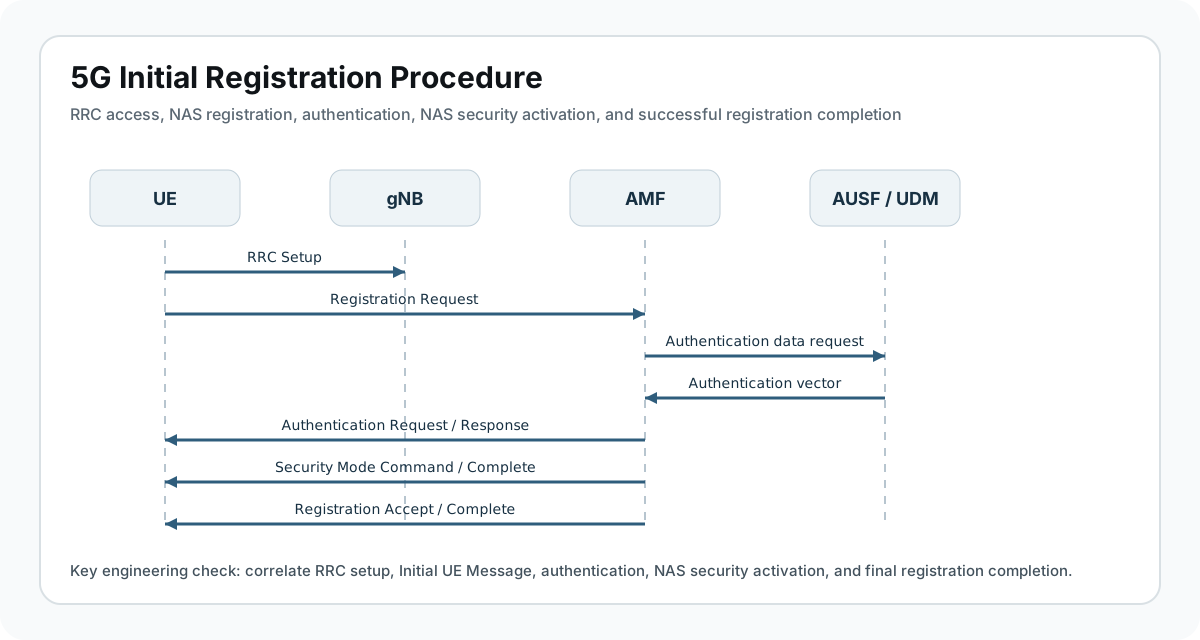
UE             visited gNB         visited AMF        home / visited functions
|                  |                  |                    |
|-- Registration Request -----------> |                    |
|                  |----------------->|-- validation ------>|
|                  |                  |<-- entitlement ------|
|<-- Authentication / Security ------|                    |
|<-- Registration Accept ------------|                    |
|-- Registration Complete ---------->|                    |
|==== registration ready for local-breakout follow-up ===>|
Major Phases
| Phase | What happens |
|---|---|
| 1. Visited-network access | The UE selects a visited PLMN and prepares to register. |
| 2. Roaming registration start | The UE sends Registration Request through the visited access network. |
| 3. Home-side validation plus visited policy alignment | Subscriber entitlement is checked while the visited network prepares the local-breakout-capable service model. |
| 4. Security and accept | The UE completes authentication and receives Registration Accept. |
| 5. Completion and local-breakout readiness | The UE returns Registration Complete and can proceed to visited-network service setup. |
Step-by-Step Breakdown
The UE enters a visited PLMN that supports local breakout
Sender -> receiver: UE -> visited gNB
Message(s): PLMN selection and access establishment
Purpose: Create the access path for a roaming registration that will later support visited-network data continuity.
State or context change: The UE prepares to register in a foreign network with a specific roaming service model in mind.
Note: This page focuses on the registration side of local breakout, not the later PDU session setup itself.
The UE sends Registration Request
Sender -> receiver: UE -> visited AMF via gNB
Message(s): Registration Request
Purpose: Start the roaming registration and expose identity plus requested context.
State or context change: The visited AMF creates a roaming registration transaction.
Note: Requested slices and service expectations matter because they affect later local-breakout feasibility.
Visited and home sides align on entitlement
Sender -> receiver: Visited AMF <-> home subscriber functions
Message(s): Subscriber validation and authentication coordination
Purpose: Confirm the subscriber may roam and that the registration can progress.
State or context change: The UE moves from provisional access toward authenticated roaming state.
Note: The local-breakout model still depends on basic roaming entitlement from the home side.
Visited network prepares the post-registration service model
Sender -> receiver: Visited AMF <-> visited policy and session functions
Message(s): Policy alignment for later local breakout
Purpose: Make sure the visited network can later offer local continuity where permitted.
State or context change: The returned registration context becomes suitable for local-breakout service follow-up.
Note: Registration may succeed even if later local-breakout session setup remains restricted. Keep those two outcomes separate.
The UE completes registration
Sender -> receiver: Visited AMF <-> UE
Message(s): Authentication Request, Registration Accept, Registration Complete
Purpose: Finish secure roaming registration so the UE can proceed to visited-network data service.
State or context change: The UE becomes stable in the local-breakout-capable roaming state.
Note: Later session success depends on this registration context, but does not prove local breakout by itself.
Important Messages in This Flow
| Message | Protocol | Direction | Purpose in this procedure | What to inspect briefly |
|---|---|---|---|---|
| Registration Request | NAS | UE -> visited AMF | Starts the local-breakout-capable roaming registration. | Inspect identity, requested context, and slice expectations. |
| Authentication Request | NAS | Network -> UE | Confirms that subscriber validation is progressing. | Useful for proving the process reached secure roaming treatment. |
| Registration Accept | NAS | visited AMF -> UE | Returns the accepted roaming context. | Check what service and slice context the UE is actually allowed to use. |
| Registration Complete | NAS | UE -> visited AMF | Finalizes the registration transaction. | Needed before later local-breakout service setup can be read cleanly. |
Important Parameters to Inspect
| Parameter | What it is | Where it appears | Why it matters | Common issues |
|---|---|---|---|---|
| Visited PLMN and TAC | Location where local-breakout-capable roaming registration is attempted. | Access and registration context | Defines the roaming environment and policy domain. | Wrong visited context invalidates the analysis. |
| UE identity | Subscriber identity used for roaming. | Registration Request | Must correlate cleanly with home-side validation. | Identity mismatch causes misleading reject behavior. |
| Allowed NSSAI / visited restrictions | What the UE may actually use after registration. | Registration Accept | Important for later local-breakout session feasibility. | Registration success may still hide later service limits. |
| Roaming entitlement | Home-side permission for the roaming attempt. | Subscriber validation path | Separates authorization failure from later session failure. | A missing entitlement blocks everything upstream. |
| Visited service model readiness | Whether the visited network is prepared to support the intended post-registration continuity model. | Visited policy context | Explains the difference between generic roaming success and useful local breakout readiness. | Often misunderstood in field troubleshooting. |
Success Criteria
- The roaming registration completes cleanly in the visited network.
- The home side authorizes the subscriber for roaming.
- The accepted context reflects the intended visited-network service limits.
- The UE is ready for later local-breakout PDU session procedures.
Common Failures and Troubleshooting
| Symptom | Likely cause | Where to inspect | Relevant message(s) | Relevant interface(s) | Likely next step |
|---|---|---|---|---|---|
| Registration succeeds but local-breakout service later fails | Registration was valid, but the visited-network service model is still too restricted. | Allowed NSSAI and visited restrictions. | Registration Accept | Policy and session follow-up | Keep registration success separate from session continuity success. |
| Roaming validation fails before Registration Accept | Subscriber entitlement or authentication did not complete cleanly. | Identity and authentication path. | Registration Request / Authentication | N1, roaming interfaces | Start with cross-network entitlement. |
| The UE never finalizes registration | The Accept was not fully adopted or the completion leg failed. | Accept-to-Complete path and UE state. | Registration Complete | N1, NR-Uu | This leaves confusing half-open roaming context. |
| Visited-network restrictions are misread as generic roaming failure | The UE is registered, but not with the service breadth expected by the operator or tester. | Accepted restrictions and later service attempts. | Registration Accept | Policy | A clean registration trace does not imply unrestricted local breakout. |
Related Pages
Related sub-procedures
- 5G NR Roaming Registration
- 5G Home-Routed Roaming Registration
- 5G Roaming PDU Session Establishment
- 5G PDU Session Establishment
Related message reference pages
Related troubleshooting pages
FAQ
What is Local Breakout Roaming Registration?
It is the roaming registration path used when the UE is expected to continue later service through a visited-network breakout model.
Does this page mean the PDU session is already locally broken out?
No. This page covers the registration context that makes later local-breakout service possible.
What proves success?
Registration Accept, Registration Complete, and a roaming context suitable for the intended visited-network service model.
What should I inspect first?
Start with visited PLMN, identity, roaming entitlement, and the accepted service restrictions.
Why can later service still fail after successful registration?
Because registration and local-breakout session establishment are related but separate procedures.