5G Measurement Reporting Procedure Call Flow
5G Measurement Reporting is the radio-observation procedure that lets the UE tell the network what it actually sees on the serving and neighbor side.
Good mobility depends on it because handover, conditional handover, beam decisions, and several recovery actions begin with these reports.
Introduction
Measurement reporting is not a user journey by itself, but it is one of the highest-value decision inputs in 5G radio troubleshooting.
When later mobility behavior looks wrong, the first question is often whether the Measurement Report was meaningful, timely, and based on sane configuration.
What Is Measurement Reporting in Simple Terms?
- What starts the procedure: The network configures the UE to measure and report radio conditions.
- What the UE and network want to achieve: Produce accurate, timely radio intelligence for mobility and optimization decisions.
- What success looks like: The gNB gets reports that lead to stable and well-timed decisions.
- What failure means: Reports are missing, noisy, late, or misleading enough to damage radio decisions.
Why this procedure matters
Measurement reporting is the evidence layer behind many 5G radio actions. Without understanding it, teams often blame handover, reconfiguration, or beam management when the real issue was the measurement input.
Quick Fact Sheet
| Procedure name | 5G Measurement Reporting Procedure |
|---|---|
| Domain | 5G NR mobility and radio optimization |
| Main trigger | The network configures the UE to measure serving and neighbor-cell conditions for later radio decisions |
| Start state | UE is connected and has active measurement configuration |
| End state | The gNB receives the report needed for mobility, optimization, or recovery decisions |
| Main nodes | UE, gNB, optionally target gNB through later mobility logic |
| Main protocols | RRC, measurement events, mobility tuning |
| Main success outcome | The UE reports meaningful radio measurements that support good handover or recovery decisions |
| Main failure outcome | Reports are missing, late, noisy, or misleading, which degrades mobility decisions |
| Most important messages | RRC Reconfiguration, Measurement Report |
| Main specs | TS 38.331, TS 38.300 |
Preconditions
- The UE is connected and has measurement configuration from the network.
- Serving and candidate neighbor signals can be observed meaningfully.
- The configured events and thresholds are appropriate for the environment.
- The network has later procedures ready to act on the measurement result.
Nodes and Interfaces
Nodes involved
| Node | Role in this procedure |
|---|---|
| UE | Measures radio quality and reports it according to network-defined objects, events, and thresholds. |
| gNB | Configures what to measure and uses the reports to make mobility and optimization decisions. |
| Target gNB or neighbor cells | Become relevant as measured candidates for handover, conditional handover, or recovery. |
Interfaces used
| Interface | Path | Role |
|---|---|---|
| NR-Uu | UE <-> gNB | Carries the measurement configuration and the resulting report. |
| Xn or N2 | gNB coordination paths | May later carry the mobility actions that were triggered by the measurements. |
End-to-End Call Flow
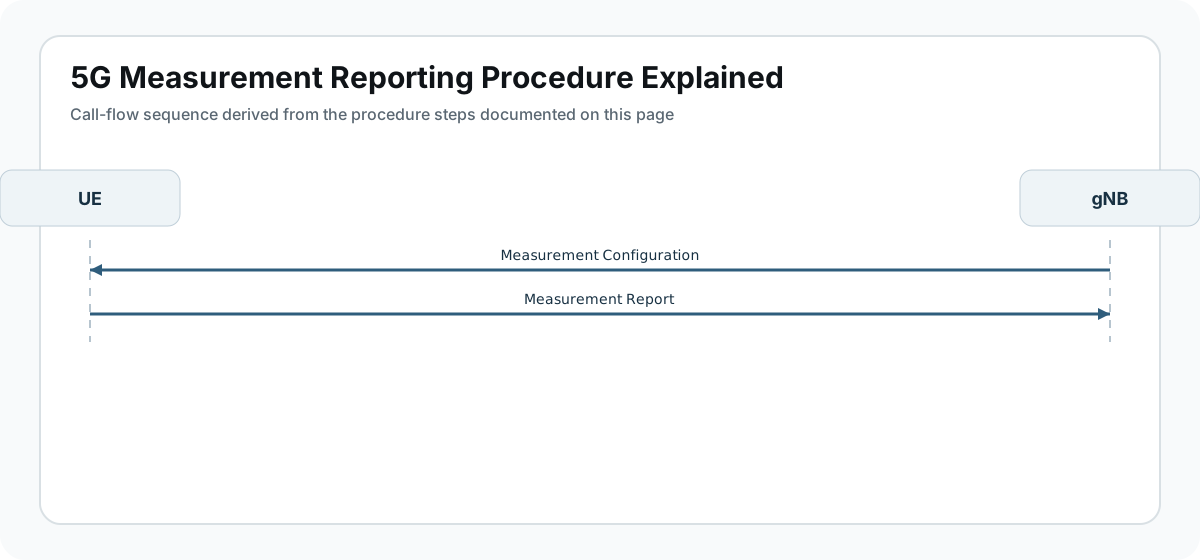
UE                    gNB
|<- RRC Reconfiguration -|
|-- measure radio ------>|
|-- Measurement Report ->|
|==== gNB uses report for later mobility or optimization ====|
Major Phases
| Phase | What happens |
|---|---|
| 1. Measurement configuration | The gNB tells the UE what to measure, when to report, and which conditions matter. |
| 2. UE measurement execution | The UE observes serving and neighbor-cell quality based on the configured rules. |
| 3. Event or threshold trigger | The report becomes eligible when the configured measurement logic is satisfied. |
| 4. Network decision support | The gNB uses the report for handover, optimization, beam management follow-up, or recovery planning. |
Step-by-Step Breakdown
gNB configures measurement behavior
Sender -> receiver: gNB -> UE
Message(s): RRC Reconfiguration
Purpose: Define measurement objects, report events, thresholds, and timing behavior.
State or context change: The UE now knows what radio conditions matter to the network.
Note: Most later problems are rooted here, especially when thresholds and hysteresis do not match the RF reality.
UE measures serving and neighbor-cell quality
Sender -> receiver: UE internal radio measurements
Message(s): RSRP, RSRQ, SINR, beam and neighbor observations
Purpose: Build the measurement view needed for mobility and optimization.
State or context change: The UE is continuously evaluating whether report conditions are met.
Note: A healthy report starts with healthy measurement inputs. Garbage in becomes bad mobility out.
Configured trigger condition becomes true
Sender -> receiver: UE event logic
Message(s): Event A1, A2, A3, A4, A5, periodic or other report trigger
Purpose: Turn raw measurements into a network-usable report at the right time.
State or context change: The report is now ready to be sent rather than just measured internally.
Note: Timing matters as much as value quality. A late but accurate report can still harm mobility.
UE sends Measurement Report
Sender -> receiver: UE -> gNB
Message(s): Measurement Report
Purpose: Give the network a structured view of the radio situation so it can act.
State or context change: The report now becomes the basis for reconfiguration, handover, recovery, or optimization decisions.
Note: When a later mobility action looks wrong, always revisit whether the underlying report was timely and meaningful.
Important Messages in This Flow
| Message | Protocol | Direction | Purpose in this procedure | What to inspect briefly |
|---|---|---|---|---|
| RRC Reconfiguration | RRC | gNB -> UE | Creates the measurement rules and event logic. | Inspect objects, events, hysteresis, time-to-trigger, and reporting style. |
| Measurement Report | RRC | UE -> gNB | Carries serving and neighbor-cell measurement results. | Inspect whether the reported cells and values actually justify the later network decision. |
Important Parameters to Inspect
| Parameter | What it is | Where it appears | Why it matters | Common issues |
|---|---|---|---|---|
| Measurement object | What frequencies or cells the UE should measure. | RRC Reconfiguration | Defines the candidate universe for mobility or optimization. | Wrong objects mean the right target may never be reported. |
| Reporting event | The trigger condition for sending a report. | RRC Reconfiguration | Controls whether the network learns at the right time. | Overly strict or loose events create late or noisy reporting. |
| Threshold and hysteresis | The numeric logic controlling report generation. | RRC Reconfiguration | Key to stable and timely mobility behavior. | Bad tuning causes ping-pong or missed handovers. |
| Time-to-trigger | How long the condition must remain true before reporting. | Measurement configuration | Balances stability against responsiveness. | Too short creates noise, too long creates late reactions. |
| Reported cell identity and quality | The actual result set delivered by the UE. | Measurement Report | Shows whether the chosen target or beam was really justified. | If values and later decision disagree, either the logic or interpretation is wrong. |
Success Criteria
- The network configures the right objects and triggers.
- The UE measures the right cells and conditions.
- The report arrives in time to support good decisions.
- Later handover, recovery, or optimization behavior reflects the report logically.
Common Failures and Troubleshooting
| Symptom | Likely cause | Where to inspect | Relevant message(s) | Relevant interface(s) | Likely next step |
|---|---|---|---|---|---|
| Reports never appear | The measurement configuration never created a valid trigger or the UE could not satisfy it. | Objects, events, thresholds, and radio environment. | RRC Reconfiguration, Measurement Report | NR-Uu | This is often a config-design problem before it is a UE problem. |
| Reports come too late | Time-to-trigger or thresholds delayed the report until mobility quality had already degraded. | Timing parameters and RF trend before the report. | Measurement Report | NR-Uu | Late but correct reports still hurt handover quality. |
| Reports are noisy and create ping-pong | The configuration is too sensitive for the real environment. | Hysteresis, thresholds, and repeated cell switches. | Measurement Report | NR-Uu | This is a classic tuning issue. |
| Network makes poor handover decisions from the report | Either the report lacked the right data or the network interpreted it badly. | Reported cells versus actual later target choice. | Measurement Report and later RRC Reconfiguration | NR-Uu, Xn, N2 | Always compare the report with the chosen mobility action. |
What to Check in Logs and Traces
- Inspect the measurement object and whether the right cells were even eligible to be reported.
- Compare thresholds, hysteresis, and time-to-trigger with the observed RF trend.
- Check whether the reported values really justify the later mobility choice.
- If reports are late or noisy, treat it as a measurement tuning problem first.
Related Pages
Related sub-procedures
Related message reference pages
Related troubleshooting pages
FAQ
What is 5G Measurement Reporting?
It is the procedure where the UE sends radio measurements to the gNB based on configured rules.
Why does it matter so much?
Because many mobility and optimization decisions are only as good as the measurements behind them.
Is Measurement Report itself a handover?
No. It is usually an input to later decisions such as reconfiguration or handover.
What should I inspect first in a bad mobility trace?
Start with the measurement configuration and whether the report came early enough with meaningful values.
What event is most common for handover?
A3-style relative neighbor improvement logic is one of the most common patterns, though exact usage depends on design.