5G Network Requested PDU Session Call Flow
5G Network Requested PDU Session is the network-triggered session setup flow used when incoming data or service needs to reach a UE that is not currently ready for delivery.
It combines reachability recovery, NAS service restoration, and session establishment into one end-to-end path.
Introduction
This procedure matters most when engineers need to explain how mobile-terminated services, push traffic, or operator-triggered services reach a UE that may be idle or inactive.
The most reliable troubleshooting path is to separate three checkpoints: paging success, Service Request success, and the correctness of the created session profile.
What Is Network Requested PDU Session in Simple Terms?
- What starts the procedure: Incoming data or service requires the network to activate a session toward the UE.
- What the UE and network want to achieve: Restore reachability and create the needed session quickly enough for the pending service.
- What success looks like: The UE responds, the session is created, and the pending traffic is delivered.
- What failure means: Reachability recovery, session creation, or actual service delivery breaks down.
Why this procedure matters
Many mobile-terminated data issues are misdiagnosed as pure paging trouble or pure session trouble. This page keeps the whole chain visible so engineers can see exactly where recovery stopped.
Quick Fact Sheet
| Procedure name | 5G Network Requested PDU Session Establishment |
|---|---|
| Domain | 5G NR + 5GC network-triggered data-session setup |
| Main trigger | The network needs to deliver data or service toward a UE that does not currently have the needed active session |
| Start state | UE may be idle or inactive, and the target session is not active for the pending service |
| End state | The network-triggered session is created and the UE becomes reachable for the intended data or service delivery |
| Main nodes | UE, gNB, AMF, SMF, UPF, application or service trigger source |
| Main protocols | Paging, NAS Service Request, NAS session establishment, NGAP, PFCP |
| Main success outcome | The UE responds to paging, resumes connectivity, and the requested session becomes usable |
| Main failure outcome | Paging succeeds but session setup fails, or session setup succeeds without useful service delivery |
| Most important messages | Paging, Service Request, PDU Session Establishment Command or Accept, PDU Session Establishment Complete |
| Main specs | TS 23.502, TS 24.501, TS 23.501, TS 29.244 |
Preconditions
- The network has a valid reason to deliver data or service toward the UE.
- The target subscriber can be paged and restored into an active signaling context.
- The requested DNN, slice, and policy treatment are allowed for the session.
- SMF and UPF can create the session after the UE becomes reachable.
Nodes and Interfaces
Nodes involved
| Node | Role in this procedure |
|---|---|
| UE | Responds to paging, restores signaling connectivity, and completes setup of the network-requested session. |
| gNB | Transmits paging, restores access context, and supports the data path once the session is ready. |
| AMF | Coordinates paging and signaling restoration toward the UE. |
| SMF | Owns the decision to activate the requested session for incoming data or service. |
| UPF | Anchors user-plane traffic for the session once it is created. |
| Service trigger source | Represents the application or network event that caused the session request. |
Interfaces used
| Interface | Path | Role |
|---|---|---|
| NR-Uu | UE <-> gNB | Carries paging response, restored signaling, and later user-plane traffic. |
| N1 | UE <-> AMF | Carries Service Request and session setup results. |
| N2 | gNB <-> AMF | Drives paging and access-side restoration. |
| N11 | AMF <-> SMF | Coordinates the network-triggered session request. |
| N4 / N3 | SMF <-> UPF and gNB <-> UPF | Create and carry the new data path. |
End-to-End Call Flow
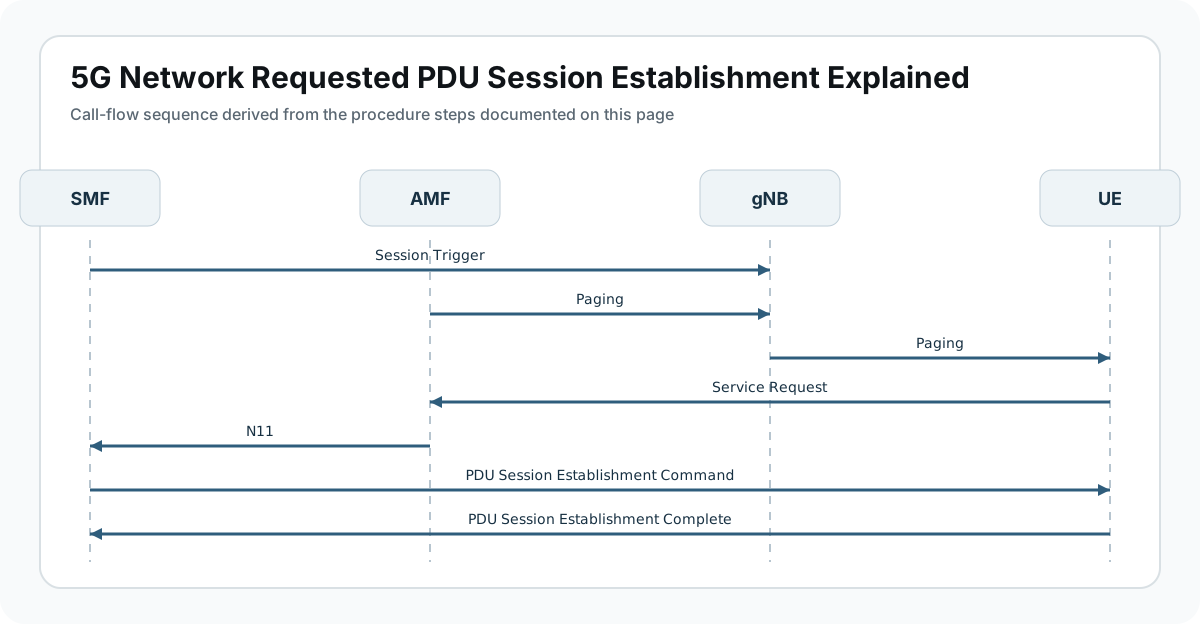
Service / SMF         AMF                gNB                UE                UPF
|                    |                  |                  |                  |
|-- trigger -------->|                  |                  |                  |
|                    |-- Paging ------->|----------------->|                  |
|                    |<-- Service Req --|<-----------------|                  |
|                    |-- setup session ------------------------------------->|
|<================ pending data delivered over new session ================>|
Major Phases
| Phase | What happens |
|---|---|
| 1. Incoming service need appears | An application or network trigger indicates data must be delivered toward the UE. |
| 2. Reachability recovery | The network pages the UE and restores signaling connectivity if the UE is idle or inactive. |
| 3. Session setup | The SMF creates the session needed for the requested service. |
| 4. UE completion | The UE accepts the setup and the session becomes usable. |
| 5. Service delivery | Real data or service traffic uses the new session. |
Step-by-Step Breakdown
The network decides the UE needs a new or resumed session
Sender -> receiver: Application trigger -> SMF / AMF
Message(s): Service trigger and session decision
Purpose: Identify that incoming data cannot be delivered with the current UE state.
State or context change: The network prepares reachability recovery and session activation.
Note: Keep the trigger context clear so you can explain why paging and session setup happened together.
The UE is paged and reachability is restored
Sender -> receiver: AMF -> gNB -> UE
Message(s): Paging
Purpose: Wake the UE and recover a signaling path if it is not currently connected.
State or context change: The UE moves from idle or inactive reachability into active signaling exchange.
Note: A paging success does not prove the later session setup is healthy. Treat them as related but separate checkpoints.
The UE sends Service Request
Sender -> receiver: UE -> gNB -> AMF
Message(s): Service Request
Purpose: Restore service connectivity so the network can finish delivering the requested session.
State or context change: The access and NAS path are re-established for further signaling.
Note: If Service Request fails, the session problem is really a reachability-recovery problem first.
The network creates the requested session
Sender -> receiver: AMF <-> SMF <-> UPF
Message(s): Network-triggered session establishment and PFCP setup
Purpose: Create the session that matches the incoming service need.
State or context change: The core network binds session, policy, and forwarding state to the restored UE context.
Note: Validate DNN, slice, and service intent carefully because these sessions are often created under time pressure from incoming traffic.
The UE completes session activation and data arrives
Sender -> receiver: SMF -> AMF -> UE and user plane
Message(s): Session completion and first service packets
Purpose: Move from signaling success into real delivery of the pending data or service.
State or context change: The network-requested session becomes operational.
Note: The strongest proof of success is pending traffic actually reaching the UE on the new session.
Important Messages in This Flow
| Message | Protocol | Direction | Purpose in this procedure | What to inspect briefly |
|---|---|---|---|---|
| Paging | RRC / NGAP | AMF -> gNB -> UE | Recovers reachability toward the UE. | Check identity, paging area, and response timing. |
| Service Request | NAS | UE -> AMF | Restores active service connectivity. | Use it to confirm the UE responded to paging correctly. |
| PDU Session Establishment Command or Accept | NAS | Network -> UE | Creates the requested session after reachability is restored. | Inspect session ID, QoS, and service profile. |
| PDU Session Establishment Complete | NAS | UE -> Network | Confirms the UE activated the session locally. | Useful for separating session-activation failure from later traffic failure. |
Important Parameters to Inspect
| Parameter | What it is | Where it appears | Why it matters | Common issues |
|---|---|---|---|---|
| Trigger source | Why the network initiated the session. | Before paging and session setup | Explains the operational reason for the whole sequence. | Without it, the flow looks arbitrary. |
| Paging identity and area | How the network tries to reach the UE. | Paging phase | Important for reachability troubleshooting. | Wrong area or stale identity breaks recovery before session setup starts. |
| PDU Session ID | Identifier of the requested session. | Establishment phase | Lets you correlate the incoming service need with the created session. | Wrong ID causes confusing post-recovery behavior. |
| DNN and slice | Requested service environment for the session. | Session creation and acceptance | Critical for proving the network created the intended session. | Wrong profile creates a usable but incorrect session. |
| First downlink packets | Real service traffic delivered after setup. | Post-establishment validation | Best final proof that the network-requested path worked. | Without real traffic, success is only partial. |
Success Criteria
- The network has a clear trigger for the session and pages the correct UE successfully.
- The UE restores signaling using Service Request or equivalent recovery steps.
- The created session has the right DNN, slice, QoS, and session identity.
- Pending traffic or service actually reaches the UE after setup.
Common Failures and Troubleshooting
| Symptom | Likely cause | Where to inspect | Relevant message(s) | Relevant interface(s) | Likely next step |
|---|---|---|---|---|---|
| UE never responds to paging | Reachability is not restored, so session setup cannot complete meaningfully. | Paging identity, area, and UE availability. | Paging | NR-Uu, N2 | Treat this as a reachability failure first. |
| Paging succeeds but Service Request fails | The UE wakes up but cannot restore the signaling path needed for session setup. | Service Request and access restoration logs. | Service Request | N1, N2 | Separate paging recovery from NAS recovery. |
| Session is created but the wrong service profile is used | The network-triggered setup selected the wrong DNN, slice, or QoS profile. | Session parameters and first traffic behavior. | Establishment Accept or Command | N1, N11 | This is a correctness issue, not just a reachability issue. |
| Session completes but pending data still does not arrive | The user plane or application path is still wrong after setup. | PFCP state, N3 path, and first downlink packets. | Complete and post-session traffic | N3, N4, service layer | The real test is delivery of the originally pending traffic. |
What to Check in Logs and Traces
- Trace the incoming service trigger before looking at paging.
- Validate paging identity and area separately from later session outcomes.
- Use Service Request as the main checkpoint for restored UE reachability.
- Inspect the created session for DNN, slice, QoS, and PDU Session ID correctness.
- Prove success with the first pending downlink packets, not just completion signaling.
Related Pages
Related sub-procedures
- 5G Paging Procedure
- 5G Service Request
- 5G Mobile-Terminated Data / Paging-to-Service Recovery
- 5G PDU Session Establishment
Related message reference pages
Related troubleshooting pages
Notes
Network-requested sessions are a chain procedure. Treat paging, reachability recovery, and session correctness as separate checkpoints even though they happen close together.
FAQ
What is Network Requested PDU Session Establishment?
It is a 5G procedure where the network triggers creation of a session because incoming data or service needs to reach the UE.
Why is paging often part of it?
Because the UE may be idle or inactive and must first become reachable again.
What proves success?
The UE responds, the session is created with the right profile, and the pending traffic actually reaches the UE.
How is it different from normal session establishment?
The trigger comes from the network or incoming service, not from the UE starting a new application flow.
What should I inspect first?
Start with the incoming trigger, paging, Service Request, and then the created session profile.