5G Paging Procedure Call Flow
5G Paging is the reachability procedure used when the network must contact a UE that is no longer in active connected mode.
It is the front half of many mobile-terminated journeys and only becomes useful when it leads cleanly into resume, setup, or service restoration.
Introduction
Paging is best understood as a find-and-wake procedure, not a complete service procedure by itself.
That is why engineers should always follow the page into the next branch, especially RRC Resume and Service Request.
What Is Paging Procedure in Simple Terms?
- What starts the procedure: The network has downlink data, voice, or signaling for a UE that is idle or inactive.
- What the UE and network want to achieve: Find the UE and trigger the correct return-to-service path.
- What success looks like: The UE detects its page and resumes useful service.
- What failure means: The UE is not reached, does not detect the page, or cannot restore service afterward.
Why this procedure matters
Paging is one of the clearest end-to-end reachability checkpoints in 5G. It connects AMF context quality, radio timing, UE state awareness, and service-restoration success.
Quick Fact Sheet
| Procedure name | 5G Paging Procedure |
|---|---|
| Domain | 5G reachability for idle and inactive UEs |
| Main trigger | The network needs to deliver downlink data, voice, or signaling to a UE that is not currently in connected mode |
| Start state | UE is in idle or inactive reachability state |
| End state | The UE detects paging and starts the correct return-to-service path |
| Main nodes | UE, gNB, AMF, optionally SMF and application-facing data source |
| Main protocols | NGAP, RRC, NAS |
| Main success outcome | The UE is found, wakes at the expected paging occasion, and continues into resume or service request |
| Main failure outcome | The UE is not reached, responds on the wrong path, or paging repeats without restored service |
| Most important messages | Paging, RRC Resume Request, Service Request |
| Main specs | TS 23.502, TS 24.501, TS 38.331, TS 38.300 |
Preconditions
- The UE is not actively connected and relies on paging for downlink reachability.
- The AMF has a usable reachability area for the UE.
- The UE is monitoring paging according to its configured behavior.
- A valid return-to-service branch exists once the UE detects the page.
Nodes and Interfaces
Nodes involved
| Node | Role in this procedure |
|---|---|
| UE | Monitors paging occasions and decides whether to resume or set up a fresh signaling path when paged. |
| gNB | Broadcasts the paging indication over the radio access and supports the next return-to-service exchange. |
| AMF | Triggers paging based on downlink service need and coordinates reachability on the access side. |
| SMF or application-side source | May be the origin of the downlink need that causes the AMF to page the UE. |
Interfaces used
| Interface | Path | Role |
|---|---|---|
| N2 | gNB <-> AMF | Carries the paging command toward the radio access side. |
| NR-Uu | UE <-> gNB | Carries the radio paging indication and the later return-to-service exchange. |
| N1 | UE <-> AMF via gNB | Carries the later NAS response path such as Service Request. |
End-to-End Call Flow
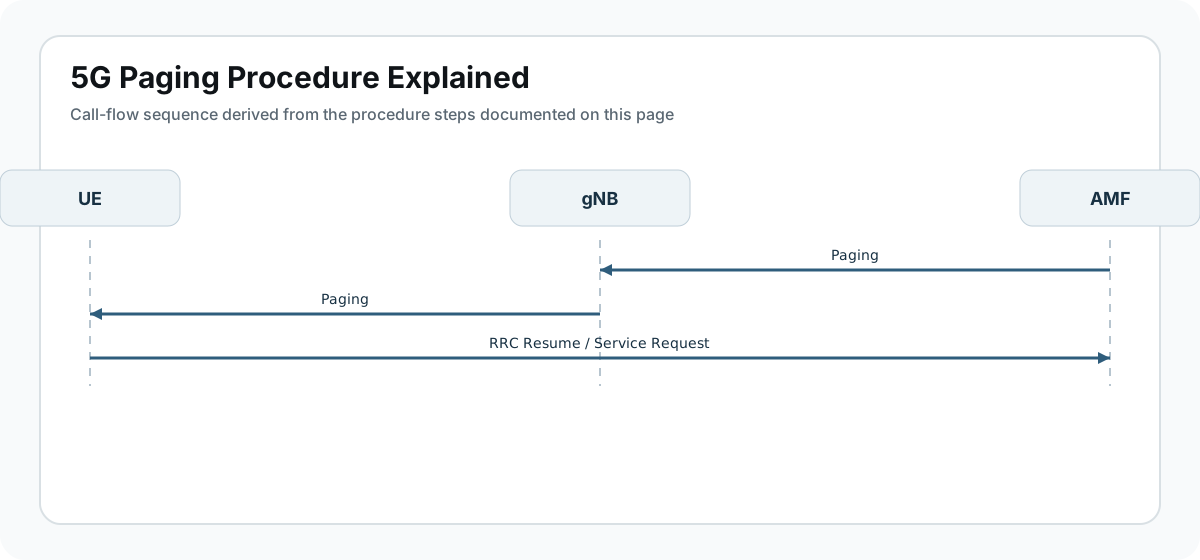
UE                 gNB                 AMF
|                  |                   |
|                  |<-- Paging --------|
|<-- Paging -------|                   |
|-- Resume or Service Request ------->|
|==== UE returns toward active service ====|
Major Phases
| Phase | What happens |
|---|---|
| 1. Downlink service need appears | The core or an application-side event creates a need to reach a UE that is not actively connected. |
| 2. Network paging decision | The AMF identifies the UE reachability area and asks the radio side to page it. |
| 3. Radio broadcast and UE detection | The gNB transmits paging and the UE wakes during the relevant paging occasions to check for its identity. |
| 4. Return-to-service path | If the UE detects its page, it responds with the correct access recovery branch such as RRC Resume or Service Request. |
Step-by-Step Breakdown
Network receives downlink work for an inactive or idle UE
Sender -> receiver: Core or application side -> AMF
Message(s): Downlink data arrival, voice reachability need, or signaling trigger
Purpose: Create the reason to wake a non-connected UE.
State or context change: The UE is still passive, but the network now needs it to become active again.
Note: The business reason matters because the later response path may be voice, data, or registration related.
AMF sends paging toward access nodes
Sender -> receiver: AMF -> gNB(s)
Message(s): Paging
Purpose: Tell the radio side to search for the UE in the right reachability area.
State or context change: The paging responsibility moves from core logic into radio broadcast behavior.
Note: Wrong TAC or stale reachability data often breaks paging before the UE ever has a chance to respond.
gNB broadcasts and UE monitors the correct occasion
Sender -> receiver: gNB -> UE
Message(s): Paging
Purpose: Expose the page over the radio interface so the UE can detect it at the expected time.
State or context change: The UE either finds its page and wakes for service or remains unaware of the request.
Note: Paging DRX, identity matching, and coverage at the wake-up instant are the main checks here.
UE follows the right return-to-service branch
Sender -> receiver: UE -> gNB -> AMF
Message(s): RRC Resume or Service Request
Purpose: Move from passive reachability into active service again.
State or context change: The paging procedure hands off into access restoration and later service continuation.
Note: Paging itself is only successful when the later branch really restores service, not merely when the page is sent.
Important Messages in This Flow
| Message | Protocol | Direction | Purpose in this procedure | What to inspect briefly |
|---|---|---|---|---|
| Paging | RRC | Network -> UE | Carries the wake-up indication for a non-connected UE. | Inspect identity, timing, and whether the UE was monitoring the right occasion. |
| RRC Resume | RRC | UE <-> gNB | Common inactive-state response path after paging. | Use it when the UE kept resumable inactive-state context. |
| Service Request | NAS | UE -> AMF | Common service-restoration step after paging response. | Inspect whether the page led to useful service restoration, not only radio wake-up. |
Important Parameters to Inspect
| Parameter | What it is | Where it appears | Why it matters | Common issues |
|---|---|---|---|---|
| Paging identity | The temporary UE identity used in the paging indication. | Paging | Lets the UE decide whether it is the target of the wake-up request. | Wrong identity mapping means the UE ignores the page. |
| Tracking area and reachability set | The area where the network expects the UE to be reachable. | AMF paging context | Controls which access nodes receive the paging request. | Stale reachability data leads to paging in the wrong place. |
| Paging DRX and occasion timing | When the UE wakes to monitor paging. | UE paging behavior | Explains whether the UE had a fair chance to detect the message. | Timing mismatch or battery-saving behavior can hide real pages. |
| UE state before paging | Whether the UE was idle or inactive. | Operational context | Determines whether the response should be setup, resume, or another recovery path. | Wrong state assumption leads to wrong branch expectations. |
| Post-paging return path | The actual signaling branch taken after the UE detects the page. | Resume or Service Request flow | Shows whether paging led to real service restoration. | Paging can look healthy while the later branch is still broken. |
Success Criteria
- The AMF pages the right reachability area.
- The UE wakes at the expected paging occasion and matches the identity correctly.
- The UE chooses the correct return-to-service branch.
- The later service-restoration path actually succeeds.
Common Failures and Troubleshooting
| Symptom | Likely cause | Where to inspect | Relevant message(s) | Relevant interface(s) | Likely next step |
|---|---|---|---|---|---|
| Paging repeats with no service restoration | The UE is not completing the later access or NAS recovery path. | Follow paging into resume or service request rather than stopping at the page. | Paging, RRC Resume, Service Request | NR-Uu, N1, N2 | This is one of the most common false-closure points in troubleshooting. |
| UE never detects its page | The page was sent, but the UE did not monitor or match it correctly. | Paging occasion timing, identity, and coverage. | Paging | NR-Uu | This is often a reachability or RF timing issue rather than a core issue. |
| Paging goes to the wrong area | The network reachability context is stale or incomplete. | Tracking area and AMF UE context. | Paging request handling | N2 | No amount of radio tuning fixes a wrong reachability map. |
| UE responds but on the wrong branch | The assumed UE state did not match reality or the implementation chose a different recovery path. | Whether the UE was idle, inactive, or partially stale. | Paging plus later response | NR-Uu, N1 | This can make an otherwise healthy trace look inconsistent if the state model was guessed wrong. |
What to Check in Logs and Traces
- Inspect the paging identity and tracking area before blaming the UE.
- Confirm whether the UE was in idle or inactive state at paging time.
- Follow the trace into resume or Service Request to see if service really returned.
- If paging loops, compare AMF reachability context with the radio-side delivery reality.
Related Pages
Related sub-procedures
Related message reference pages
Related troubleshooting pages
FAQ
What is the 5G Paging Procedure?
It is the procedure the network uses to wake a UE that is idle or inactive when downlink service is needed.
Does paging itself restore service?
No. Paging only finds the UE. Real service returns through resume, setup, and or Service Request afterward.
Why does paging fail even when the core sends it?
Because the UE may be paged in the wrong area, at the wrong time, or without matching identity information.
What should I inspect first?
Start with paging identity, reachability area, and whether the UE answered with the expected recovery branch.
How is paging linked to Service Request?
Paging often triggers the UE to restore access and then send Service Request so the core can resume active service.