5G PCC Policy Enforcement Call Flow
5G PCC Policy Enforcement is the procedure family that turns service policy into real traffic behavior.
It joins PCF decisions, SMF session control, and UPF enforcement so charging, gating, and QoS intent become operational reality.
Introduction
Many service problems that look like generic packet loss or poor quality are really policy-enforcement problems.
The right troubleshooting pattern is to trace the full path from policy trigger to SMF translation, then to PFCP state and finally to user-visible packet behavior.
What Is PCC Policy Enforcement in Simple Terms?
- What starts the procedure: A policy, charging, or application event requires new service treatment.
- What the UE and network want to achieve: Apply the correct gating, charging, or QoS behavior to the right traffic.
- What success looks like: Live service behavior matches the intended policy outcome.
- What failure means: Policy exists in control logic but not in actual traffic treatment.
Why this procedure matters
Policy enforcement is where business logic meets packet forwarding. If this layer drifts out of sync, users experience confusing service failures that are hard to explain without the full end-to-end picture.
Quick Fact Sheet
| Procedure name | 5G PCC Policy Enforcement |
|---|---|
| Domain | 5G policy and charging control applied to live session and QoS behavior |
| Main trigger | Subscription, application, charging, or service conditions require policy enforcement on an active service |
| Start state | UE has registration and one or more sessions that can be influenced by policy |
| End state | SMF, UPF, and UE behavior reflect the intended PCC outcome |
| Main nodes | UE, AMF, SMF, UPF, PCF, application function when present |
| Main protocols | N7 policy control, NAS session signaling, PFCP, QoS rules |
| Main success outcome | The intended charging, QoS, gating, or usage policy becomes visible in real session behavior |
| Main failure outcome | Policy exists in control logic but is not enforced correctly in the live path |
| Most important messages | Policy update interactions, PDU Session Modification Command, PFCP updates, usage-trigger outcomes |
| Main specs | TS 23.503, TS 23.501, TS 23.502, TS 29.244 |
Preconditions
- The UE already has registration and a service context that can be policy-controlled.
- The PCF has enough subscription or application information to make a decision.
- The SMF can translate that decision into session and forwarding rules.
- The UPF can apply the resulting enforcement state in the live path.
Nodes and Interfaces
Nodes involved
| Node | Role in this procedure |
|---|---|
| UE | Applies rule changes that affect how traffic is handled locally and how service behaves from the user side. |
| AMF | Relays session policy updates when NAS signaling toward the UE is required. |
| SMF | Translates policy decisions into session, QoS, and charging enforcement actions. |
| UPF | Enforces packet handling, forwarding, gating, and usage reporting behavior tied to PCC rules. |
| PCF | Owns policy decisions related to charging, QoS, steering, gating, and service treatment. |
| Application Function | May provide service intent that influences PCC decisions for a specific application flow. |
Interfaces used
| Interface | Path | Role |
|---|---|---|
| N7 | SMF <-> PCF | Carries policy decisions that drive session and QoS enforcement. |
| N4 | SMF <-> UPF | Installs packet handling and charging-related enforcement state. |
| N1 | UE <-> AMF | Carries session updates that the UE must apply when PCC changes affect local behavior. |
| N11 | AMF <-> SMF | Links NAS session updates to the policy-driven session logic. |
| N3 / NR-Uu | UPF <-> gNB and gNB <-> UE | Reveal whether the enforced policy is actually visible in live traffic. |
End-to-End Call Flow
UE                AMF                SMF                PCF                UPF
|                  |                  |                  |                  |
|                  |                  |<-- policy event -|                  |
|                  |                  |-- request / sync ->|                |
|                  |                  |<-- policy rules ---|                |
|<-- session rule update if needed ---|                  |-- PFCP install -->|
|==== live traffic now reflects policy, charging, or gating behavior ======>|
Major Phases
| Phase | What happens |
|---|---|
| 1. Policy trigger | Charging, service intent, subscription, or usage state triggers a PCC decision. |
| 2. SMF policy translation | The SMF converts the decision into session, QoS, and forwarding changes. |
| 3. Enforcement installation | UPF and sometimes UE receive the new behavior. |
| 4. Service behavior change | Traffic, gating, or charging outcomes become visible operationally. |
| 5. Validation and monitoring | Counters, usage, and packet behavior confirm the policy is really active. |
Step-by-Step Breakdown
A PCC event requires a new enforcement action
Sender -> receiver: Subscription / charging / AF -> PCF -> SMF
Message(s): Policy decision update
Purpose: Start the process that changes how an existing service should be treated.
State or context change: The session moves from its current enforcement state toward a new one.
Note: Understanding the business or service trigger helps explain every later network action.
SMF translates policy into actionable session behavior
Sender -> receiver: SMF internal rule building
Message(s): Session and QoS rule preparation
Purpose: Turn abstract policy into concrete forwarding, charging, and UE-visible rule changes.
State or context change: The network has a deployable enforcement model for the service.
Note: This is where policy intent can be lost if the session context or slice assumptions are wrong.
UPF and UE receive the enforcement change
Sender -> receiver: SMF -> UPF and SMF -> UE via AMF when needed
Message(s): PFCP update and possibly PDU Session Modification Command
Purpose: Activate the new policy in the user plane and, when relevant, in the UE rule set.
State or context change: The session now has a new enforcement posture.
Note: A policy update that never reaches the UPF is not real enforcement, only paperwork.
Traffic behavior changes under policy control
Sender -> receiver: UE <-> gNB <-> UPF
Message(s): Live packet flow with updated gating, QoS, or charging treatment
Purpose: Show the operational effect of the PCC decision.
State or context change: The service becomes measurably different from before the update.
Note: Look for packet drops, priority changes, or flow steering that align with the intended rule.
Usage and compliance are monitored
Sender -> receiver: UPF / SMF / PCF
Message(s): Usage reports and policy-state observation
Purpose: Confirm that the enforced policy continues behaving as intended.
State or context change: The policy outcome is now part of normal session operation.
Note: The best validation often combines signaling, counters, and user-plane evidence instead of using only one of them.
Important Messages in This Flow
| Message | Protocol | Direction | Purpose in this procedure | What to inspect briefly |
|---|---|---|---|---|
| Policy update interaction | Policy control | PCF <-> SMF | Defines what enforcement outcome the session should adopt. | Anchor the trace on this decision when possible. |
| PDU Session Modification Command | NAS | SMF -> UE via AMF | Updates the UE when policy changes affect local session rules. | Check whether UE-facing rule changes match the policy intent. |
| PFCP session update | PFCP | SMF <-> UPF | Installs the actual enforcement logic in the user plane. | Most important proof that PCC became operational. |
| Usage reporting or service counters | Operational evidence | UPF / SMF / charging | Reveal whether the policy was enforced and observed over time. | Useful for validating charging and gating effects. |
Important Parameters to Inspect
| Parameter | What it is | Where it appears | Why it matters | Common issues |
|---|---|---|---|---|
| Policy rule identifier | Reference to the PCC decision being enforced. | Policy and SMF context | Lets you correlate the intent with the operational result. | Without this, policy troubleshooting becomes guesswork. |
| Affected session and QFI | The exact traffic context influenced by the rule. | SMF, NAS, and UPF traces | Shows the enforcement target. | Wrong session targeting causes surprising service impact. |
| Charging / gating action | Whether traffic should be allowed, blocked, rated, or shaped. | Policy decision and PFCP state | Defines the service outcome the user will feel. | Easy to misread if you only inspect QoS parameters. |
| QoS and filter changes | Detailed rule set that matches traffic to the enforced policy. | NAS and UPF state | Explains which packets are actually affected. | Filter mismatch makes policy look inconsistent. |
| Observed traffic effect | What changed in real packet or application behavior. | Live service observation | Best proof of enforcement success. | No user-plane evidence means no trustworthy conclusion. |
Success Criteria
- The policy trigger is clearly translated into session behavior.
- PFCP installs the intended enforcement state in the UPF.
- UE-facing updates are delivered when local behavior must change.
- Traffic, QoS, charging, or gating outcomes match policy intent.
Common Failures and Troubleshooting
| Symptom | Likely cause | Where to inspect | Relevant message(s) | Relevant interface(s) | Likely next step |
|---|---|---|---|---|---|
| Policy is accepted but traffic does not change | The decision never became real enforcement in the UPF or UE. | PFCP state and live packets. | Policy update / session modification | N4, N1, N3 | This is the most common PCC troubleshooting pattern. |
| The wrong traffic is controlled | Filters or session targeting are wrong. | Affected session, QFI, and packet filters. | Rule payload | N1, N4 | Always verify the intended application mapping. |
| Charging looks wrong after a policy update | Usage reporting or charging action does not match the PCC intent. | Usage reports and PCF/SMF correlation. | Policy and usage records | Charging interfaces | Treat charging evidence as part of the call flow outcome. |
| Service is degraded unexpectedly after enforcement | The policy was installed, but the resulting QoS or gating is harsher than intended. | 5QI, gating action, and live KPIs. | PFCP and traffic outcome | N4, N3 | This can be a valid enforcement result but an incorrect policy design. |
Related Pages
Related sub-procedures
Related message reference pages
Related troubleshooting pages
FAQ
What is PCC Policy Enforcement?
It is the process that turns 5G policy decisions into real QoS, charging, gating, or traffic-handling behavior.
Which node really enforces PCC?
The SMF coordinates it, but the UPF usually provides the main user-plane enforcement.
What proves success?
The policy decision is visible in PFCP state and in live traffic or charging behavior.
What should I inspect first?
Start with the policy trigger, the affected session, the PFCP update, and the observed packet outcome.
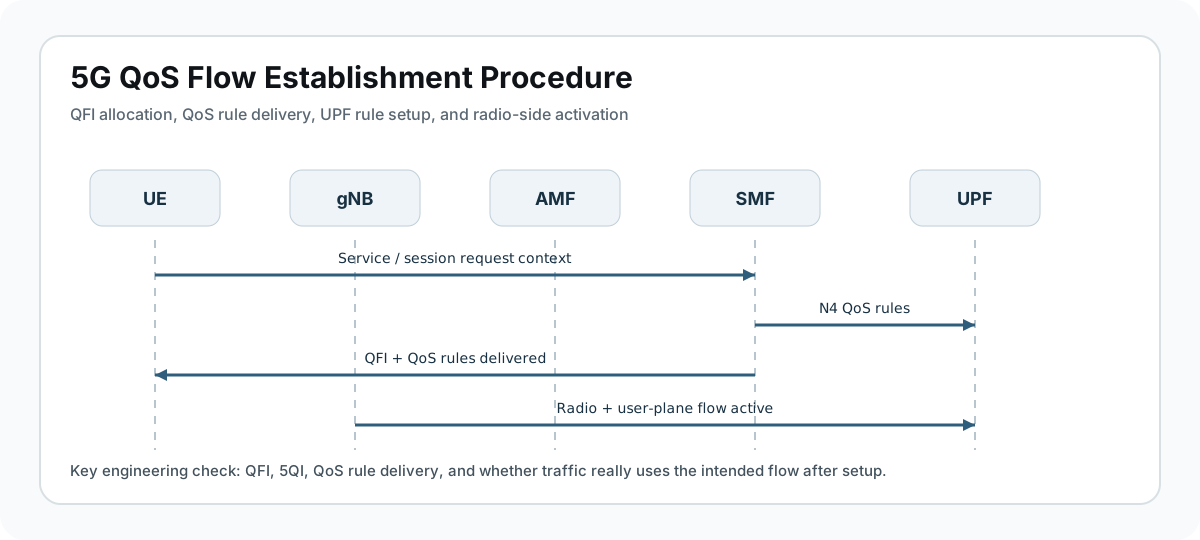
Why is this page related to QoS flows?
Because many PCC decisions are delivered through QoS rules and session-modification behavior.