5G PDU Session Modification Procedure Call Flow
5G PDU Session Modification updates an already-established PDU session when QoS, policy, routing, or service behavior needs to change.
It is the procedure that keeps a session usable as traffic conditions, policy decisions, or service expectations evolve.
Introduction
This is the session-management update path engineers use when the UE already has connectivity but the session profile is no longer correct for the service it is carrying.
The strongest troubleshooting pattern is to compare the old session behavior, the requested or policy-driven change, the delivered modification command, and the first real packets after the update.
What Is PDU Session Modification in Simple Terms?
- What starts the procedure: A live session needs different QoS, filters, policy treatment, or routing.
- What the UE and network want to achieve: Update the active PDU session without tearing it down and recreating it.
- What success looks like: The modification completes and the session behaves according to the new service profile.
- What failure means: The change is rejected, partial, or technically accepted but operationally wrong.
Why this procedure matters
A large share of real 5G service issues are modification problems rather than establishment problems. If you misclassify them, you waste time chasing registration or transport layers that are not actually broken.
Quick Fact Sheet
| Procedure name | 5G PDU Session Modification Procedure |
|---|---|
| Domain | 5G NR + 5GC session update and QoS change handling |
| Main trigger | Existing session needs updated QoS, policy, route, or service treatment |
| Start state | UE already has an active PDU session |
| End state | The session remains active but with updated parameters and user-plane treatment |
| Main nodes | UE, gNB, AMF, SMF, UPF, PCF |
| Main protocols | NAS, NGAP, PFCP, QoS policy signaling |
| Main success outcome | Modification command completes and the changed QoS or forwarding behavior works in live traffic |
| Main failure outcome | The session stays active but the requested update is rejected, partial, or operationally wrong |
| Most important messages | PDU Session Modification Command, PDU Session Modification Complete, related PFCP updates |
| Main specs | TS 23.502, TS 24.501, TS 23.501, TS 29.244 |
Preconditions
- A valid PDU session already exists.
- The network can identify the session context and the reason a change is needed.
- SMF, UPF, and policy functions can apply the updated session profile.
- The UE can receive and process the modification command successfully.
Nodes and Interfaces
Nodes involved
| Node | Role in this procedure |
|---|---|
| UE | Applies the new QoS rules, packet filters, and session parameters for the already-active PDU session. |
| gNB | Adapts access-side QoS and transport behavior that matches the modified session treatment. |
| AMF | Carries the NAS signaling path between UE and SMF. |
| SMF | Decides what changes are allowed and updates session, policy, and UPF state. |
| UPF | Implements the new forwarding, QoS enforcement, and packet detection behavior. |
| PCF | Supplies updated policy decisions when the modification is policy-driven. |
Interfaces used
| Interface | Path | Role |
|---|---|---|
| NR-Uu | UE <-> gNB | Carries modified access-side QoS behavior and later traffic. |
| N1 | UE <-> AMF | Carries the modification command and completion result. |
| N2 | gNB <-> AMF | Allows access-side context to stay aligned with the modified session. |
| N11 | AMF <-> SMF | Coordinates the session update decision and NAS payload generation. |
| N4 / N3 | SMF <-> UPF and gNB <-> UPF | Install new forwarding rules and keep the user plane aligned to the updated session. |
End-to-End Call Flow
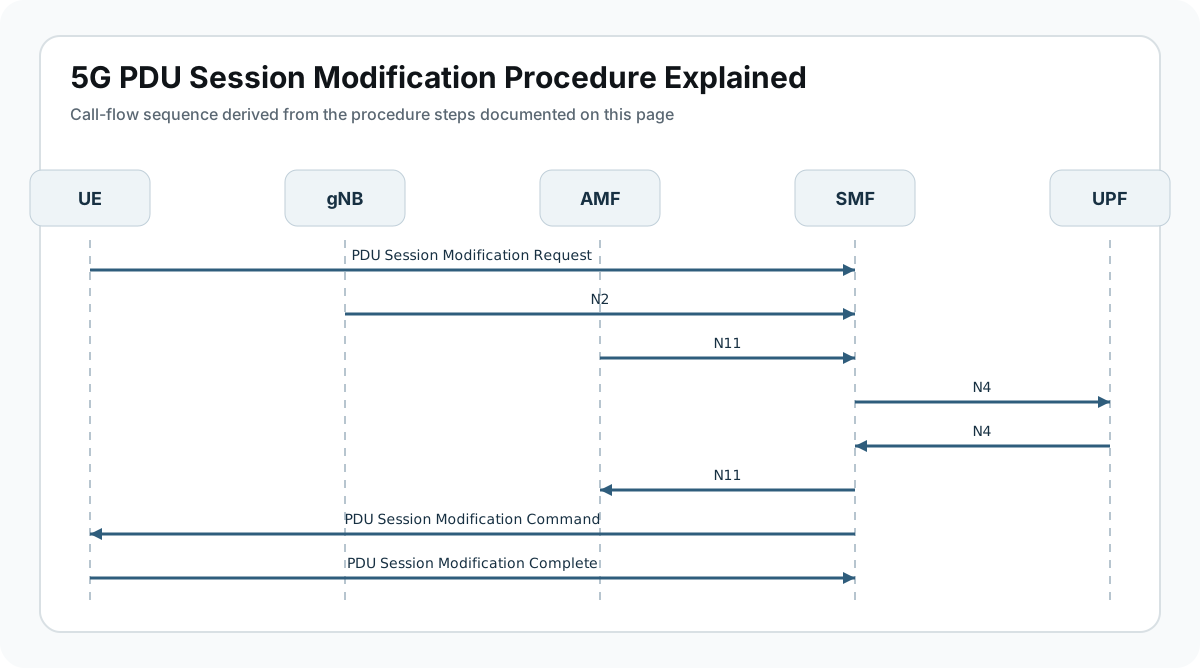
UE                gNB                AMF                SMF                UPF
|                  |                  |                  |                  |
|<-- Modification Command ------------|<-----------------|                  |
|                  |                  |                  |-- PFCP update -->|
|                  |                  |                  |<-- updated rules -|
|-- Modification Complete ----------->|----------------->|----------------->|
|==== traffic follows updated QoS and forwarding ========================>|
Major Phases
| Phase | What happens |
|---|---|
| 1. Change need appears | A policy, application, service, or mobility event requires an existing session to change behavior. |
| 2. Update decision | The UE or network requests a modification to the current PDU session context. |
| 3. Core and UPF update | The SMF updates QoS, filters, routing, or policy-linked state and pushes the change to the UPF. |
| 4. UE application | The network instructs the UE to apply the updated session settings. |
| 5. Service validation | Traffic confirms the modified session works as intended after the change. |
Step-by-Step Breakdown
A session change is triggered
Sender -> receiver: UE or network policy logic
Message(s): Policy trigger, service request, or mobility-driven update
Purpose: Identify that the current PDU session no longer matches the needed service behavior.
State or context change: The session is active but needs changed parameters.
Note: Separate a true modification case from a new-session case before interpreting the signaling.
The session modification is evaluated
Sender -> receiver: UE -> AMF -> SMF or network-internal trigger
Message(s): PDU Session Modification handling
Purpose: Decide whether the requested QoS or service change is allowed.
State or context change: The SMF works against existing session and policy context.
Note: Use the session ID and old-vs-new QoS values to keep the analysis grounded.
UPF and policy state are updated
Sender -> receiver: SMF <-> UPF and policy functions
Message(s): PFCP rule changes, QoS and filter updates
Purpose: Turn the approved modification into actual user-plane behavior.
State or context change: The modified session design is staged in the core network.
Note: Many field failures are partial updates where NAS looks good but UPF enforcement is stale.
The network sends PDU Session Modification Command
Sender -> receiver: SMF -> AMF -> UE
Message(s): PDU Session Modification Command
Purpose: Tell the UE exactly what has changed in the active session.
State or context change: The UE receives the new QoS rules and session behavior details.
Note: Compare the command to the requested change, not only to the previous Accept.
The UE confirms and traffic proves the change
Sender -> receiver: UE -> AMF and user plane
Message(s): PDU Session Modification Complete
Purpose: Confirm that the UE accepted the change and that the updated session behaves correctly.
State or context change: The modified session becomes operational.
Note: The best proof is application traffic that now follows the expected QoS or routing treatment.
Important Messages in This Flow
| Message | Protocol | Direction | Purpose in this procedure | What to inspect briefly |
|---|---|---|---|---|
| PDU Session Modification Command | NAS | SMF -> UE via AMF | Instructs the UE to apply updated session settings. | Inspect updated QoS rules, QFIs, filters, and any removed resources. |
| PDU Session Modification Complete | NAS | UE -> SMF via AMF | Confirms the UE applied the new session settings. | Use it to separate command delivery issues from later service failures. |
| PFCP session update | PFCP | SMF <-> UPF | Applies the new forwarding and enforcement behavior in the UPF. | Check QER, FAR, and PDR alignment with the requested service change. |
| Related policy decision | Policy | PCF -> SMF | Explains why the session profile had to change. | Helpful when modification appears unexpected from the UE perspective. |
Important Parameters to Inspect
| Parameter | What it is | Where it appears | Why it matters | Common issues |
|---|---|---|---|---|
| PDU Session ID | Identifier of the session being changed. | Modification command and session context | Lets you correlate the update to the correct active session. | Wrong correlation can make the wrong session look broken. |
| QFI and QoS rules | QoS treatment applied to flows in the session. | Command and UPF state | Critical for proving whether the requested service change actually happened. | Mismatch causes silent quality or reachability failures. |
| Packet filters | Rules that bind traffic to the right QoS behavior. | Command and UPF state | Help explain how application traffic is classified after the update. | Wrong filters create partial service failures. |
| AMBR and policy profile | Bandwidth and policy treatment attached to the session. | Policy decision and NAS update | Important for congestion, voice, or premium-service behavior. | Looks healthy until real traffic load appears. |
| Cause or trigger context | Why the modification happened. | Trigger source and policy path | Separates user-driven changes from network-enforced behavior. | Without it, troubleshooting becomes guesswork. |
Success Criteria
- The correct active session is modified without creating a new session accidentally.
- The UE receives and applies the updated session settings.
- UPF and access-side enforcement match the new QoS and filter rules.
- Real traffic demonstrates the intended service behavior after the change.
Common Failures and Troubleshooting
| Symptom | Likely cause | Where to inspect | Relevant message(s) | Relevant interface(s) | Likely next step |
|---|---|---|---|---|---|
| Modification command never arrives | The change was not successfully signaled toward the UE. | SMF decision path, N1 transport, and UE reachability. | Modification Command | N1, N11 | Separate session-update failure from generic UE signaling failure. |
| Command arrives but traffic behavior does not change | UPF or access-side enforcement did not line up with the NAS update. | PFCP state, QFI behavior, and first application packets after the change. | Modification Command, Complete | N3, N4 | This is the classic partial-update failure pattern. |
| Wrong QoS profile is applied | The modification was processed against the wrong policy or service intent. | Updated QoS rules, policy inputs, and old-vs-new session profile. | Modification Command | Policy, N11 | Compare requested behavior against actual delivered profile. |
| Session becomes unstable after modification | The update itself succeeded, but service continuity was weakened by the change. | Traffic loss, latency spike, filter mismatch, or radio-side bearer behavior. | Post-modification traffic | NR-Uu, N3 | Treat this as a correctness issue after modification, not a release failure. |
What to Check in Logs and Traces
- Correlate everything using the PDU Session ID before comparing old and new state.
- Inspect the Modification Command for QFI, filter, and policy changes, not just whether it arrived.
- Check PFCP updates to confirm the UPF actually changed forwarding behavior.
- Validate the result with live application traffic after the update, especially under load.
- When the change looks unexpected, trace the policy trigger that caused it.
Related Pages
Related sub-procedures
- 5G PDU Session Establishment
- 5G PDU Session Release
- 5G QoS Flow Modification
- 5G Session Recovery after Mobility / Path Switch
Related message reference pages
Related troubleshooting pages
Notes
Modification success is not just message success. The winning check is whether the session now behaves like the updated service profile intended.
FAQ
What is 5G PDU Session Modification?
It is the procedure used to change the parameters of an already-active PDU session without creating a new one.
What usually triggers it?
QoS changes, policy updates, service changes, mobility events, or application-driven requirements.
What proves success?
The UE completes the modification and live traffic follows the new QoS or routing behavior correctly.
How is it different from PDU Session Establishment?
Establishment creates a new session. Modification updates an existing session.
What should I inspect first?
Start with the session ID, the trigger for change, the modification command, and UPF rule updates.