5G Radio Link Failure Recovery Call Flow
5G Radio Link Failure Recovery is the broader failure-handling path that begins when connected-mode radio continuity is lost badly enough that ordinary connected-mode control is no longer enough.
It joins failure detection, branch selection, reestablishment or fresh setup, and later service restoration into one practical recovery story.
Introduction
RLF recovery is bigger than a single message. It starts before the visible recovery exchange and ends only when the UE has real service again.
That is why this page sits naturally beside Beam Failure Recovery and RRC Reestablishment rather than replacing them.
What Is Radio Link Failure Recovery in Simple Terms?
- What starts the procedure: The active radio link becomes unusable.
- What the UE and network want to achieve: Recover the fastest valid radio and service path after failure.
- What success looks like: The UE chooses the right branch and real service returns with acceptable outage time.
- What failure means: Recovery branch selection, context continuity, or post-recovery service continuation breaks down.
Why this procedure matters
Radio link failure recovery is where 5G access resilience becomes measurable. It reveals whether the network can turn severe radio trouble into a short interruption or whether the outage cascades into a long restart.
Quick Fact Sheet
| Procedure name | 5G Radio Link Failure Recovery |
|---|---|
| Domain | 5G NR connected-mode radio failure handling |
| Main trigger | The UE or network determines that the active radio link is no longer usable |
| Start state | UE was connected, but radio continuity has broken down badly enough to threaten the session |
| End state | The UE either recovers through reestablishment or falls back to fresh access and broader restoration |
| Main nodes | UE, gNB, optionally AMF and later target nodes |
| Main protocols | RRC, radio-failure detection, NAS as later recovery continuation |
| Main success outcome | The failure is recognized quickly and the UE follows the correct next recovery branch |
| Main failure outcome | Recovery branch selection is wrong, context is lost, or the UE remains out of service too long |
| Most important messages | RRC Reestablishment Request, RRC Reestablishment, RRC Setup Request |
| Main specs | TS 38.331, TS 38.300, TS 23.502 |
Preconditions
- The UE was previously in connected mode.
- Radio continuity has degraded beyond ordinary connected-mode correction.
- The UE can still attempt a valid recovery branch.
- Later NAS or service restoration remains possible after radio recovery.
Nodes and Interfaces
Nodes involved
| Node | Role in this procedure |
|---|---|
| UE | Detects that connected-mode continuity is gone and chooses the right next recovery branch. |
| gNB | May accept reestablishment, reject it, or indirectly force the UE to fall back to fresh access. |
| AMF | Becomes relevant once the UE must continue into broader service restoration after radio recovery. |
Interfaces used
| Interface | Path | Role |
|---|---|---|
| NR-Uu | UE <-> gNB | Carries the immediate radio recovery attempt after link failure. |
| N1 and N2 | UE/gNB <-> AMF | Carry later recovery continuation if the UE must rebuild higher-layer service after radio recovery. |
End-to-End Call Flow
UE                    gNB                    AMF
|== radio link fails ==|                       |
|-- Reestablishment Request? ->|               |
|<- Reestablishment -----------|               |
|   or fallback to Setup       |               |
|-- later service restoration ---------------->|
Major Phases
| Phase | What happens |
|---|---|
| 1. Radio failure detection | The connection degrades beyond normal connected-mode recovery and is treated as a real radio link failure. |
| 2. Recovery branch selection | The UE decides whether it can attempt RRC Reestablishment or must fall back to fresh setup. |
| 3. Radio recovery attempt | The network either restores the connection through reestablishment or leaves the UE to perform new access. |
| 4. Higher-layer continuation | After radio recovery, the UE still may need service restoration, security refresh, or session continuity work. |
Step-by-Step Breakdown
UE recognizes that connected mode is no longer viable
Sender -> receiver: UE radio failure detection
Message(s): RLF detection, failed handover continuation, or severe beam or signal collapse
Purpose: Move from ordinary connected-mode handling into explicit failure recovery logic.
State or context change: The connection is no longer trustworthy enough for normal traffic continuation.
Note: The most valuable context is often the few seconds before this point, not only the recovery branch itself.
UE decides whether reestablishment is possible
Sender -> receiver: UE recovery logic
Message(s): RRC Reestablishment Request or fresh setup path
Purpose: Choose the least disruptive valid recovery option based on surviving context.
State or context change: The failure branches into reestablishment or new access.
Note: A wrong branch choice or stale context can waste time and deepen the outage.
Network accepts reestablishment or forces fallback
Sender -> receiver: UE <-> gNB
Message(s): RRC Reestablishment or later RRC Setup Request
Purpose: Recover the radio link in the quickest valid way.
State or context change: The UE either regains connected mode with preserved context or starts over with fresh access.
Note: The presence or absence of usable context is the main divider between graceful and disruptive recovery.
UE continues into broader service restoration
Sender -> receiver: UE -> gNB -> AMF
Message(s): RRC Reestablishment Complete, Setup Complete, Service Request, or Registration Request
Purpose: Restore actual service after the radio problem is under control.
State or context change: The recovery shifts from pure radio continuity into end-to-end service continuity.
Note: Do not mark the case as solved until traffic or signaling really resumes.
Important Messages in This Flow
| Message | Protocol | Direction | Purpose in this procedure | What to inspect briefly |
|---|---|---|---|---|
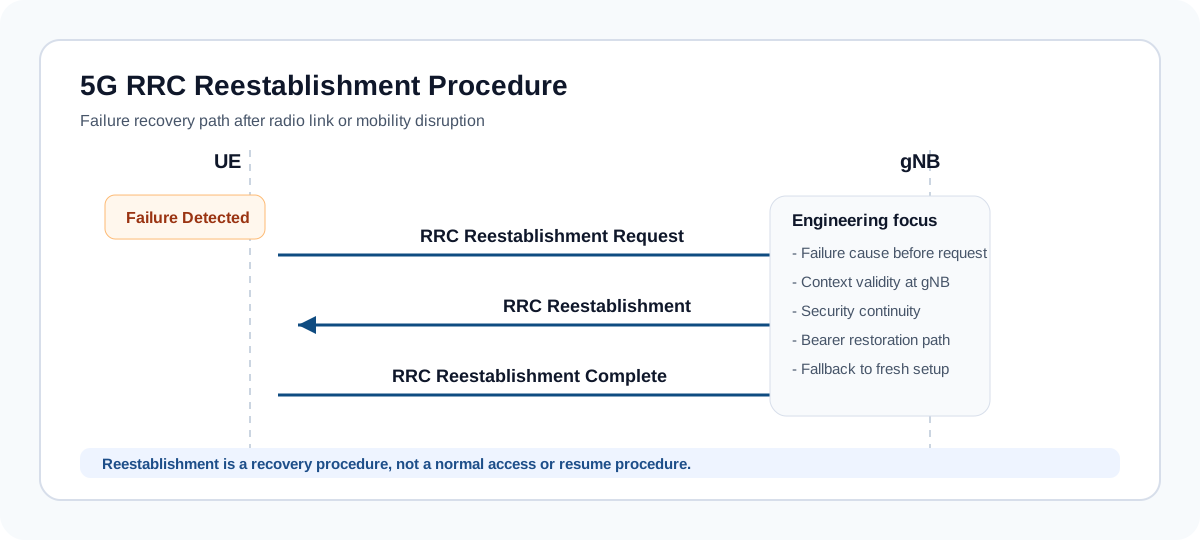
| RRC Reestablishment Request | RRC | UE -> gNB | Starts the preferred failure-recovery branch when enough context survives. | Inspect cause, short identity, and whether the target cell is appropriate. |
| RRC Reestablishment | RRC | gNB -> UE | Restores the radio leg if recovery is accepted. | Inspect whether the network really had usable context for the UE. |
| RRC Setup Request | RRC | UE -> gNB | Represents the fallback to fresh access if reestablishment is not viable. | Use it to confirm that the trace shifted from recovery into restart. |
Important Parameters to Inspect
| Parameter | What it is | Where it appears | Why it matters | Common issues |
|---|---|---|---|---|
| Failure cause context | What triggered the RLF path: beam collapse, handover failure, interference, or rapid signal loss. | Pre-failure trace window | Explains why the link failed and what kind of fix is realistic. | Without cause context, teams only treat symptoms. |
| Surviving context validity | Whether the UE still has enough context for reestablishment. | Recovery branch selection | Determines whether quick recovery is possible. | Stale context leads to failed reestablishment and longer outage. |
| Recovery timing | How quickly the UE moves from failure detection into a valid branch. | RLF timeline | Directly affects outage duration. | Delayed branch selection wastes the limited recovery window. |
| Target or serving cell suitability | Whether the chosen cell can support recovery. | Reestablishment or fresh access attempt | A good branch still fails on a bad cell choice. | Poor cell choice can look like generic radio failure. |
| Post-recovery service continuation | What happens after the radio link comes back. | Later NAS and user-plane behavior | Confirms whether the user experience really recovered. | Radio recovery alone may not restore traffic. |
Success Criteria
- The failure cause is understood early enough to guide the right branch.
- Reestablishment is used when context is still valid, or fresh setup is used quickly when it is not.
- The recovery cell and access path are suitable.
- Service continuity really returns after radio recovery.
Common Failures and Troubleshooting
| Symptom | Likely cause | Where to inspect | Relevant message(s) | Relevant interface(s) | Likely next step |
|---|---|---|---|---|---|
| Reestablishment is attempted but never completes | The surviving context was insufficient or the chosen recovery cell was unsuitable. | Reestablishment cause, identity, and target-cell viability. | RRC Reestablishment Request, RRC Reestablishment | NR-Uu | This is a core RLF recovery failure branch. |
| UE falls back to setup but service still takes too long | The radio failure forced a full restart and later higher-layer restoration also struggled. | Fallback timing and post-setup NAS continuation. | RRC Setup Request, Setup Complete, Service Request | NR-Uu, N1, N2 | Treat this as a longer outage chain, not one isolated event. |
| RLF is blamed on the wrong domain | The visible failure happened in radio recovery, but the root cause was earlier beam trouble or poor mobility decisions. | The trace window before the explicit failure declaration. | Measurements and earlier reconfiguration | NR-Uu | Look backward before optimizing only the recovery branch. |
| Radio recovers but user traffic remains broken | The access leg returned, but session, security, or service restoration still failed. | Post-recovery NAS and user-plane behavior. | Reestablishment Complete, Setup Complete, Service Request | N1, N2, N3 | Do not stop at radio success. |
What to Check in Logs and Traces
- Look at the seconds before RLF, not only the recovery messages.
- Confirm whether reestablishment was truly viable or whether the UE correctly needed fresh setup.
- Measure the gap between failure detection and restored useful service.
- If the radio recovers but traffic does not, keep following NAS and session continuity.
Related Pages
Related sub-procedures
Related message reference pages
Related troubleshooting pages
FAQ
What is 5G Radio Link Failure Recovery?
It is the broader recovery handling used when the active connected-mode radio link breaks down and the UE must restore service through reestablishment or fresh access.
Is it the same as RRC Reestablishment?
No. Reestablishment is one important branch inside the broader RLF recovery story.
What commonly causes RLF?
Beam collapse, rapid signal degradation, interference, failed mobility execution, or severe radio instability can all lead to it.
What should I inspect first?
Start with the pre-failure radio trend, then identify whether reestablishment or fresh setup was the right branch.
When is the case really solved?
Only when radio recovery leads to real service continuity, not just when a recovery message appears.