5G Roaming PDU Session Establishment Call Flow
5G Roaming PDU Session Establishment explains how a roaming UE turns successful registration into real data service.
It joins roaming policy, session admission, UPF path creation, and first live packets into one end-to-end flow.
Introduction
This procedure is where the roaming service model becomes operational. It is no longer enough that the UE is registered; the network must now allow and create the actual session.
The strongest troubleshooting pattern is to compare the requested DNN and slice with the accepted session, then verify the real user-plane path in packet traces.
What Is Roaming PDU Session Establishment in Simple Terms?
- What starts the procedure: A roaming UE needs a PDU session after registration.
- What the UE and network want to achieve: Bring up a valid roaming data session with the permitted path and QoS model.
- What success looks like: The UE gets a usable accepted session and real traffic flows.
- What failure means: Admission fails or the accepted session does not produce the intended service.
Why this procedure matters
Many roaming issues appear only when data service starts. This page helps separate registration success from actual session success in the roaming environment.
Quick Fact Sheet
| Procedure name | 5G Roaming PDU Session Establishment |
|---|---|
| Domain | 5G roaming data-session setup across visited and home policy contexts |
| Main trigger | A roaming UE needs a PDU session after successful registration in the visited network |
| Start state | UE is registered in roaming but does not yet have the needed session for service |
| End state | A roaming PDU session is established with the allowed data path, QoS, and policy model |
| Main nodes | UE, visited gNB, visited AMF, SMF, UPF, home and visited policy functions |
| Main protocols | NAS, NGAP, PFCP, roaming policy coordination |
| Main success outcome | The UE receives a valid PDU Session Establishment Accept and traffic uses the permitted roaming path |
| Main failure outcome | The session is rejected or comes up with restrictions that do not match the intended roaming service model |
| Most important messages | PDU Session Establishment Request, PDU Session Establishment Accept, NGAP resource setup, PFCP updates |
| Main specs | TS 23.502, TS 23.501, TS 24.501, TS 29.244 |
Preconditions
- The UE already has successful roaming registration.
- The requested DNN and slice are meaningful in the roaming context.
- SMF and UPF can build the session according to the active roaming model.
- The gNB can create access-side resources for the accepted session.
Nodes and Interfaces
Nodes involved
| Node | Role in this procedure |
|---|---|
| UE | Requests data service while roaming and validates the accepted roaming session behavior. |
| Visited gNB | Provides access resources for the roaming session. |
| Visited AMF | Relays the NAS session request and coordinates access-side setup. |
| SMF | Creates the roaming session context and chooses the service path according to the roaming model. |
| UPF | Provides the user-plane anchor and forwarding state for the accepted session. |
| Home / visited policy functions | Influence whether the session is allowed and how the service path should be anchored or broken out. |
Interfaces used
| Interface | Path | Role |
|---|---|---|
| N1 | UE <-> visited AMF | Carries the PDU session request and accept/reject outcome. |
| N2 | visited gNB <-> visited AMF | Carries access-side resource setup for the session. |
| N11 | AMF <-> SMF | Connects the roaming request to session-management decisions. |
| N4 | SMF <-> UPF | Installs forwarding and enforcement state for the roaming session. |
| N3 / NR-Uu | UPF <-> gNB and gNB <-> UE | Carry the actual service traffic after setup. |
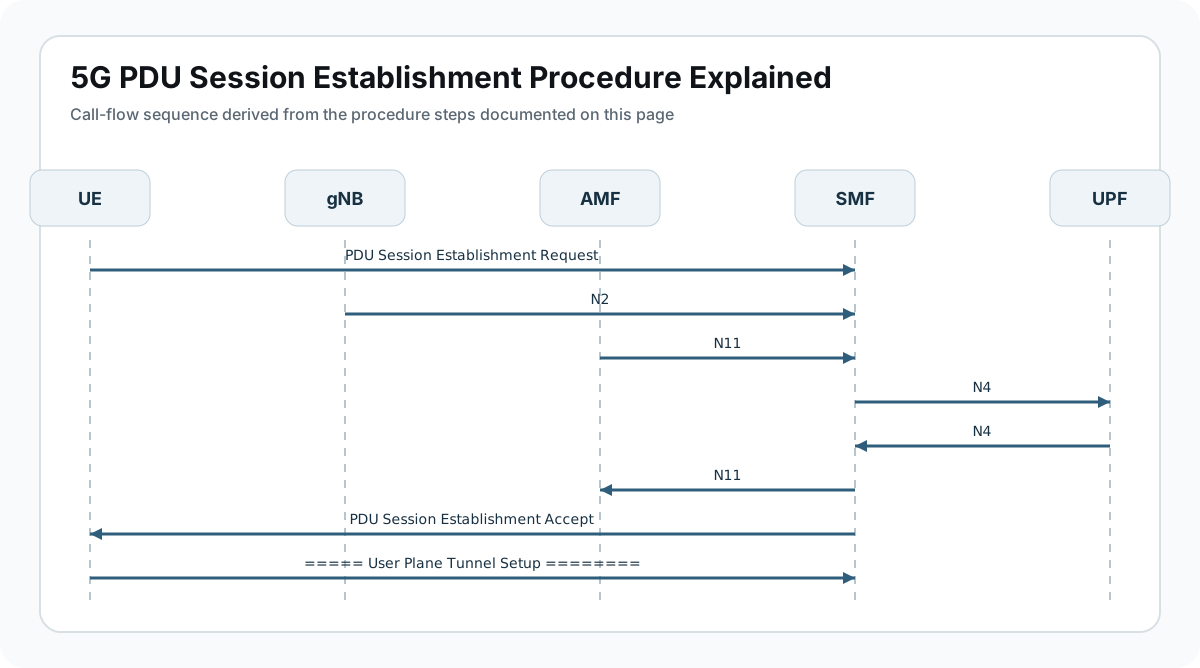
End-to-End Call Flow
UE             visited gNB         visited AMF        SMF / UPF / policy
|                  |                  |                    |
|-- PDU Session Establishment Request -------------------->|
|                  |                  |-- admit / build -->|
|                  |<-- resource setup --------------------|
|<-- PDU Session Establishment Accept ---------------------|
|==== first roaming data packets =========================>|
Major Phases
| Phase | What happens |
|---|---|
| 1. Roaming service need | The registered roaming UE requests a PDU session for data service. |
| 2. Session admission and policy checks | The network verifies slice, DNN, roaming, and policy constraints. |
| 3. Core and access setup | SMF, UPF, and gNB build the roaming session path. |
| 4. UE acceptance | The UE receives PDU Session Establishment Accept. |
| 5. Live traffic validation | Real data confirms the accepted roaming path is operational. |
Step-by-Step Breakdown
The roaming UE requests a session
Sender -> receiver: UE -> visited AMF via gNB
Message(s): PDU Session Establishment Request
Purpose: Start the roaming data session using the allowed DNN, slice, and service expectations.
State or context change: The network begins evaluating whether the roaming UE may get the requested service.
Note: DNN and S-NSSAI are especially important because roaming restrictions often appear here first.
The network checks roaming policy and session feasibility
Sender -> receiver: Visited AMF / SMF <-> policy functions
Message(s): Roaming admission and policy coordination
Purpose: Determine whether the requested session fits the active roaming model and subscriber permissions.
State or context change: The request either progresses toward setup or is limited by policy and entitlement.
Note: A session may be accepted with narrower behavior than the engineer initially expected.
SMF and UPF prepare the roaming data path
Sender -> receiver: SMF <-> UPF
Message(s): PFCP session creation or update
Purpose: Create the forwarding state for the accepted roaming service model.
State or context change: The user-plane anchor becomes ready for the session.
Note: This is the key place to understand whether the path behaves more like home-routed or local-breakout continuity.
Access resources are created and the UE receives acceptance
Sender -> receiver: AMF <-> gNB and AMF -> UE
Message(s): PDU Session Resource Setup Request and PDU Session Establishment Accept
Purpose: Bring the access-side path up and tell the UE which session was accepted.
State or context change: The roaming session becomes operational from a signaling perspective.
Note: Compare the accepted parameters with the originally requested DNN, slice, and QoS expectations.
Traffic proves the roaming session works
Sender -> receiver: UE <-> gNB <-> UPF
Message(s): First service packets over the roaming session
Purpose: Validate the real data path and its policy treatment.
State or context change: The roaming UE reaches usable data service.
Note: First packets matter more than a clean accept if the roaming path is misanchored or restricted unexpectedly.
Important Messages in This Flow
| Message | Protocol | Direction | Purpose in this procedure | What to inspect briefly |
|---|---|---|---|---|
| PDU Session Establishment Request | NAS | UE -> SMF via AMF | Requests the roaming data session. | Inspect DNN, S-NSSAI, and request context carefully. |
| PDU Session Establishment Accept | NAS | SMF -> UE via AMF | Confirms the accepted session and its parameters. | Check what was actually granted versus requested. |
| PDU Session Resource Setup Request | NGAP | AMF -> gNB | Creates access-side session resources. | Shows what the gNB was asked to activate. |
| PFCP session update | PFCP | SMF <-> UPF | Builds the roaming user-plane path. | Best proof of the actual user-plane model. |
Important Parameters to Inspect
| Parameter | What it is | Where it appears | Why it matters | Common issues |
|---|---|---|---|---|
| DNN and S-NSSAI | Requested service and slice identifiers. | Session request and accept | Drive admission and roaming policy evaluation. | Frequent source of roaming mismatch. |
| PDU Session ID | Identifier of the accepted roaming session. | NAS and NGAP traces | Anchor for all later troubleshooting. | Wrong correlation can mix up multiple sessions. |
| Accepted QoS and restrictions | What the UE really got for the roaming session. | PDU Session Establishment Accept | Explains service quality and later behavior. | Do not assume the accepted context matches the request. |
| Roaming path model | Whether the session behavior follows home-routed or visited breakout expectations. | SMF / UPF context | Key to understanding the actual service path. | Misreading this leads to incorrect troubleshooting. |
| First packet outcome | Real traffic behavior on the accepted session. | Live packet traces | Final proof that the session is usable. | No packets means no real service. |
Success Criteria
- The requested session is admitted under the correct roaming model.
- SMF and UPF create the intended roaming user-plane path.
- The gNB activates the needed access-side resources.
- First packets confirm the roaming data session is usable.
Common Failures and Troubleshooting
| Symptom | Likely cause | Where to inspect | Relevant message(s) | Relevant interface(s) | Likely next step |
|---|---|---|---|---|---|
| The session request is rejected in roaming | Requested DNN, slice, or policy treatment is not allowed in the active roaming model. | Request parameters and policy context. | PDU Session Establishment Request / Reject | N1, policy | Start with entitlement and admission rules. |
| The session is accepted but service is narrower than expected | The network granted a restricted roaming session rather than the requested full service profile. | Accepted parameters and roaming restrictions. | PDU Session Establishment Accept | N1, policy | This is very common in real roaming networks. |
| The control plane succeeds but the roaming path does not pass traffic | UPF or access-side setup is incomplete or misanchored. | PFCP state, NGAP resource setup, and first packets. | Accept and resource setup | N2, N4, N3 | Treat this as a user-plane establishment failure inside the roaming context. |
| The wrong roaming model is assumed | The engineer expects home-routed behavior while the trace shows local breakout, or vice versa. | UPF path state and accepted service restrictions. | Overall trace interpretation | SMF / UPF context | Always classify the path model early. |
Related Pages
Related sub-procedures
- 5G NR Roaming Registration
- 5G Home-Routed Roaming Registration
- 5G Local Breakout Roaming Registration
- 5G User Plane Establishment
Related message reference pages
Related troubleshooting pages
FAQ
What is Roaming PDU Session Establishment?
It is the session setup procedure used when a roaming UE requests data service after registering in a visited network.
Does it always behave like home-routed roaming?
No. The actual path depends on the roaming model and policy applied to the session.
What proves success?
PDU Session Establishment Accept, successful access and UPF setup, and working first packets.
What should I inspect first?
Start with DNN, S-NSSAI, accepted restrictions, and the actual user-plane path model.
Why is this page separate from roaming registration?
Because registration proves reachability and entitlement, while this procedure proves real data service.