5G RRC Reconfiguration Procedure Call Flow
5G RRC Reconfiguration is the main connected-mode radio-control procedure used when the network needs to change how a UE is configured after access already exists.
It appears in many real journeys, including bearer activation, measurement setup, handover preparation, and multi-cell reconfiguration.
Introduction
This procedure is less a single use case and more a general connected-mode change container.
That is why successful troubleshooting starts by identifying what kind of change the network intended before reading the individual fields of RRC Reconfiguration.
What Is RRC Reconfiguration in Simple Terms?
- What starts the procedure: The network wants to change radio behavior after the UE is already connected.
- What the UE and network want to achieve: Apply a new bearer, mobility, measurement, or multi-cell configuration without rebuilding access from scratch.
- What success looks like: The UE confirms completion and the intended service behavior improves or continues cleanly.
- What failure means: The command is not completed, is applied badly, or causes later service or mobility instability.
Why this procedure matters
RRC Reconfiguration is where many access, mobility, and service decisions become real radio behavior. If this page is read too generically, engineers miss whether the break is in measurements, bearer mapping, or the handover context hidden inside the same message.
Quick Fact Sheet
| Procedure name | 5G NR RRC Reconfiguration Procedure |
|---|---|
| Domain | 5G NR radio control, bearer setup, mobility, and measurement management |
| Main trigger | The network needs to change UE radio configuration after connected-mode access already exists |
| Start state | UE is already connected and has an active signaling path |
| End state | The UE applies the new radio configuration and confirms completion |
| Main nodes | UE, gNB, optionally AMF and target gNB in mobility cases |
| Main protocols | RRC, NGAP, mobility coordination |
| Main success outcome | The UE activates the intended bearer, mobility, measurement, or dual-connectivity configuration |
| Main failure outcome | The configuration is rejected by behavior, never completed, or causes later instability |
| Most important messages | RRC Reconfiguration, RRC Reconfiguration Complete, Measurement Report |
| Main specs | TS 38.331, TS 38.300, TS 23.502 |
Preconditions
- The UE is already in connected mode with a working signaling path.
- The gNB has a concrete reason to change bearer, mobility, measurement, or secondary-cell state.
- Any linked session or mobility context needed for the change has been prepared.
- The UE capabilities support the intended reconfiguration.
Nodes and Interfaces
Nodes involved
| Node | Role in this procedure |
|---|---|
| UE | Applies the new configuration and confirms whether connected-mode service can continue under the updated settings. |
| gNB | Builds the new radio configuration for bearer setup, measurement control, mobility preparation, or cell changes. |
| AMF or target gNB | May participate indirectly when the reconfiguration is part of mobility or session continuity handling. |
Interfaces used
| Interface | Path | Role |
|---|---|---|
| NR-Uu | UE <-> gNB | Carries the reconfiguration command and the completion response. |
| N2 | gNB <-> AMF | Supports mobility or session coordination that can lead to an RRC reconfiguration. |
| Xn | source gNB <-> target gNB | May support target preparation before a mobility-oriented reconfiguration. |
End-to-End Call Flow
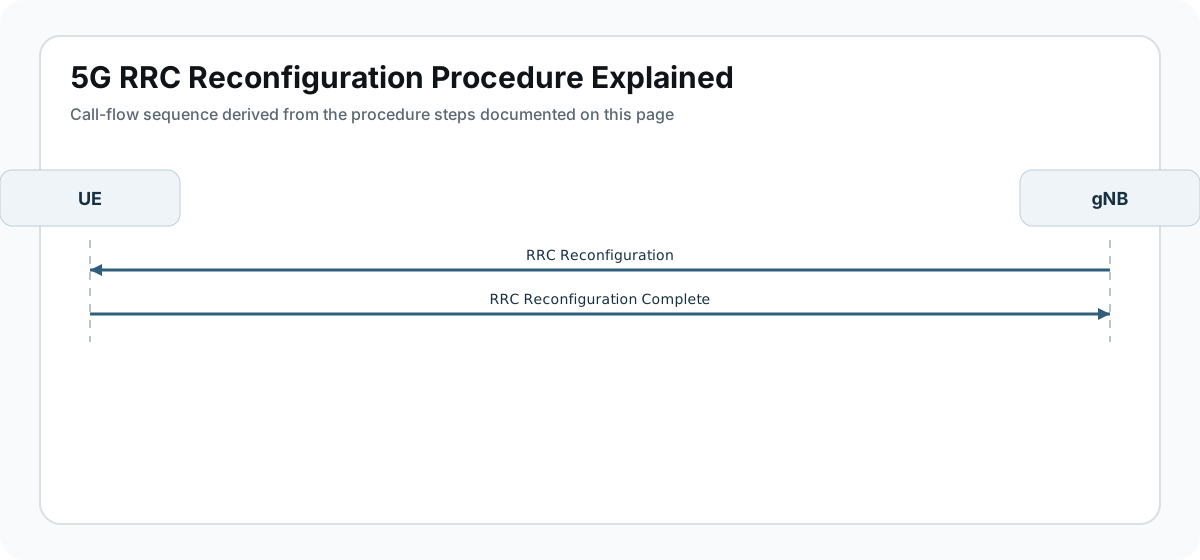
UE                    gNB                 AMF / target
|                     |                       |
|<- RRC Reconfiguration|<-- prep / policy --->|
|-- apply config ------|                       |
|-> RRC Reconfiguration Complete --------------|
|==== Connected mode continues under new settings ====|
Major Phases
| Phase | What happens |
|---|---|
| 1. Network decides to change radio state | The gNB determines that bearer, mobility, measurement, or cell-related settings must change. |
| 2. Reconfiguration build | The network composes the updated radio instructions and any linked mobility or bearer context. |
| 3. Command delivery | The UE receives RRC Reconfiguration and starts applying the change. |
| 4. Activation and confirmation | The UE applies the settings and answers with RRC Reconfiguration Complete. |
Step-by-Step Breakdown
Network decides what must change
Sender -> receiver: gNB internal logic
Message(s): Bearer setup, measurement update, mobility preparation, or cell-change decision
Purpose: Choose the exact connected-mode change required for service continuity or optimization.
State or context change: The session stays connected, but a new radio plan is prepared.
Note: RRC Reconfiguration is a container for many use cases, so identify the real scenario before troubleshooting details.
gNB sends reconfiguration command
Sender -> receiver: gNB -> UE
Message(s): RRC Reconfiguration
Purpose: Deliver the new radio, bearer, mobility, or measurement settings.
State or context change: The UE begins applying the configuration while remaining in connected mode.
Note: The payload often explains whether this is a plain bearer change, a mobility step, or a multi-cell feature activation.
UE applies radio and procedure-specific changes
Sender -> receiver: UE internal processing
Message(s): Configuration application plus possible measurement or bearer activation
Purpose: Make the instructed change operational on the UE side.
State or context change: The old connected-state configuration is replaced or extended by the new one.
Note: Problems here can surface later as missing bearers, unstable measurements, or handover failures.
UE confirms completion
Sender -> receiver: UE -> gNB
Message(s): RRC Reconfiguration Complete
Purpose: Tell the network that the requested change was applied successfully.
State or context change: The connected-mode session continues under the new configuration.
Note: A clean completion does not guarantee good user-plane behavior, so keep following the trace if service remains bad.
Important Messages in This Flow
| Message | Protocol | Direction | Purpose in this procedure | What to inspect briefly |
|---|---|---|---|---|
| RRC Reconfiguration | RRC | gNB -> UE | Carries the actual radio-control change. | Inspect whether the message is about DRBs, measurements, mobility, cells, or multiple features at once. |
| RRC Reconfiguration Complete | RRC | UE -> gNB | Confirms that the UE applied the instructed configuration. | Check whether it is present and correctly timed relative to later service behavior. |
| Measurement Report | RRC | UE -> gNB | Often provides the basis for reconfiguration in mobility and optimization cases. | Use it to understand why the gNB decided to change configuration. |
Important Parameters to Inspect
| Parameter | What it is | Where it appears | Why it matters | Common issues |
|---|---|---|---|---|
| DRB and QoS mapping | Bearer-to-flow configuration applied during connected mode. | RRC Reconfiguration | Controls whether the intended service actually gets a usable data path. | Wrong mapping causes traffic issues after a seemingly successful reconfiguration. |
| Measurement configuration | Events, thresholds, and reporting instructions. | RRC Reconfiguration | Explains mobility behavior and later handover decisions. | Bad thresholds create unstable or missing mobility triggers. |
| Cell or secondary-node configuration | PCell or secondary-cell related radio settings. | RRC Reconfiguration | Needed for CA, EN-DC, MR-DC, and several mobility cases. | UE capability mismatch or unsupported combos. |
| Transaction timing | The sequence between command, application, and completion. | RRC exchange timeline | Separates genuine apply failures from later downstream issues. | Delayed or absent completion is an early sign of trouble. |
| Linked mobility context | Preparation information tied to handover or conditional behavior. | RRC plus N2 or Xn prep | Shows whether the reconfiguration is pure radio tuning or part of a larger move. | Ignoring the mobility context can lead to shallow root-cause analysis. |
Success Criteria
- The UE receives a scenario-appropriate reconfiguration payload.
- The command is completed without losing signaling continuity.
- The intended bearer, mobility, or measurement behavior becomes visible after completion.
- No new instability is introduced by the change.
Common Failures and Troubleshooting
| Symptom | Likely cause | Where to inspect | Relevant message(s) | Relevant interface(s) | Likely next step |
|---|---|---|---|---|---|
| Reconfiguration command is sent but never completed | The UE could not apply the change or lost signaling continuity. | UE capability, radio quality, and command payload complexity. | RRC Reconfiguration, RRC Reconfiguration Complete | NR-Uu | Treat this as application failure before assuming higher-layer issues. |
| Completion is present but service still degrades | The configured change was accepted syntactically but not useful operationally. | Bearer mapping, measurement thresholds, or mobility preparation quality. | RRC Reconfiguration Complete and later user-plane traces | NR-Uu, N2, N3 | Success at RRC level does not mean the whole feature worked well. |
| Mobility becomes unstable after reconfiguration | The measurement or handover-related configuration was too aggressive, too late, or inconsistent. | Measurement events, thresholds, and neighbor-cell context. | RRC Reconfiguration, Measurement Report | NR-Uu | This often surfaces as a policy or tuning problem rather than a parsing issue. |
| Bearer activation looks incomplete | The network intended to activate service but the access and session sides drifted apart. | DRB details, QoS flow mapping, and core-side session coordination. | RRC Reconfiguration and session follow-up | NR-Uu, N2, N11, N3 | Correlate radio changes with session state before closing the case. |
What to Check in Logs and Traces
- Classify the trace as bearer setup, mobility, measurement change, or multi-cell feature before deep inspection.
- Check whether RRC Reconfiguration Complete is present and timely.
- Correlate the command with Measurement Report if the change was mobility-driven.
- If traffic fails after success, inspect DRB and QoS mapping rather than stopping at the RRC result.
Related Pages
Related sub-procedures
Related message reference pages
Related troubleshooting pages
FAQ
What is 5G RRC Reconfiguration used for?
It is used to change a UE radio configuration after the initial connected-mode leg already exists.
Is it only for handover?
No. It is used for bearer setup, measurement configuration, mobility preparation, secondary-cell changes, and many other connected-mode updates.
Why can a trace look successful but service still fail?
Because the UE may complete the command while the chosen configuration is still wrong for the real traffic or mobility condition.
What should I inspect first?
Identify the scenario class first: bearer setup, mobility, measurements, or multi-cell configuration.
What commonly follows RRC Reconfiguration?
Bearer activation, measurement reporting, handover execution, or ongoing service under the new radio settings.