5G RRC Resume Procedure Call Flow
5G RRC Resume is the fast access-restoration procedure used when a UE in inactive state needs to return to connected mode without a full fresh setup.
It is one of the most important bridges between paging or bursty traffic and low-latency service restoration in 5G.
Introduction
The resume path exists because inactive state keeps enough context to avoid rebuilding everything from zero.
That makes it faster than RRC Setup, but also more sensitive to context age, reachability timing, and whether the network still trusts the stored identity.
What Is RRC Resume in Simple Terms?
- What starts the procedure: The UE in inactive state needs connected-mode access again.
- What the UE and network want to achieve: Return to connected mode quickly using stored context.
- What success looks like: Resume completes and the service-restoration flow continues with low overhead.
- What failure means: Stored context is missing or invalid, forcing fallback to fresh setup or broader recovery.
Why this procedure matters
RRC Resume is where 5G inactive-state efficiency becomes visible. It affects latency, battery life, paging responsiveness, and how gracefully the network handles intermittent traffic patterns.
Quick Fact Sheet
| Procedure name | 5G NR RRC Resume Procedure |
|---|---|
| Domain | 5G NR inactive-state return to connected service |
| Main trigger | The UE in inactive state needs to send or receive traffic again and can still use stored context |
| Start state | UE is in RRC Inactive with resumable access context |
| End state | UE returns to RRC Connected without full fresh setup |
| Main nodes | UE, gNB, optionally AMF depending on broader service continuation |
| Main protocols | RRC, NGAP, NAS as the next step after access restoration |
| Main success outcome | The UE restores connected-mode access quickly using stored inactive-state context |
| Main failure outcome | Resume is rejected, context is missing, or the UE must fall back to fresh setup |
| Most important messages | RRC Resume Request, RRC Resume, RRC Resume Complete |
| Main specs | TS 38.331, TS 38.300, TS 23.502 |
Preconditions
- The UE was previously moved into RRC Inactive with resumable context.
- The stored identity and context have not expired or been discarded.
- The serving network can still map the UE to the expected inactive context.
- A real service need exists, such as paging response or uplink data demand.
Nodes and Interfaces
Nodes involved
| Node | Role in this procedure |
|---|---|
| UE | Uses stored inactive-state context to request quick return to connected mode. |
| gNB | Finds or validates the stored context and restores radio configuration if resume is allowed. |
| AMF | May become relevant immediately after resume when NAS service restoration or paging continuation follows. |
Interfaces used
| Interface | Path | Role |
|---|---|---|
| NR-Uu | UE <-> gNB | Carries the full resume exchange. |
| N2 | gNB <-> AMF | Supports broader UE context restoration after the radio leg returns. |
End-to-End Call Flow
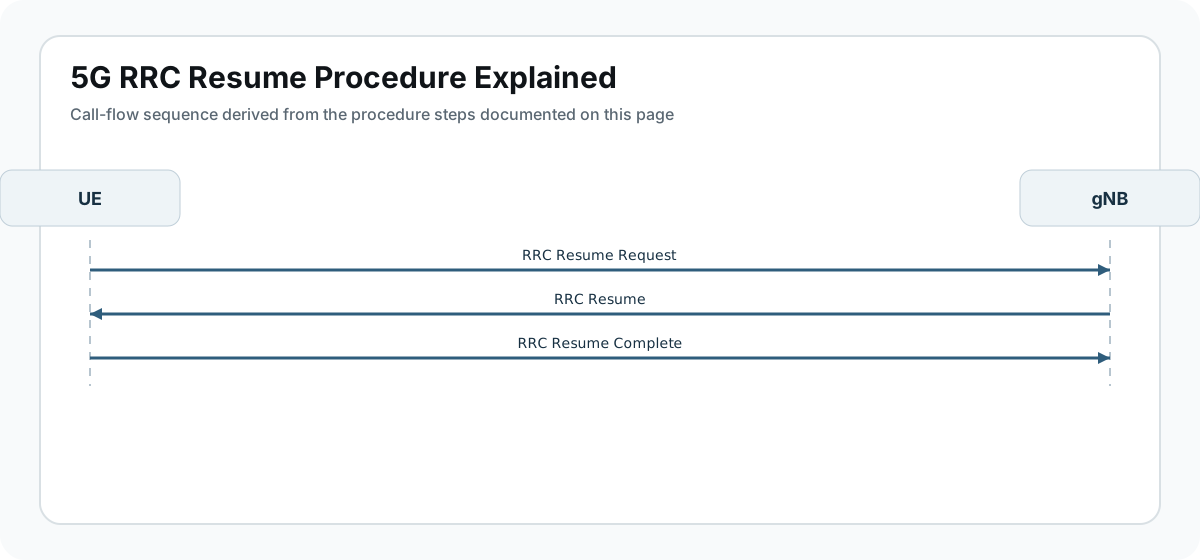
UE                    gNB                    AMF
|                     |                       |
|-- RRC Resume Request ->|                    |
|<- RRC Resume ----------|                    |
|-- RRC Resume Complete ->|-- later NAS ----->|
|==== UE is back in RRC Connected ====|
Major Phases
| Phase | What happens |
|---|---|
| 1. Trigger to leave inactive state | The UE receives paging or has new uplink demand while resumable context still exists. |
| 2. Resume attempt | The UE sends the resume request using its stored identity and inactive-state context reference. |
| 3. Context restoration | The gNB validates or restores the stored context and returns resume configuration. |
| 4. Completion and service continuation | The UE confirms resume and connected-mode service continues toward NAS or user-plane recovery. |
Step-by-Step Breakdown
UE decides to return from inactive state
Sender -> receiver: UE internal trigger or paging response
Message(s): Paging reaction or uplink service trigger
Purpose: Start a fast connected-mode return without full fresh setup.
State or context change: The UE leaves purely inactive behavior and starts using stored context again.
Note: Always confirm that the UE was truly in inactive state; otherwise the trace may belong to setup or reestablishment instead.
UE sends resume request
Sender -> receiver: UE -> gNB
Message(s): RRC Resume Request
Purpose: Ask the network to restore the prior context quickly.
State or context change: The resume path is now committed unless the network refuses it.
Note: The resume identity and cause explain whether the attempt is consistent with the earlier suspend or inactive transition.
gNB restores stored context
Sender -> receiver: gNB -> UE
Message(s): RRC Resume
Purpose: Reapply the stored radio context so the UE can continue as a connected device.
State or context change: The inactive context becomes active connected-mode configuration again.
Note: If the context is stale or missing, the flow usually degrades into a fresh setup path instead.
UE confirms completion and continues service
Sender -> receiver: UE -> gNB
Message(s): RRC Resume Complete
Purpose: Confirm successful restoration and hand control back to the ongoing service or NAS flow.
State or context change: The UE is back in RRC Connected and can continue service restoration.
Note: A clean resume may still be followed by Service Request or other higher-layer steps before traffic returns.
Important Messages in This Flow
| Message | Protocol | Direction | Purpose in this procedure | What to inspect briefly |
|---|---|---|---|---|
| RRC Resume Request | RRC | UE -> gNB | Starts the inactive-state return path. | Inspect resume cause, stored identity, and whether the request matches the earlier suspend context. |
| RRC Resume | RRC | gNB -> UE | Restores the saved radio context. | Inspect whether the configuration matches the intended resumed service state. |
| RRC Resume Complete | RRC | UE -> gNB | Confirms that connected-mode restoration succeeded. | Check for later NAS continuation rather than stopping at the radio result. |
Important Parameters to Inspect
| Parameter | What it is | Where it appears | Why it matters | Common issues |
|---|---|---|---|---|
| Resume identity | The identifier linking the UE to stored inactive-state context. | Resume Request | Lets the gNB find the right stored context quickly. | If wrong or stale, resume fails even with good radio conditions. |
| Resume cause | Why the UE is returning from inactive state now. | Resume Request | Separates paging response from UE-originated activity. | Unexpected causes can reveal the wrong assumed user journey. |
| Stored context availability | Whether the network still has the inactive-state context. | gNB context lookup | Determines whether resume is possible at all. | Missing context forces fallback to full setup. |
| Paging and reachability timing | Whether the UE woke and responded within the expected window. | Paging plus resume timeline | Critical in mobile-terminated recovery paths. | Late wakeup or wrong paging assumption can look like resume failure. |
| Post-resume NAS path | The next service-restoration step after radio return. | After Resume Complete | Shows whether connected-mode return actually restored useful service. | Resume can succeed while later NAS still fails. |
Success Criteria
- The network still has valid resumable context for the UE.
- The resume request matches the expected inactive-state identity.
- The UE returns to connected mode without full setup overhead.
- Later NAS and user-plane continuation proceed cleanly after resume.
Common Failures and Troubleshooting
| Symptom | Likely cause | Where to inspect | Relevant message(s) | Relevant interface(s) | Likely next step |
|---|---|---|---|---|---|
| Resume request gets no useful response | The context was missing, the cell could not resume it, or radio continuity was poor. | Stored context lookup and uplink continuity. | RRC Resume Request, RRC Resume | NR-Uu | This often falls back to fresh setup rather than ending the user journey outright. |
| Resume completes but service still does not return | Access restoration worked, but later NAS or user-plane continuation failed. | Post-resume Service Request and user-plane recovery. | RRC Resume Complete and follow-on NAS | NR-Uu, N1, N2 | Keep following the trace into service restoration. |
| Paging leads to repeated resume attempts | The UE is reachable enough to try, but the context or continuation path is unstable. | Paging identity, resume identity, and access-state loops. | Paging, RRC Resume Request | NR-Uu, N2 | This is a strong sign of reachability continuity trouble, not just one bad message. |
| Resume unexpectedly falls back to setup | The inactive-state context was no longer trusted or usable. | Whether the network lost context or intentionally declined resume. | Resume failure signs and later RRC Setup | NR-Uu | This is an important branch, not just a generic error. |
What to Check in Logs and Traces
- Verify that the UE really came from RRC Inactive.
- Inspect the resume identity and whether the cell could still find the stored context.
- Correlate paging timing with the resume attempt if the trigger was mobile-terminated traffic.
- If the radio side succeeds, immediately inspect Service Request or later service-continuation behavior.
Related Pages
Related sub-procedures
Related message reference pages
Related troubleshooting pages
FAQ
What is 5G RRC Resume?
It is the fast return path from RRC Inactive back to RRC Connected using stored context.
How is it different from RRC Setup?
Setup creates a fresh access leg, while Resume tries to reuse stored context from an earlier inactive state.
When is RRC Resume used?
Usually after paging or UE-originated traffic when the UE was placed in inactive state rather than fully released.
Why can resume succeed but the user still sees no data?
Because later NAS or user-plane restoration may still fail after the radio leg returns.
What should I inspect first?
Start with whether the stored context should still exist and whether the trigger was paging-driven or UE-driven.