5G RRC Setup Procedure Call Flow
5G RRC Setup is the access-side radio procedure that creates a connected-state signaling path between the UE and the gNB.
It is the bridge between camped idle-state behavior and the first real NAS procedure such as initial registration, emergency registration, or service request.
Introduction
The procedure begins when a UE needs active signaling and cannot use a stored inactive-state resume path.
Once RRC Setup Complete is sent, the radio side is ready and the journey usually continues into core-facing NAS signaling.
What Is RRC Setup in Simple Terms?
- What starts the procedure: The UE needs connected-mode signaling for registration, paging response, or data.
- What the UE and network want to achieve: Create an initial signaling radio bearer and deliver the first NAS message.
- What success looks like: The UE enters connected mode and the first NAS procedure starts cleanly.
- What failure means: The UE cannot finish setup, is rejected, or never reaches meaningful NAS continuation.
Why this procedure matters
RRC Setup is the front door for many 5G user journeys. If engineers treat it as an isolated radio exchange, they can miss whether the real break happened during admission, setup completion, or the immediate NAS handoff.
Quick Fact Sheet
| Procedure name | 5G NR RRC Setup Procedure |
|---|---|
| Domain | 5G NR access-side radio connection establishment |
| Main trigger | The UE needs to move from idle into connected mode for registration, service request, paging response, or uplink data |
| Start state | UE is camped on a suitable NR cell and has no active RRC connection |
| End state | UE enters RRC Connected and can carry NAS signaling toward the 5G Core |
| Main nodes | UE, gNB, AMF |
| Main protocols | RRC, NAS, NGAP |
| Main success outcome | The UE completes setup and delivers the first NAS container over the new signaling path |
| Main failure outcome | Setup is rejected, access stalls before completion, or later NAS signaling never reaches the AMF |
| Most important messages | RRC Setup Request, RRC Setup, RRC Setup Complete |
| Main specs | TS 38.331, TS 38.300, TS 23.502 |
Preconditions
- The UE has selected a suitable NR cell and is not already in connected mode.
- Access is allowed for the intended establishment cause.
- The gNB has resources to admit the UE and create the initial signaling leg.
- The UE has a next-step NAS procedure ready to send after setup completes.
Nodes and Interfaces
Nodes involved
| Node | Role in this procedure |
|---|---|
| UE | Starts the access-side connection and carries the first NAS payload after radio setup succeeds. |
| gNB | Admits the UE, creates the initial signaling configuration, and forwards the NAS message toward the core. |
| AMF | Receives the first NAS procedure after the radio path is ready, typically registration or service request. |
Interfaces used
| Interface | Path | Role |
|---|---|---|
| NR-Uu | UE <-> gNB | Carries the initial RRC signaling that creates the connected-state radio leg. |
| N1 | UE <-> AMF via gNB | Carries the first NAS container inside RRC Setup Complete. |
| N2 | gNB <-> AMF | Carries NGAP signaling once the gNB forwards the UE NAS message toward the core. |
End-to-End Call Flow
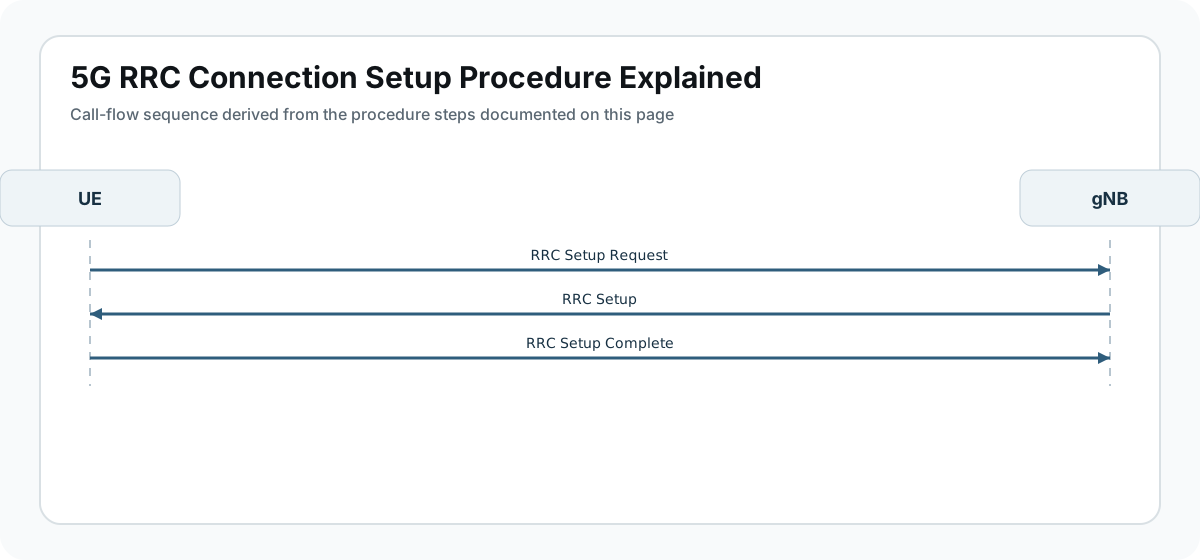
UE                    gNB                    AMF
|                     |                       |
|-- RRC Setup Request ->|                      |
|<- RRC Setup ----------|                      |
|-- RRC Setup Complete ->|-- NAS / NGAP ----->|
|===== UE is in RRC Connected and NAS continues =====>|
Major Phases
| Phase | What happens |
|---|---|
| 1. Access intent | The UE decides it needs connected-state signaling for registration, service restoration, paging response, or uplink data. |
| 2. Initial RRC request | The UE sends RRC Setup Request with an establishment cause. |
| 3. Radio configuration delivery | The gNB returns RRC Setup with the initial SRB and radio parameters. |
| 4. Completion and NAS handoff | The UE applies the configuration and sends RRC Setup Complete with the first NAS payload. |
Step-by-Step Breakdown
UE requests access-side connection
Sender -> receiver: UE -> gNB
Message(s): RRC Setup Request
Purpose: Tell the gNB that the UE needs a connected-state signaling path.
State or context change: The UE moves from cell camping into active access establishment.
Note: The establishment cause is one of the first clues for why the UE entered connected mode.
gNB accepts and builds the initial signaling leg
Sender -> receiver: gNB -> UE
Message(s): RRC Setup
Purpose: Create the initial SRB and radio configuration needed for protected signaling continuation.
State or context change: The radio leg becomes usable for the final setup confirmation and NAS delivery.
Note: If setup is sent but the UE never completes, inspect uplink quality and configuration compatibility.
UE confirms setup and carries the first NAS container
Sender -> receiver: UE -> gNB -> AMF
Message(s): RRC Setup Complete with NAS container
Purpose: Confirm the radio configuration and hand the first core-facing message to the network.
State or context change: The UE is now in RRC Connected and the procedure hands off into registration or service signaling.
Note: If the RRC side looks healthy but the user journey still fails, follow the NAS payload next.
Important Messages in This Flow
| Message | Protocol | Direction | Purpose in this procedure | What to inspect briefly |
|---|---|---|---|---|
| RRC Setup Request | RRC | UE -> gNB | Starts the access-side connection. | Inspect establishment cause, UE identity style, and whether repeated retries occur. |
| RRC Setup | RRC | gNB -> UE | Provides the initial radio configuration. | Inspect SRB settings, cell-specific configuration, and whether the message reaches the UE cleanly. |
| RRC Setup Complete | RRC + NAS | UE -> gNB | Confirms setup and transports the first NAS payload. | Inspect the embedded NAS container and whether it matches the intended user journey. |
Important Parameters to Inspect
| Parameter | What it is | Where it appears | Why it matters | Common issues |
|---|---|---|---|---|
| Establishment cause | Why the UE is asking for connected mode. | RRC Setup Request | Explains whether the flow is registration, paging response, emergency, or another access reason. | Unexpected causes often point to a different user journey than assumed. |
| UE identity | Temporary or random identity used during access setup. | RRC Setup Request | Helps the network correlate the request and later NAS handling. | Identity mismatch or stale context can confuse later troubleshooting. |
| SRB configuration | Initial signaling bearer settings. | RRC Setup | Determines whether subsequent signaling can proceed reliably. | Bad configuration can block completion or later NAS exchange. |
| NAS container | The first 5GC-facing message inside setup completion. | RRC Setup Complete | Bridges radio setup to registration or service restoration. | If missing or malformed, the radio procedure may succeed but the full call flow still breaks. |
| Cell and access policy state | Admission and barring conditions seen by the UE and gNB. | Access attempt context | Explains rejections, repeated attempts, or cell-specific failures. | Access barring or overload can look like generic setup failure. |
Success Criteria
- The UE reaches RRC Setup Complete without repeated retries.
- The first NAS container matches the intended procedure such as registration or service request.
- The gNB forwards the payload toward the AMF without losing context.
- The user journey progresses beyond radio setup into meaningful service signaling.
Common Failures and Troubleshooting
| Symptom | Likely cause | Where to inspect | Relevant message(s) | Relevant interface(s) | Likely next step |
|---|---|---|---|---|---|
| Repeated setup requests with no stable completion | The UE reaches the gNB but the setup leg never finishes cleanly. | Uplink quality, random access follow-through, and whether RRC Setup is acknowledged by behavior. | RRC Setup Request, RRC Setup | NR-Uu | This is often radio-side, not core-side. |
| Setup is delivered but no NAS procedure continues | RRC succeeded but the first NAS container did not progress toward the AMF. | RRC Setup Complete payload and NGAP forwarding behavior. | RRC Setup Complete | NR-Uu, N2 | Do not stop at the radio trace; follow the NAS handoff. |
| UE is rejected or barred | Admission or policy logic prevented access establishment. | Cell barring, overload, and establishment-cause handling. | RRC Setup Request or reject behavior | NR-Uu | The cause is often policy-driven rather than RF-driven. |
| Setup succeeds but service remains unusable | The next-stage NAS procedure failed after radio setup. | Registration, service request, or session signaling immediately after setup. | RRC Setup Complete and follow-on NAS | N1, N2 | Treat RRC Setup as only the first stage of the full user journey. |
What to Check in Logs and Traces
- Confirm the establishment cause before interpreting the rest of the trace.
- Check whether RRC Setup was followed by a clean Setup Complete.
- Read the NAS container inside RRC Setup Complete to understand the real business flow.
- If the UE loops, correlate radio quality, access barring, and gNB admission state.
Related Pages
Related sub-procedures
Related message reference pages
Related troubleshooting pages
FAQ
What is 5G RRC Setup?
It is the radio procedure that moves the UE from idle into connected mode so NAS signaling can continue.
Is RRC Setup the same as registration?
No. RRC Setup creates the radio signaling path. Registration is a NAS procedure that usually follows.
When is RRC Setup used instead of RRC Resume?
RRC Setup is used when the UE does not have resumable inactive-state context.
What should I inspect first in a failure trace?
Start with establishment cause, whether setup completion was sent, and what NAS payload followed.
Why can a page still fail after RRC Setup succeeds?
Because paging response often still depends on later NAS service restoration after the radio leg is ready.