5G RRC Suspend Procedure Call Flow
5G RRC Suspend is the state-transition procedure that lets the network stop active radio use while still preserving enough context for a fast later return.
It is one of the core mechanisms behind RRC Inactive and the low-latency, low-overhead behavior expected from modern 5G access.
Introduction
Suspend is not just a lighter release. It is a deliberate decision to preserve resumable context because the network expects the UE may need service again soon.
That makes it tightly linked to RRC Resume, paging, and service patterns with short idle gaps.
What Is RRC Suspend in Simple Terms?
- What starts the procedure: The network wants to leave connected mode but keep fast return capability.
- What the UE and network want to achieve: Reduce radio overhead while preserving resumable inactive-state context.
- What success looks like: The UE becomes inactive, stays reachable, and later resumes quickly when needed.
- What failure means: Stored context is not useful later or the state model becomes unstable and noisy.
Why this procedure matters
Suspend is a practical optimization point for latency, battery life, and signaling efficiency. It is also a common place where policy choices decide whether the user experience feels smooth or full of short reconnects.
Quick Fact Sheet
| Procedure name | 5G NR RRC Suspend Procedure |
|---|---|
| Domain | 5G NR connected-to-inactive state transition |
| Main trigger | The network wants to stop active radio use but preserve context for a faster later return |
| Start state | UE is in RRC Connected |
| End state | UE moves to RRC Inactive with resumable context preserved |
| Main nodes | UE, gNB, optionally AMF through broader context behavior |
| Main protocols | RRC, NGAP, paging context |
| Main success outcome | Active radio resources are released while the UE remains resumable through inactive-state context |
| Main failure outcome | Suspend context is unusable later, the UE cannot resume cleanly, or the state model becomes unstable |
| Most important messages | RRC Suspend, later RRC Resume Request, Paging |
| Main specs | TS 38.331, TS 38.300, TS 23.502 |
Preconditions
- The UE is currently in connected mode.
- The network and UE support inactive-state behavior.
- Preserving resumable context is operationally more useful than forcing full fresh setup later.
- Paging and later service-restoration paths remain available after inactive entry.
Nodes and Interfaces
Nodes involved
| Node | Role in this procedure |
|---|---|
| UE | Leaves connected mode while keeping the information needed for a later resume attempt. |
| gNB | Chooses inactive-state entry, sends suspend information, and stores resumable context. |
| AMF | Supports later reachability and service-restoration behavior after inactive entry. |
Interfaces used
| Interface | Path | Role |
|---|---|---|
| NR-Uu | UE <-> gNB | Carries the suspend command and defines the transition out of connected mode. |
| N2 | gNB <-> AMF | Supports the broader reachability model once the UE is no longer actively connected. |
End-to-End Call Flow
UE                    gNB                    AMF
|                     |                       |
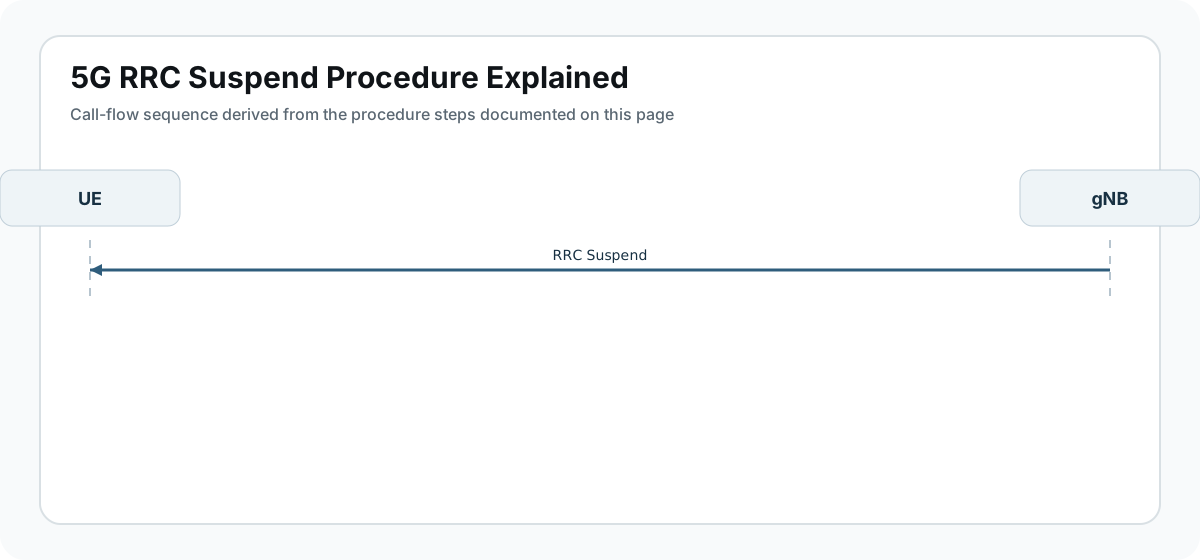
|<- RRC Suspend ------|                       |
|==== UE enters RRC Inactive ====|           |
|<----------- later Paging if needed --------|
|-- RRC Resume when service returns -------->|
Major Phases
| Phase | What happens |
|---|---|
| 1. Inactive-state suitability decision | The network decides that full connected mode is no longer needed but fast return should remain possible. |
| 2. Suspend delivery | The gNB tells the UE to leave connected mode while keeping resumable context. |
| 3. Inactive-state monitoring | The UE becomes reachable through paging and can later use resume instead of full setup. |
Step-by-Step Breakdown
Network chooses inactive entry instead of full release
Sender -> receiver: gNB internal policy and traffic evaluation
Message(s): Inactivity decision and context-preservation choice
Purpose: Balance low signaling overhead with quick future return to service.
State or context change: The UE is still connected, but the network is preparing an inactive-state transition.
Note: Suspend is most useful for bursty traffic patterns where full setup each time would be inefficient.
gNB sends suspend information
Sender -> receiver: gNB -> UE
Message(s): RRC Suspend
Purpose: Tell the UE to enter inactive state and preserve the identifiers needed for resume.
State or context change: Active radio resources are removed, but resumable context remains.
Note: If the suspend context is not preserved correctly, the later failure often appears during resume rather than here.
UE enters inactive reachability mode
Sender -> receiver: UE internal transition
Message(s): Paging monitoring and stored-context behavior
Purpose: Stay reachable with lower overhead until service is needed again.
State or context change: The UE is no longer connected, but not forced into a full fresh-setup model for the next return.
Note: The health of suspend is really proven later by a successful RRC Resume.
Important Messages in This Flow
| Message | Protocol | Direction | Purpose in this procedure | What to inspect briefly |
|---|---|---|---|---|
| RRC Suspend | RRC | gNB -> UE | Moves the UE from connected mode into inactive state while keeping resumable context. | Inspect whether the intended inactive behavior is consistent with the later resume path. |
| Paging | RRC | Network -> UE | Common next-step signal that wakes the UE from inactive reachability. | Use it to confirm that the post-suspend reachability model works. |
| RRC Resume | RRC | UE <-> gNB | Validates that the preserved suspend context was actually useful. | If resume fails, revisit what happened during suspend and context storage. |
Important Parameters to Inspect
| Parameter | What it is | Where it appears | Why it matters | Common issues |
|---|---|---|---|---|
| Inactive-state eligibility | Whether the UE and network support suspend-based handling for this scenario. | Suspend decision logic | Explains why the network chose suspend rather than full release. | Wrong assumptions about eligibility can misread normal release behavior. |
| Resume identity | Stored identifier used later for RRC Resume. | Suspend context | Critical for fast connected-mode return. | Bad or stale identity leads to later resume failure. |
| Paging reachability settings | How the UE will be located after entering inactive state. | Post-suspend context | Needed for mobile-terminated traffic during inactive operation. | Wrong reachability configuration causes later paging misses. |
| Traffic pattern suitability | How bursty or intermittent the service really is. | Operational context | Helps justify whether suspend is actually the right optimization. | Bad fit creates churn between suspend and resume. |
| Stored context lifetime | How long the preserved inactive context remains usable. | gNB context handling | Explains whether later resume should work or not. | Context expiry often surprises troubleshooting teams. |
Success Criteria
- The UE enters inactive state with valid resumable context.
- Radio resources are reduced without losing reachability.
- Paging still works while the UE is inactive.
- Later resume succeeds with lower latency than fresh setup.
Common Failures and Troubleshooting
| Symptom | Likely cause | Where to inspect | Relevant message(s) | Relevant interface(s) | Likely next step |
|---|---|---|---|---|---|
| Suspend seems successful but resume later fails | The stored context was not preserved or was no longer usable. | Suspend context details and later resume identity matching. | RRC Suspend and later Resume Request | NR-Uu | Suspend quality is often judged by the later resume result. |
| UE enters churn between suspend and resume | The traffic pattern or policy is causing too many state changes. | Timer settings, application behavior, and resume success rate. | RRC Suspend, RRC Resume | NR-Uu | This is usually a tuning issue, not a decoder issue. |
| Mobile-terminated traffic is slow after suspend | Paging or reachability behavior after inactive entry is not optimal. | Paging timing, DRX behavior, and later service restoration. | Paging and Resume | NR-Uu, N2 | Look at the full paging-to-service chain. |
| The network should have released, not suspended | Inactive optimization was chosen for a scenario that does not benefit from preserved context. | Traffic pattern and later resume usefulness. | Suspend decision behavior | Operational policy | This is a design or tuning issue rather than a single protocol error. |
What to Check in Logs and Traces
- Confirm why the network chose suspend instead of full release.
- Track whether the created resume identity is later used successfully.
- Inspect paging behavior after inactive entry rather than stopping at the state transition.
- If churn exists, compare traffic pattern with the suspend policy choice.
Related Pages
Related sub-procedures
Related message reference pages
Related troubleshooting pages
FAQ
What is 5G RRC Suspend?
It is the procedure that moves a UE from connected mode into inactive state while preserving resumable context.
How is it different from RRC Release?
Suspend preserves context for faster return, while release is the broader connected-mode exit path without the same inactive-state optimization focus.
When is Suspend useful?
It is most useful for bursty traffic patterns where the UE needs to return to service quickly and often.
How do I know suspend worked well?
The best proof is a later clean RRC Resume and good paging responsiveness.
What should I inspect first when resume fails?
Check whether the suspend-created identity and stored context should still have been valid.