VoNR Registration Procedure Call Flow
VoNR Registration is the preparation path that makes a UE reachable for native voice service on 5G standalone.
It is not one message but a chain: 5GS registration, IMS-capable session setup, and SIP registration inside IMS.
Introduction
Engineers often describe VoNR registration as IMS registration over NR, but the real procedure starts earlier with stable 5GS access and the right IMS data path.
The final proof is not just a PDU session or a first SIP message. It is the point where IMS returns 200 OK and the UE is truly voice-ready.
What Is VoNR Registration in Simple Terms?
- What starts the procedure: The UE needs to become voice-ready for native 5G voice service.
- What the UE and network want to achieve: Complete the full chain needed for IMS-based VoNR reachability.
- What success looks like: The UE is registered in 5GS, registered in IMS, and reachable for VoNR service.
- What failure means: The access, IMS session, or SIP registration chain breaks before true voice readiness exists.
Why this procedure matters
VoNR registration is the entry gate for every later voice journey. If it is only partially complete, mobile-originated and mobile-terminated call traces become misleading quickly.
Quick Fact Sheet
| Procedure name | VoNR Registration |
|---|---|
| Domain | 5G SA voice readiness through IMS registration over NR |
| Main trigger | The UE wants to become voice-ready for native VoNR service |
| Start state | UE is not yet fully IMS-registered for VoNR service |
| End state | UE is 5G registered, IMS-capable session is active, and SIP registration is complete |
| Main nodes | UE, gNB, AMF, SMF, UPF, P-CSCF, S-CSCF, IMS core |
| Main protocols | 5G registration, PDU session signaling, SIP REGISTER |
| Main success outcome | The UE becomes VoNR-ready and can place or receive native 5G voice calls |
| Main failure outcome | Registration, IMS session, or SIP authentication fails so voice readiness is incomplete |
| Most important messages | Registration Request, PDU Session Establishment Request, SIP REGISTER, 401 Unauthorized, 200 OK |
| Main specs | TS 23.501, TS 23.502, TS 24.229, TS 24.501 |
Preconditions
- The UE supports VoNR and has valid 5GS access credentials.
- The network provides 5G SA, IMS service, and the right policy for voice readiness.
- The UE can build an IMS-capable data path.
- IMS subscriber profile and SIP authentication data are provisioned correctly.
Nodes and Interfaces
Nodes involved
| Node | Role in this procedure |
|---|---|
| UE | Completes 5GS registration, brings up the IMS-capable data session, and performs SIP registration toward IMS. |
| gNB | Provides NR radio access and carries the access and session signaling needed for IMS readiness. |
| AMF | Anchors 5G registration and coordinates the session and reachability state before IMS registration. |
| SMF and UPF | Provide the IMS-capable data path used for SIP registration and later VoNR signaling. |
| P-CSCF and S-CSCF | Anchor IMS registration, challenge the UE, and maintain voice-service readiness inside IMS. |
Interfaces used
| Interface | Path | Role |
|---|---|---|
| NR-Uu | UE <-> gNB | Carries the radio access used for 5GS registration and IMS-capable packet service. |
| N1 and N2 | UE/gNB <-> AMF | Carry 5G registration and access management signaling before voice readiness. |
| N11, N3, N4 | AMF/SMF/UPF path | Create the IMS service path used later for SIP registration and voice signaling. |
| IMS SIP path | UE <-> P-CSCF / IMS core | Carries SIP REGISTER and later in-dialog VoNR signaling. |
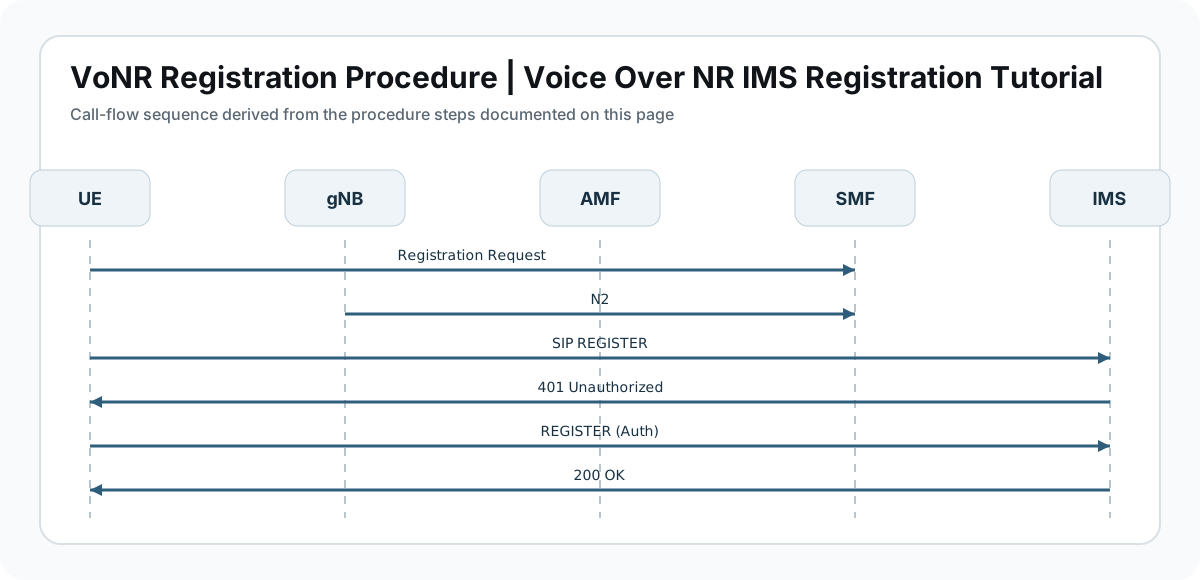
End-to-End Call Flow
UE              gNB              AMF / SMF / UPF            IMS
|-- 5GS registration ->|                                         |
|-- IMS session setup ----------------------------->|            |
|-------------------------------------------- SIP REGISTER ----->|
|<------------------------------------------ 401 Unauthorized ---|
|-------------------------------------------- REGISTER + auth -->|
|<------------------------------------------------------ 200 OK -|
Major Phases
| Phase | What happens |
|---|---|
| 1. 5GS access readiness | The UE completes 5G registration and becomes eligible for service continuity on 5GS. |
| 2. IMS-capable session setup | The network creates the IMS data path needed for SIP registration and later voice handling. |
| 3. SIP registration challenge | The UE sends SIP REGISTER and receives the normal IMS authentication challenge. |
| 4. Authenticated IMS registration | The UE resends REGISTER with credentials and receives 200 OK, becoming VoNR-ready. |
Step-by-Step Breakdown
UE completes 5G registration first
Sender -> receiver: UE -> gNB -> AMF
Message(s): 5G Initial Registration
Purpose: Create the basic 5GS trust and reachability context needed before IMS service can be used.
State or context change: The UE becomes 5GS-registered but not yet voice-ready inside IMS.
Note: VoNR readiness always depends on both 5GS registration and IMS-side registration; one without the other is only partial success.
UE or network brings up the IMS-capable session
Sender -> receiver: UE -> AMF -> SMF -> UPF
Message(s): IMS PDU Session Establishment for Voice
Purpose: Provide the SIP-capable data path used for IMS registration and later voice signaling.
State or context change: The UE now has connectivity that can reach the IMS core.
Note: Many VoNR-registration failures are really IMS-session profile or DNS issues rather than SIP-procedure issues.
UE sends SIP REGISTER and receives authentication challenge
Sender -> receiver: UE -> P-CSCF -> S-CSCF
Message(s): SIP REGISTER and 401 Unauthorized
Purpose: Start IMS registration and obtain the challenge needed for authenticated registration.
State or context change: IMS knows the UE is attempting registration but still needs proof of identity and authorization.
Note: A first REGISTER followed by 401 Unauthorized is normal in many healthy IMS traces.
UE completes authenticated SIP registration
Sender -> receiver: UE -> IMS core
Message(s): SIP REGISTER with credentials and 200 OK
Purpose: Finish IMS registration and make the UE reachable for native VoNR service.
State or context change: The UE becomes VoNR-ready and can place or receive native voice sessions on 5G SA.
Note: Do not mark success until the final 200 OK proves the registration binding is active inside IMS.
Important Messages in This Flow
| Message | Protocol | Direction | Purpose in this procedure | What to inspect briefly |
|---|---|---|---|---|
| Registration Request | NAS | UE -> AMF | Starts the 5GS branch that voice readiness depends on. | Inspect whether the UE really reached a stable registered state first. |
| PDU Session Establishment Request | NAS | UE -> SMF via AMF | Creates the IMS-capable data path used for SIP registration. | Inspect DNN, slice, and QoS intent. |
| SIP REGISTER | SIP | UE -> IMS core | Starts IMS registration for VoNR service. | Inspect Contact, P-CSCF reachability, and whether the right voice profile is being used. |
| 401 Unauthorized | SIP | IMS core -> UE | Normal SIP authentication challenge during IMS registration. | A missing challenge or malformed challenge often means IMS interworking trouble. |
| 200 OK | SIP | IMS core -> UE | Confirms final IMS registration success. | This is the real VoNR-readiness proof. |
Important Parameters to Inspect
| Parameter | What it is | Where it appears | Why it matters | Common issues |
|---|---|---|---|---|
| IMS DNN and session profile | The service profile used for IMS connectivity. | IMS session setup | Explains whether the UE built the right data path for voice service. | Wrong session profile often makes SIP fail later. |
| P-CSCF reachability | Whether the UE can actually reach the first IMS hop. | SIP REGISTER path | Core prerequisite for IMS registration success. | DNS or routing issues can look like generic SIP failure. |
| SIP authentication challenge | The IMS challenge used between the first and second REGISTER. | 401 Unauthorized and second REGISTER | Shows whether IMS is authenticating the subscriber normally. | Malformed or repeated challenge loops often mean profile or credential mismatch. |
| Registration binding freshness | Whether the 200 OK created a usable current IMS registration. | Final SIP result | Needed for later MT calls and voice continuity. | Stale or short-lived binding causes later call failures. |
| Voice readiness after registration | Whether the UE is really reachable for VoNR after IMS success. | Post-registration behavior | Distinguishes cosmetic SIP success from operational readiness. | Paging and MT issues often reveal that readiness was incomplete. |
Success Criteria
- The UE reaches a stable 5GS-registered state.
- The IMS-capable session is created with the correct service profile.
- IMS authentication challenge and response complete successfully.
- The final 200 OK creates a real, usable voice-ready IMS registration.
Common Failures and Troubleshooting
| Symptom | Likely cause | Where to inspect | Relevant message(s) | Relevant interface(s) | Likely next step |
|---|---|---|---|---|---|
| 5GS registration works but IMS registration fails | The UE is on the network but not yet voice-ready. | IMS session profile, DNS, P-CSCF reachability, and SIP challenge handling. | SIP REGISTER, 401, 200 OK | IMS SIP path | This is one of the most common VoNR onboarding failures. |
| IMS session is created but SIP never starts | The data path exists, but the UE or IMS client never moves into registration. | UE IMS client state and session usability. | PDU Session Establishment Accept | Session and application layer | Do not blame SIP if the client never attempted it. |
| REGISTER loops with repeated 401 | IMS is challenging the UE repeatedly without final success. | Credential handling, subscriber profile, and authentication continuity. | SIP REGISTER, 401 Unauthorized | IMS core | Repeated 401 is a strong sign of IMS-auth mismatch or profile issue. |
| Registration succeeds but MT calls still fail | The binding exists, but operational reachability is incomplete. | Final registration binding, paging readiness, and service continuity after registration. | 200 OK and later MT-call trace | IMS and access continuity | Treat this as post-registration readiness trouble, not registration syntax trouble. |
What to Check in Logs and Traces
- Confirm 5GS registration stability before looking at IMS.
- Inspect the IMS-capable session profile and P-CSCF reachability.
- Read the SIP REGISTER -> 401 -> REGISTER -> 200 OK sequence as one chain, not isolated messages.
- After success, verify the UE is really reachable for later voice service.
Related Pages
Related sub-procedures
- 5G Initial Registration
- IMS PDU Session Establishment for Voice
- IMS Registration Refresh / Re-registration
- VoNR Mobile Originated Call
Related message reference pages
Related troubleshooting pages
FAQ
What is VoNR Registration?
It is the complete process that makes a UE voice-ready for native 5G SA voice service by combining 5GS registration, IMS-capable session setup, and SIP registration.
Does 5G registration alone make the UE VoNR-ready?
No. The UE also needs an IMS-capable session and successful IMS SIP registration.
Is 401 Unauthorized a failure?
No. It is often the normal IMS authentication challenge before the final authenticated REGISTER succeeds.
What should I inspect first in a failure?
Start with whether 5GS registration finished, then check IMS session setup, and finally inspect the SIP REGISTER challenge sequence.
What proves success?
A stable 200 OK for IMS registration followed by real voice reachability and service readiness.