LTE ASN.1 / Encoding Error Handling Call Flow
LTE ASN.1 / Encoding Error Handling is the LTE failure-handling branch used when a procedure cannot continue normally and the network or UE has to reject, report, or classify the problem.
This page focuses on the failure path itself rather than the earlier success flow that should have happened before it.
Introduction
ASN.1 or encoding error handling is used when the receiving side cannot parse the message structure correctly. This is different from a valid but unsupported IE or a missing mandatory field.
Use this page when the payload looks malformed, truncated, or structurally inconsistent before any deeper IE-level check is possible.
What Is LTE ASN.1 / Encoding Error Handling in Simple Terms?
- What starts the procedure: A message cannot be encoded, decoded, or interpreted correctly at the syntax or structure level.
- What the UE and network want to achieve: Detect the malformed payload and stop the broken branch from being treated as valid signaling.
- What success looks like: The malformed message is identified correctly and the failure is not confused with a normal semantic reject.
- What failure means: The trace is analyzed as if the IEs were valid even though the message itself was structurally broken.
Why this procedure matters
Encoding trouble can make later behavior look random. If the payload never decoded correctly, cause-value analysis and IE-level interpretation may be misleading from the start.
Quick Fact Sheet
| Procedure name | LTE ASN.1 / Encoding Error Handling |
|---|---|
| Domain | LTE encoding and decoding failure handling |
| Main trigger | A message cannot be encoded, decoded, or interpreted correctly at the syntax or structure level. |
| Start state | A wider LTE procedure is already in progress and something has gone wrong or become invalid |
| End state | The message is rejected, dropped, or the wider procedure stops because the content cannot be parsed reliably |
| Main nodes | UE, eNB, MME / network side |
| Main protocols | RRC, NAS, procedure context |
| Main success outcome | The failure branch is clearly identified and the next corrective action is possible |
| Main failure outcome | The real break point stays unclear or the wrong failure branch is assumed |
| Most important messages | Broken RRC or NAS message, later reject or release behavior |
| Main specs | TS 36.331, TS 24.301 |
Preconditions
- A wider LTE procedure is already underway or has just failed.
- The network and UE still have enough context to reject, report, or classify the failure.
- The trace includes the messages immediately before and after the failure branch.
Nodes and Interfaces
Nodes involved
| Node | Role in this procedure |
|---|---|
| UE | Detects the condition, rejects the invalid branch, or reports failure context after the earlier problem. |
| eNB | Carries the LTE radio side and receives failure or reject behavior from the UE. |
| MME / network side | Interprets the reject, timeout, or failure report and decides the next correction or release step. |
Interfaces used
| Interface | Path | Role |
|---|---|---|
| LTE Uu | UE <-> eNB | Carries the reject or failure-report signaling seen on the radio side. |
| S1-MME | eNB <-> MME | Carries the wider procedure context behind the failure or reject branch. |
End-to-End Call Flow
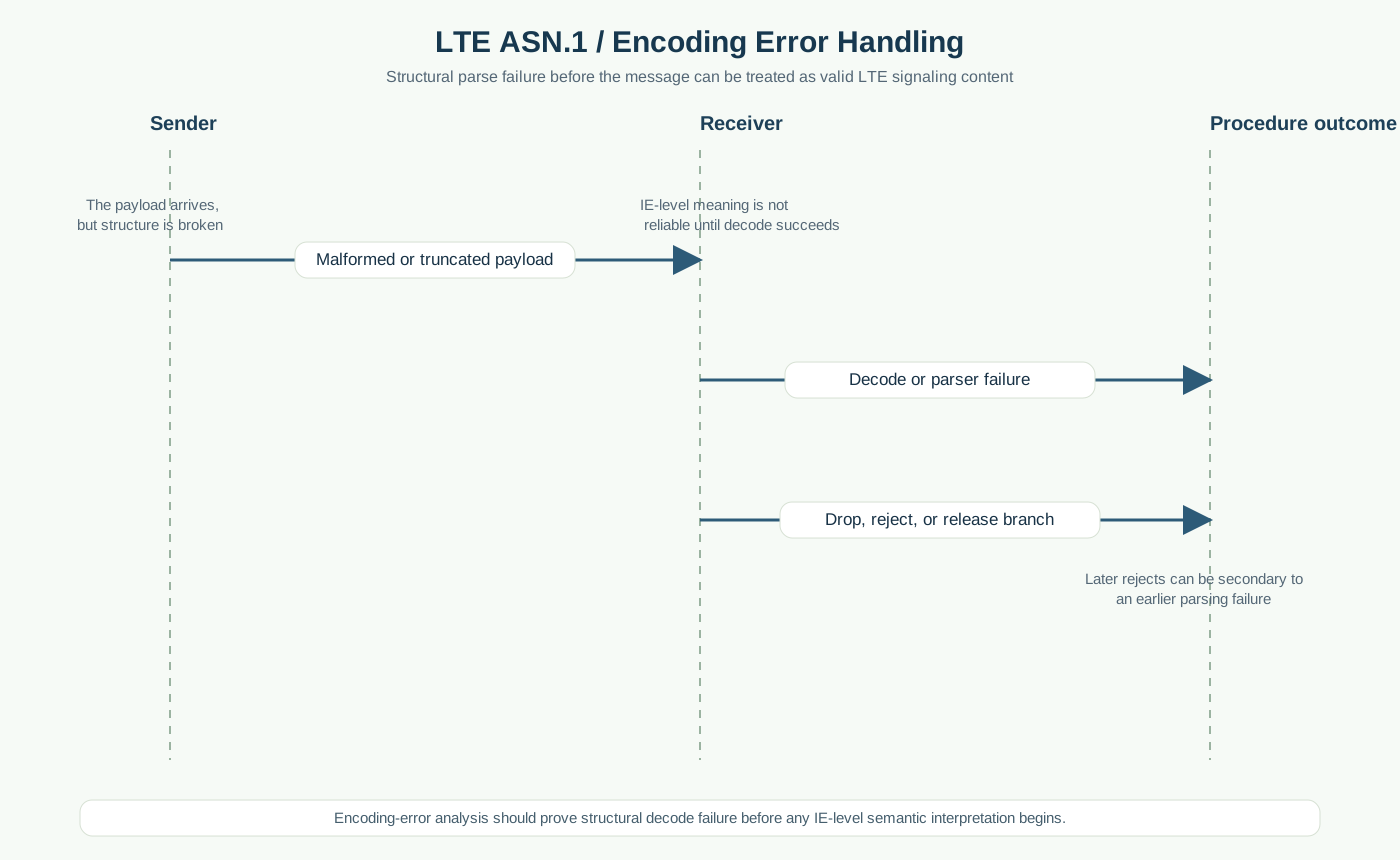
Sender             Receiver
|--broken payload---->|
|--decode fails------>|
|--drop / reject----->|
Major Phases
| Phase | What happens |
|---|---|
| 1. Receive the malformed message | The receiver gets a message whose structure cannot be parsed correctly. |
| 2. Detect the decode problem | The parser or decoder identifies the encoding failure. |
| 3. Apply the handling rule | The message is rejected, ignored, or the wider procedure ends. |
Step-by-Step Breakdown
Step 1: Receive the message
Sender -> receiver: Sender -> Receiver
Message(s): Malformed or corrupted message payload
Purpose: Deliver the payload that later fails structural parsing.
State or context change: The receiver has raw signaling but not yet usable decoded content.
Note: The raw payload may still be present in the trace even when the decoded form is unusable.
Step 2: Fail the decode stage
Sender -> receiver: Receiver
Message(s): ASN.1 / decoder failure
Purpose: Stop the branch because the message structure cannot be trusted.
State or context change: The message is no longer a valid candidate for IE-level semantic checks.
Note: This is the key point that separates encoding failure from semantic content failure.
Step 3: End the broken branch
Sender -> receiver: Receiver -> peer or internal handling
Message(s): Reject, ignore, or release behavior
Purpose: Finish failure handling after decode failure is confirmed.
State or context change: The wider procedure stops or moves into a later recovery path.
Note: Do not assume a later reject means the message was ever decoded correctly.
Important Messages
| Message | Protocol | Direction | Purpose in this procedure | What to inspect briefly |
|---|---|---|---|---|
| RRC message under decode failure | RRC | Sender -> Receiver | Represents the payload that failed ASN.1 parsing. | Check whether the problem is really structural rather than an unsupported but valid IE. |
| Security Mode Reject | NAS | UE -> Network | Useful visible outcome if a wider branch later rejects after content could not be used. | Check whether the reject is secondary to earlier decode trouble rather than a normal semantic decision. |
Important Parameters to Inspect
| Parameter | What it is | Where it appears | Why it matters | Common issues |
|---|---|---|---|---|
| Decode stage result | Whether the message could be parsed structurally. | Decoder or parser view | This is the first proof that the problem is encoding-related. | The message is read as semantically wrong when it was structurally invalid. |
| Payload completeness | Whether the full message payload was present in the trace. | Raw signaling capture | Useful when truncation or incomplete capture caused the apparent decode problem. | A capture issue is mistaken for a protocol issue. |
| Message family | Whether the failure happened in RRC, NAS, or another LTE layer. | Procedure context | Explains which parser rules and handling expectations apply. | The wrong protocol parser is assumed. |
| First parser complaint | The earliest structural inconsistency seen by the decoder. | Decoder output or raw comparison | Points to the actual structure problem instead of later visible symptoms. | Later symptoms hide the first real structural break. |
| Later procedure reaction | What the wider procedure did after the decode failure. | Later messages | Shows whether the branch was dropped, retried, or rejected. | The post-failure behavior is analyzed without proving the decode failure first. |
Successful Completion
Success here means the broken payload is correctly recognized as an encoding problem and not confused with a semantic reject branch.
Common Failures and Troubleshooting
| Symptom | Likely cause | Where to inspect | Relevant message(s) | Relevant interface(s) | Likely next step |
|---|---|---|---|---|---|
| Message looks semantically wrong, but no one checked decoding first | The payload may never have parsed correctly at all. | Raw payload, decoder result, and the first parser complaint. | Broken message and later reject | Protocol-specific | Prove structural decode success before interpreting the IEs. |
| Only one capture tool shows the failure | The trace may be truncated or decoded differently by one tool. | Raw payload completeness and alternate decoder view. | Raw signaling | Capture and decoder path | Separate capture quality problems from protocol encoding problems. |
What to Check in Logs and Traces
- Check raw payload completeness before IE-level interpretation.
- Decide whether the failure is structural parsing or semantic content.
- Treat later rejects as secondary until decode success is proven.
Related Pages
Related sub-procedures
Related message reference pages
Related troubleshooting pages
Notes
ASN.1 or encoding failure sits below normal IE interpretation. If this branch is real, later cause-level reading may not be trustworthy.
FAQ
What is the main sign of LTE encoding error handling?
The main sign is that the receiver cannot parse the message structure cleanly before any normal IE-level decision is made.
Is encoding failure the same as unsupported IE handling?
No. Unsupported IE handling assumes the message decoded structurally; encoding failure means that assumption may already be false.