LTE Bearer Release Procedure Call Flow
LTE Bearer Release Procedure removes an EPS bearer that was previously active. It appears when the network no longer wants to keep that bearer alive because service ended, policy changed, a dedicated bearer is no longer needed, or the session is moving toward teardown.
The main NAS pair is Deactivate EPS Bearer Context Request and Deactivate EPS Bearer Context Accept.
Introduction
The bearer release branch is the inverse of bearer activation. It removes an existing bearer context while the rest of the PDN session may either continue or move toward a broader disconnect path.
The main nodes are the UE, MME, SGW, and PGW. The eNB may also release matching access-side resources after the bearer is removed.
What Is LTE Bearer Release Procedure in Simple Terms?
- What starts the procedure: The network decides an active bearer should be removed.
- What the UE and network want to achieve: Cleanly deactivate the bearer while keeping state aligned across the UE and EPC.
- What success looks like: The UE receives Deactivate EPS Bearer Context Request and returns Deactivate EPS Bearer Context Accept.
- What failure means: The bearer is removed only partially or later traces still show stale bearer context.
Why this procedure matters
This procedure explains why a bearer disappears from a live session and how to separate normal release from failure-led teardown.
Quick Fact Sheet
| Procedure name | LTE Bearer Release Procedure |
|---|---|
| Domain | EPS bearer deactivation |
| Main trigger | Service ends or the network removes a bearer |
| Start state | UE has an active bearer that the network wants to release |
| End state | The target bearer is no longer active |
| Main nodes | UE, MME, SGW, PGW |
| Main protocols | NAS, GTPv2-C |
| Main success outcome | The bearer is cleanly removed from UE and EPC context |
| Main failure outcome | Bearer state becomes stale or only partially released |
| Most important messages | Deactivate EPS Bearer Context Request, Deactivate EPS Bearer Context Accept |
| Main specs | TS 24.301, TS 23.401, TS 29.274 |
Preconditions
- The bearer already exists and is active.
- The EPC has a reason to remove that bearer.
- The UE and network still share enough context to identify the bearer cleanly.
Nodes and Interfaces
Nodes involved
| Node | Role in this procedure |
|---|---|
| UE | Removes the target bearer context when deactivation is accepted. |
| MME | Delivers the deactivation request toward the UE. |
| SGW | Releases serving-side bearer state. |
| PGW | Releases or updates PDN-side bearer state. |
Interfaces used
| Interface | Path | Role |
|---|---|---|
| S11 | MME <-> SGW | Coordinates EPC bearer removal. |
| S5/S8 | SGW <-> PGW | Releases the PDN-side bearer relation. |
| NAS | UE <-> MME | Carries the bearer deactivation pair. |
End-to-End Call Flow
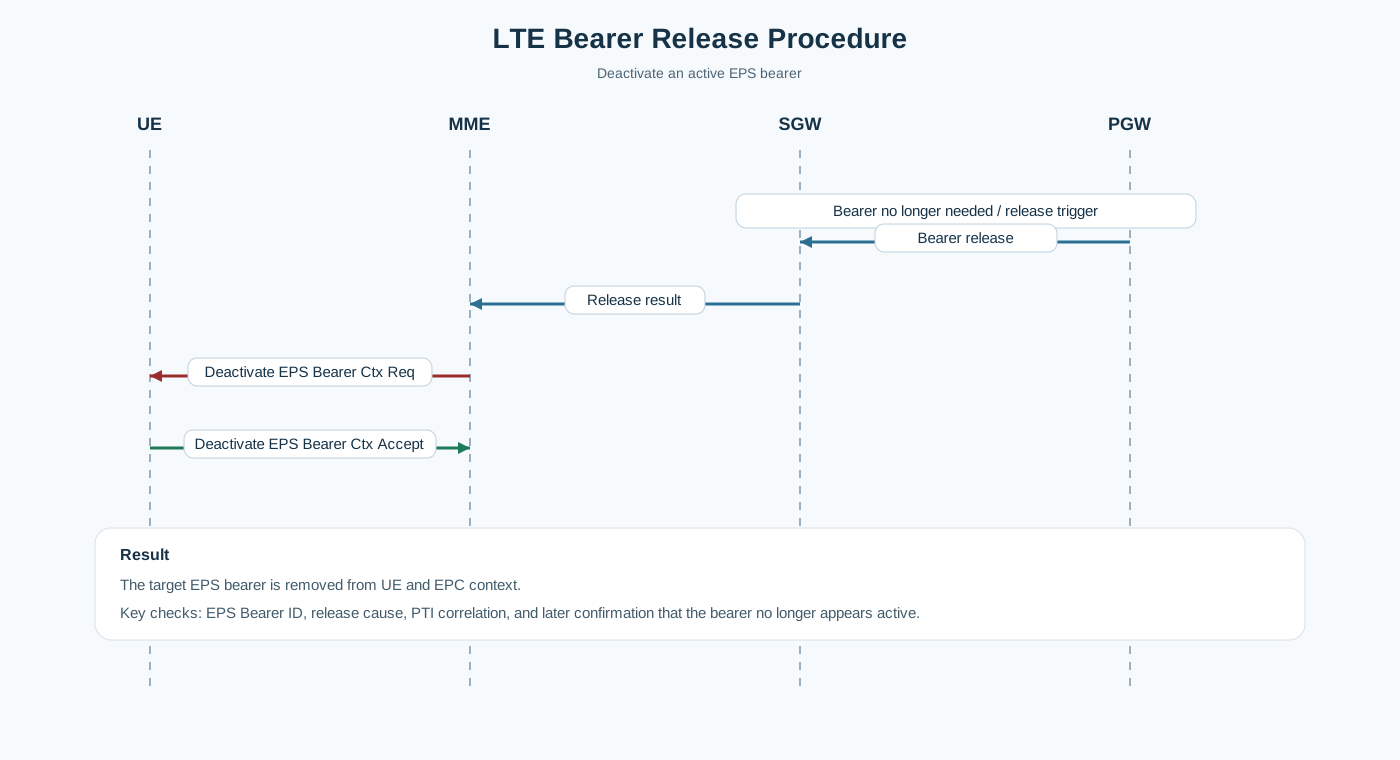
UE               MME               SGW               PGW
|                 |                 |-- Bearer release ->|
|                 |                 |<-- Release result --|
|<- Deactivate EPS Bearer Ctx Req --|                    |
|-- Deactivate EPS Bearer Ctx Accept ->|                 |
|   bearer is removed from the session |                 |
Major Phases
| Phase | What happens |
|---|---|
| 1. Release decision | The EPC decides the active bearer should be removed. |
| 2. NAS deactivation | The MME sends the bearer deactivation to the UE. |
| 3. UE confirmation | The UE confirms that the bearer context was removed. |
Step-by-Step Breakdown
Step 1: Release handling in the EPC
Sender -> receiver: PGW -> SGW -> MME
Message(s): GTPv2-C bearer release handling
Purpose: Remove the live bearer from the EPC side.
State or context change: The control plane is ready to tell the UE to delete the bearer.
Note: This is where normal release and failure-led release often start to diverge.
Step 2: Deactivate bearer context
Sender -> receiver: MME -> UE
Message(s): Deactivate EPS Bearer Context Request
Purpose: Tell the UE which bearer must be removed.
State or context change: The UE starts deleting the target bearer context.
Note: EBI and any included cause values are the first checks.
Step 3: UE accept
Sender -> receiver: UE -> MME
Message(s): Deactivate EPS Bearer Context Accept
Purpose: Confirm the bearer was removed.
State or context change: The bearer is no longer active in UE context.
Note: Missing accept often leaves stale context in multi-layer traces.
Important Messages in This Flow
| Message | Protocol | Direction | Purpose in this procedure | What to inspect briefly |
|---|---|---|---|---|
| Deactivate EPS Bearer Context Request | NAS | MME -> UE | Starts bearer removal at the UE side. | EBI, included cause, and whether the release is normal or failure-led. |
| Deactivate EPS Bearer Context Accept | NAS | UE -> MME | Confirms bearer deactivation. | Return timing and correlation to the same bearer identity. |
Important Parameters to Inspect
| Parameter | What it is | Where it appears | Why it matters | Common issues |
|---|---|---|---|---|
| EPS Bearer ID | The bearer being removed. | Deactivate request and accept | Shows exactly which bearer is leaving the session. | Wrong bearer released or mismatched correlation. |
| ESM cause | The reason attached to the deactivation branch when present. | Deactivate request | Helps separate normal cleanup from failure handling. | Cause interpretation errors. |
| PTI | The ESM transaction identity. | NAS deactivation handling | Helps align the release with earlier session transactions. | PTI mismatch. |
Successful Completion
Success is confirmed when the UE accepts the deactivation request and the target bearer disappears from both UE and EPC context views.
Common Failures and Troubleshooting
| Symptom | Likely cause | Where to inspect | Relevant message(s) | Relevant interface(s) | Likely next step |
|---|---|---|---|---|---|
| Deactivate request appears, but bearer still looks active later | UE did not apply the release or later cleanup was incomplete. | EBI continuity before and after the request. | Deactivate EPS Bearer Context Request | NAS, later bearer context checks | Confirm whether the accept returned and whether the EPC also closed the bearer. |
| Release looks like a failure instead of normal cleanup | Cause value points to network or bearer error handling. | Included cause and preceding bearer events. | Deactivate request and earlier failure branch | NAS, S11, S5/S8 | Trace backward to the first failing update or bearer-control step. |
What to Check in Logs and Traces
- Check the release reason before assuming the bearer was removed normally.
- Track the EBI from activation through deactivation to confirm the right bearer was released.
- Confirm the UE-side accept and EPC-side release branch both completed.
Related Pages
Related sub-procedures
Related message reference pages
Related troubleshooting pages
Notes
Bearer release can be normal or failure-led. The included cause and the earlier bearer history decide which branch you are looking at.
FAQ
What is LTE Bearer Release Procedure?
It is the procedure that removes an active EPS bearer from the UE and EPC context.
Which message is the clearest start of the release?
Deactivate EPS Bearer Context Request is the clearest UE-side start of the deactivation branch.