LTE CMAS Notification Procedure Call Flow
LTE CMAS Notification Procedure is the LTE warning-delivery path used when Commercial Mobile Alert System information has to be exposed to UEs through the broadcast and warning-related LTE context.
It depends on the same broadcast-side foundations as other warning flows: valid system information, warning-related SIB handling, and idle-side awareness where the UE must notice a change.
Introduction
The LTE CMAS Notification Procedure is a public-alert broadcast path rather than a normal UE-specific signaling transaction. The main question is whether the UE could actually see the warning-related LTE context when it mattered.
Use this page when the problem is not basic LTE access, but whether the alert-related broadcast context became visible and current at the UE.
What Is LTE CMAS Notification Procedure in Simple Terms?
- What starts the procedure: The network activates CMAS-related warning broadcasting for the cell or area.
- What the UE and network want to achieve: Expose the alert-related LTE broadcast context clearly to the UE.
- What success looks like: The UE reads the alert-related broadcast path in time and the warning context becomes visible.
- What failure means: The alert-related broadcast path is stale, incomplete, or missed at the UE.
Why this procedure matters
CMAS analysis is mainly about the visibility of the alert-related broadcast path. A UE can look healthy from the ordinary LTE service point of view while still missing the warning-side update that mattered most.
Quick Fact Sheet
| Procedure name | LTE CMAS Notification Procedure |
|---|---|
| Domain | LTE public alert broadcast |
| Main trigger | CMAS warning activation by the network |
| Start state | UE is camped or monitoring LTE broadcast behavior in the alert area |
| End state | UE has the CMAS-related LTE context needed for the alert path |
| Main nodes | UE, eNB |
| Main protocols | RRC broadcast information, paging-side reachability where relevant |
| Main success outcome | The alert-related broadcast context is visible to the UE |
| Main failure outcome | The alert path is stale, incomplete, or missed |
| Most important messages | SIB1, warning-related SIB family, Paging where relevant |
| Main specs | TS 36.331, TS 36.300 |
Preconditions
- The UE already has the basic LTE broadcast context for the cell.
- The cell or area is configured to expose CMAS-related warning information.
- The UE is in a state where broadcast refresh or warning visibility can be observed.
Nodes and Interfaces
Nodes involved
| Node | Role in this procedure |
|---|---|
| UE | Reads the alert-related LTE broadcast context and reacts to it. |
| eNB | Schedules the alert-related LTE information and any related alerting path. |
| Broadcast warning context | Provides the CMAS-related alert information visible to UEs in the affected area. |
Interfaces used
| Interface | Path | Role |
|---|---|---|
| LTE Uu | UE <-> eNB | Carries the CMAS-related LTE warning path. |
| BCCH / DL-SCH | eNB -> UE | Carry the warning-related system-information content. |
| Paging-side path | eNB -> UE | May support idle awareness of warning-related changes. |
End-to-End Call Flow
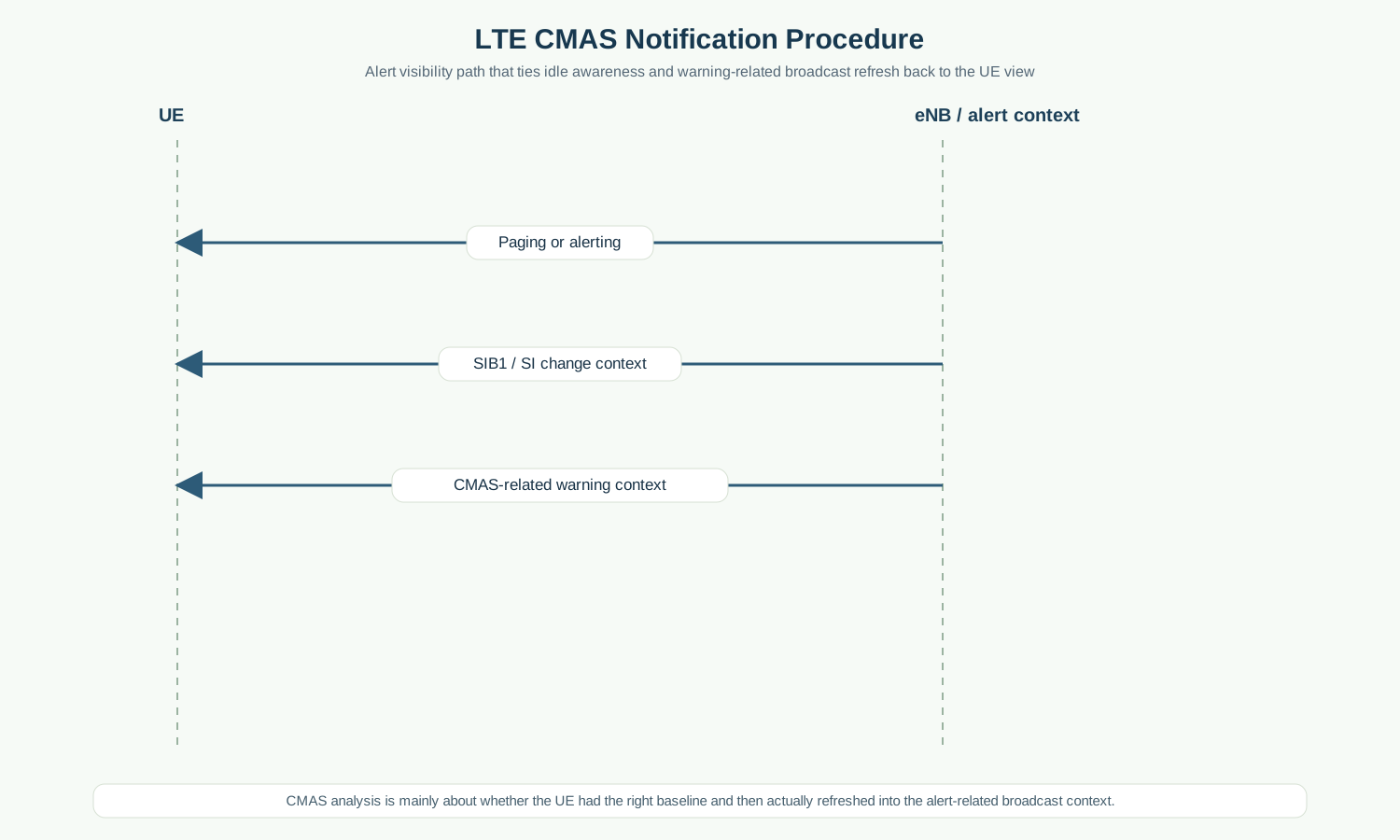
UE                         eNB / alert context
|--idle monitoring----------->|
|<--Paging (if used)----------|
|<--SIB1 / SI change----------|
|<--CMAS-related broadcast----|
Major Phases
| Phase | What happens |
|---|---|
| 1. Alert activation | The network activates the CMAS-related alert path. |
| 2. Idle-side awareness or refresh | The UE becomes aware that warning-related broadcast context matters. |
| 3. Alert-related broadcast read | The UE reads the CMAS-related LTE warning context. |
| 4. Alert visibility at the UE | The alert-related LTE path is now visible as either complete or incomplete. |
Step-by-Step Breakdown
Start from the broadcast baseline
Sender -> receiver: UE
Message(s): SIB1 and existing LTE system-information view
Purpose: Anchor CMAS analysis in the current broadcast state of the cell.
State or context change: The UE has the normal broadcast baseline needed before alert-specific analysis.
Note: A broken broadcast baseline can make the alert path look worse than it really is.
Check whether the UE was alerted to refresh
Sender -> receiver: eNB -> UE
Message(s): Paging or SI-change-driven continuation
Purpose: Explain how the UE would have noticed the alert-related update.
State or context change: The UE is positioned to observe the later alert-related broadcast content.
Note: The exact pattern can differ, so keep the paging and broadcast views together.
Read the alert-related broadcast context
Sender -> receiver: eNB -> UE
Message(s): Warning-related SIB family within LTE system information
Purpose: Expose CMAS-related warning information to the UE.
State or context change: The UE now has the warning-related LTE context needed for the alert path.
Note: The warning-related SIB family on this site is covered through the broader LTE system-information reference.
Correlate the alert visibility
Sender -> receiver: UE
Message(s): Warning handling continuation
Purpose: Check whether the CMAS-related context was actually visible at the UE when needed.
State or context change: The alert path is now visible as complete or incomplete.
Note: The main question is timing and visibility, not only theoretical broadcast configuration.
Important Messages
| Message | Protocol | Direction | Purpose in this procedure | What to inspect briefly |
|---|---|---|---|---|
| System Information Block Type 1 | RRC | eNB -> UE | Provides the scheduling and change-detection baseline. | Check whether the UE had the right baseline before the warning update. |
| Paging | RRC | eNB -> UE | May support idle awareness of warning-related updates. | Check whether the UE had a clear reason to return attention to the warning path. |
| LTE System Information Reference | RRC | eNB -> UE | Maps the warning-related SIB family used for CMAS analysis. | Check the public-warning blocks through the LTE system-information reference. |
Important Parameters to Inspect
| Parameter | What it is | Where it appears | Why it matters | Common issues |
|---|---|---|---|---|
| Alert-area context | The cell or area scope where the alert should be visible. | Broadcast and idle context | Needed to confirm the UE was in the intended alert scope. | The UE was outside the relevant alert-side LTE context. |
| Baseline broadcast view | The broadcast state before the alert-related update. | SIB1 and earlier system-information read | Shows whether the UE had the correct starting point for alert analysis. | The alert path is blamed even though the broadcast baseline was already broken. |
| Warning-related SIB visibility | Whether the public-warning SIB family was present and current. | LTE system-information view | Shows whether the alert content was really visible to the UE. | The alert path is assumed without proving the warning block was readable. |
| Idle awareness path | How the UE became aware of the alert-related change while idle. | Paging and SI-change context | Useful when the UE had to refresh broadcast context. | The UE never refreshed the broadcast view after the alert was activated. |
| Alert timing | When the alert-related information became visible compared with UE monitoring time. | Across activation and refresh timing | Important in time-sensitive alert analysis. | The UE monitoring window and alert broadcast window do not match. |
Successful Completion
Success means the CMAS-related warning context became visible to the UE through a valid LTE broadcast path.
Common Failures and Troubleshooting
| Symptom | Likely cause | Where to inspect | Relevant message(s) | Relevant interface(s) | Likely next step |
|---|---|---|---|---|---|
| The alert should have been visible, but the UE shows no warning-side behavior | The alert-related broadcast path may have been stale, absent, or never refreshed at the UE. | SIB1, paging-side context, and the warning-related SIB family. | SIB1, Paging, warning-related SIBs | LTE Uu | Check how the UE would have learned that the warning-related broadcast set changed. |
| The cell configuration looks right, but the warning still seems missed | The problem may be visibility timing rather than baseline configuration. | Alert activation timing and the UE refresh window. | Warning-related system information | LTE Uu | Keep timing visible instead of treating the warning path as static. |
What to Check in Logs and Traces
- Prove the broadcast baseline first.
- Check how the UE would have refreshed or noticed alert-related changes while idle.
- Use the LTE system-information reference for the public-warning SIB family.
Related Pages
Related sub-procedures
Related message reference pages
Related troubleshooting pages
Notes
This page treats CMAS as an LTE broadcast warning path. The site’s deep-reference layer for the warning-related SIB family is the LTE system-information page.
FAQ
What is the LTE CMAS Notification Procedure?
It is the LTE alert-related broadcast path used to expose CMAS warning information to UEs.
What should I inspect first in a CMAS-related LTE trace?
Start with the normal broadcast baseline, then check how the UE would have refreshed or noticed the warning-related broadcast change.