LTE DL / UL Information Transfer Procedure Call Flow
LTE DL / UL Information Transfer is the connected-mode RRC transport path used to carry NAS payloads and related dedicated information between the UE and the network after the basic radio connection already exists. It is built around DL Information Transfer and UL Information Transfer.
This procedure matters because many LTE NAS messages are only visible to the UE over these RRC wrappers once connected signaling is already active.
Introduction
The LTE DL / UL Information Transfer procedure is not a standalone registration or bearer setup flow. It is the transport layer inside connected mode that lets NAS continuation cross the radio interface after RRC setup or resume has already succeeded.
The main nodes are UE, eNB, and MME. The eNB bridges the RRC wrappers on the radio side to S1AP and NAS on the core side.
What Is LTE DL / UL Information Transfer in Simple Terms?
- What starts the procedure: A NAS payload needs to cross the radio interface after connected signaling already exists.
- What the UE and network want to achieve: Carry later NAS messages reliably over the dedicated RRC path.
- What success looks like: The expected DL or UL RRC wrapper appears and the matching NAS continuation is visible on the other side.
- What failure means: NAS seems to disappear between radio and core traces, or the wrapper appears without the expected later NAS handling.
Why this procedure matters
This is one of the most important correlation points between LTE air traces and EPC-side NAS traces after connected mode already exists.
Quick Fact Sheet
| Procedure name | LTE DL / UL Information Transfer Procedure |
|---|---|
| Domain | Connected-mode NAS transport over RRC |
| Main trigger | Later NAS payload needs radio transport in connected mode |
| Start state | UE already has a connected signaling path |
| End state | NAS payload crosses the radio interface and continues toward its next endpoint |
| Main nodes | UE, eNB, MME |
| Main protocols | RRC, NAS, S1AP |
| Main success outcome | Air and core traces line up around the same NAS continuation |
| Main failure outcome | Radio-side wrapper and core-side NAS continuation do not align |
| Most important messages | DL Information Transfer, UL Information Transfer |
| Main specs | TS 36.331, TS 24.301, TS 36.413 |
Preconditions
- The UE is already in connected signaling.
- A NAS message needs to be sent downlink or uplink through the radio path.
- The eNB has the matching S1AP context toward the MME.
Nodes involved
| Node | Role in this procedure |
|---|---|
| UE | Sends or receives the RRC wrapper carrying the NAS payload. |
| eNB | Bridges the RRC transfer message to or from the S1AP/NAS side. |
| MME | Owns the NAS message being transported toward or from the UE. |
Interfaces used
| Interface | Path | Role |
|---|---|---|
| LTE Uu | UE <-> eNB | Carries the DL and UL RRC transfer wrappers. |
| S1-MME | eNB <-> MME | Carries the corresponding NAS transport toward the core. |
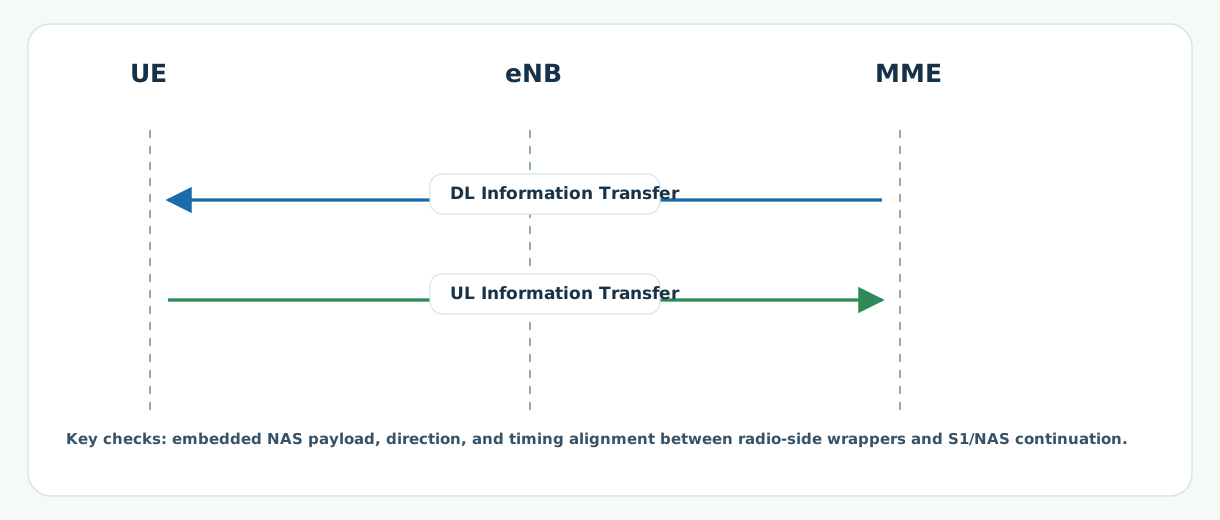
End-to-end call flow
UE               eNB               MME
|                 |                 |
|<- DL Information Transfer ------- |
|                 |                 |
|-- UL Information Transfer ------> |
|                 |                 |
|   matching NAS continues over S1  |
Major phases
| Phase | What happens |
|---|---|
| 1. NAS payload exists | A later NAS message needs radio transport. |
| 2. RRC wrapper transfer | The payload is carried through DL or UL Information Transfer. |
| 3. Core-side continuation | The eNB bridges the payload to the matching S1AP or NAS leg. |
Step-by-step breakdown
Step 1: Downlink transfer when the network sends NAS
Sender -> receiver: MME -> eNB -> UE
Message(s): DL Information Transfer
Purpose: Carry NAS payload toward the UE over the connected radio path.
State or context change: The UE receives the later NAS message inside the RRC wrapper.
Note: The real content to inspect is often the NAS payload inside the wrapper.
Step 2: Uplink transfer when the UE sends NAS
Sender -> receiver: UE -> eNB -> MME
Message(s): UL Information Transfer
Purpose: Carry NAS payload from the UE toward the core over the connected radio path.
State or context change: The MME receives the later uplink NAS continuation.
Note: This message is often the cleanest radio-side proof that the NAS uplink really left the UE.
Important messages
| Message | Protocol | Direction | Purpose in this procedure | What to inspect briefly |
|---|---|---|---|---|
| DL Information Transfer | RRC | eNB -> UE | Carries downlink NAS payload to the UE. | Which NAS message is inside and whether it matches the expected scenario. |
| UL Information Transfer | RRC | UE -> eNB | Carries uplink NAS payload from the UE. | Which NAS message is inside and whether the MME later receives it. |
Important parameters to inspect
| Parameter | What it is | Where it appears | Why it matters | Common issues |
|---|---|---|---|---|
| Embedded NAS message | The real NAS payload carried inside the RRC wrapper. | DL or UL Information Transfer | Defines the actual meaning of the transfer. | Wrapper decoded but NAS payload overlooked. |
| Direction | Whether the payload is traveling downlink or uplink. | DL vs UL Information Transfer | Helps match the radio event to the correct S1AP or NAS continuation. | Wrong side correlated in multi-layer traces. |
| Timing relation | The time gap between radio-side transfer and core-side continuation. | Radio trace plus S1-MME trace | Shows whether transport and correlation are healthy. | Partial capture, timing drift, trace merge issues. |
| Connected context continuity | The active RRC context carrying the transfer. | Around the transfer messages | Explains whether the payload was sent on a stable connected path. | Connection release, resume, or radio instability near the transfer. |
Successful completion of the procedure
Success means the DL or UL RRC wrapper appears and the corresponding NAS continuation is visible on the other side of the radio-core boundary.
Common failures in LTE DL / UL Information Transfer
| Symptom | Likely cause | Where to inspect | Relevant message(s) | Relevant interface(s) | Likely next step |
|---|---|---|---|---|---|
| NAS exists on S1, but not on air trace | Partial air capture or wrong radio-side correlation. | Connected radio context around the expected transfer. | DL / UL Information Transfer | LTE Uu, S1-MME | Rebuild correlation before assuming payload loss. |
| UL Information Transfer is present, but MME seems not to receive NAS | Bridge problem between eNB and MME or missing S1 trace visibility. | Radio-core timing alignment. | UL Information Transfer | LTE Uu, S1-MME | Check whether the issue is true transport loss or only trace incompleteness. |
| DL wrapper appears, but UE handling still looks wrong | The NAS content inside the wrapper does not match the expected scenario. | Embedded NAS message and its procedure meaning. | DL Information Transfer | LTE Uu | Decode the payload first, not only the wrapper. |
What to check in logs and traces
- Always decode the NAS payload inside the RRC wrapper.
- Correlate DL and UL transfer timing with matching S1AP or NAS events.
- Check whether the connected radio context was stable when the transfer happened.
Related Pages
Related sub-procedures
Related message reference pages
Related troubleshooting pages
Notes
The wrapper is not the whole meaning of the procedure. The real interpretation comes from the NAS message carried inside it.
FAQ
What is LTE DL / UL Information Transfer?
It is the connected-mode RRC wrapper procedure used to transport NAS payloads over the LTE radio interface.
Why is it important?
Because it links the air trace and the core NAS trace after connected mode already exists.
What should I inspect first?
Start with the embedded NAS message, not only the wrapper name.