LTE Handover Failure and Recovery Call Flow
LTE Handover Failure and Recovery describes what happens when a connected mobility attempt does not complete cleanly and the UE must recover service through re-establishment, source-side fallback, idle return, or a later NAS-side continuation. It is the recovery view of interrupted connected mobility, not the normal handover success path.
This page helps separate handover execution failure from later service-restoration behavior.
Introduction
A failed handover can break the connected path even when the handover preparation itself looked correct. The UE may then try re-establishment, return to the source side, or later continue through a recovery branch once radio access is stable again.
The main nodes are the UE, source eNB, target eNB, and later the MME.
What Is LTE Handover Failure and Recovery in Simple Terms?
- What starts the procedure: A connected-mode handover is interrupted or does not complete successfully.
- What the UE and network want to achieve: Restore usable service and a stable signaling path after the failed mobility attempt.
- What success looks like: The UE regains a stable path through re-establishment or another valid recovery branch and later service continues.
- What failure means: Recovery also fails, service is interrupted longer, or the UE must restart from a broader entry path.
Why this procedure matters
This page explains why a mobility failure can later appear as a radio recovery problem or a NAS service-recovery problem instead of as a clean handover reject.
Quick Fact Sheet
| Procedure name | LTE Handover Failure and Recovery |
|---|---|
| Domain | Failed mobility continuation and recovery |
| Main trigger | Connected handover does not complete cleanly |
| Start state | UE was in a connected handover branch |
| End state | Service is restored on a stable path or the UE falls back to broader recovery |
| Main nodes | UE, source eNB, target eNB, MME |
| Main protocols | RRC, S1AP, NAS |
| Main success outcome | UE regains a stable serving path after failed mobility |
| Main failure outcome | Repeated interruption or full service loss |
| Most important messages | RRC Connection Reestablishment Request, Mobility From E-UTRA Command |
| Main specs | TS 36.331, TS 36.300, TS 23.401 |
Preconditions
- The UE was already in a connected mobility branch.
- A handover command or execution branch had already started.
- The failed mobility still leaves at least one possible recovery path.
Nodes and Interfaces
Nodes involved
| Node | Role in this procedure |
|---|---|
| UE | Attempts mobility execution and later starts the recovery branch if handover fails. |
| Source eNB | May remain the fallback point if target-side continuation fails. |
| Target eNB | May be the intended destination but not the final stable serving cell if mobility fails. |
| MME | Becomes relevant again if later service restoration continues through NAS. |
Interfaces used
| Interface | Path | Role |
|---|---|---|
| LTE Uu | UE <-> cells | Carries handover execution and any later radio recovery branch. |
| S1-MME / X2 | Between eNBs and MME | Provide the mobility context behind the failed branch. |
| NAS | UE <-> MME | May appear later if service restoration continues after radio recovery. |
End-to-End Call Flow
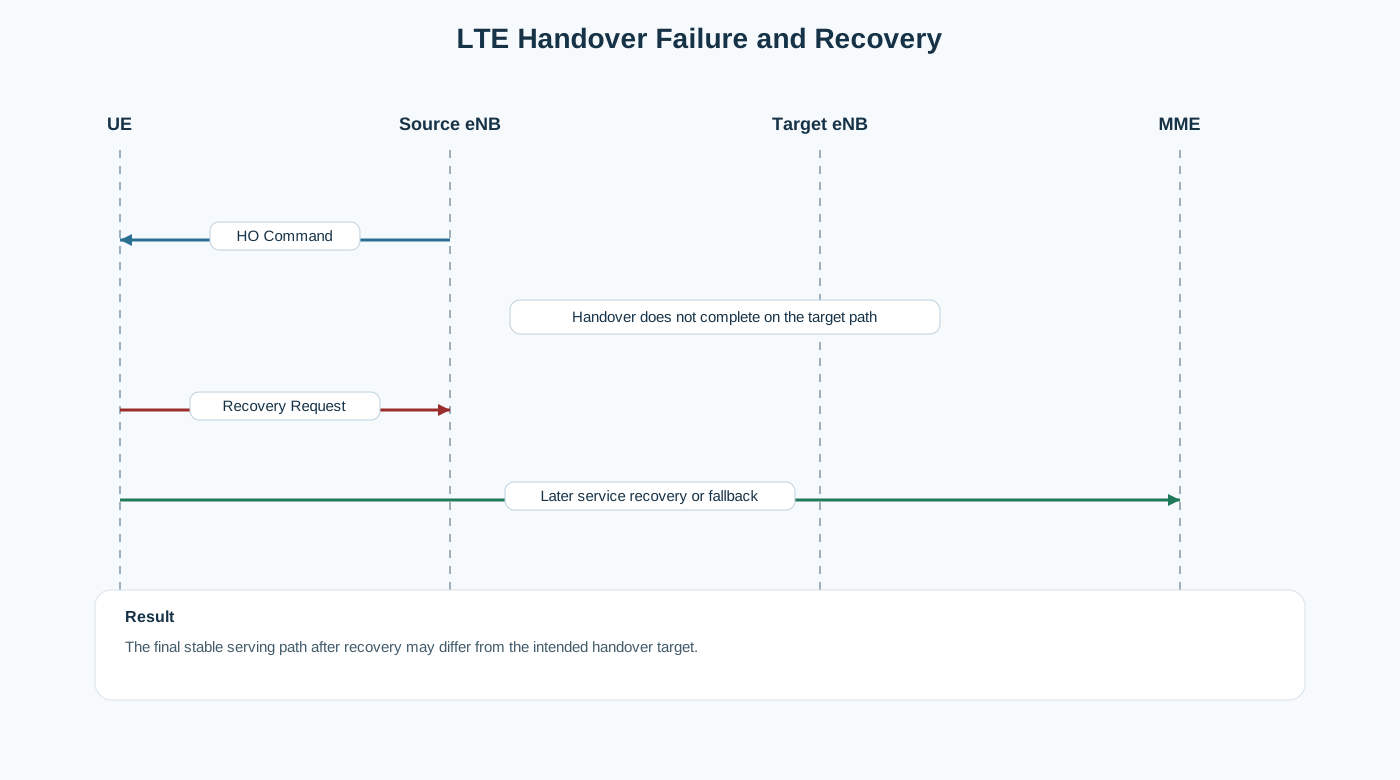
UE         Source eNB       Target eNB        MME
|-- handover execution ---------------------->|
|   handover does not complete               |
|-- Reestablishment / fallback branch ------>|
|<-- recovery result ------------------------|
|---------------------- later NAS recovery ------------------------>|
Major Phases
| Phase | What happens |
|---|---|
| 1. Mobility execution | The UE starts the connected handover branch. |
| 2. Handover failure | The mobility path breaks before stable target-side continuation. |
| 3. Radio recovery | The UE tries re-establishment or another fallback branch. |
| 4. Service recovery | Later NAS or access continuation restores service on a stable path. |
Step-by-Step Breakdown
Step 1: Handover execution starts
Sender -> receiver: eNB -> UE
Message(s): Often Mobility From E-UTRA Command or another handover execution branch
Purpose: Move the UE from the source serving path to the intended target path.
State or context change: The UE enters a connected mobility branch.
Note: A prepared handover can still fail during execution.
Step 2: Handover fails
Sender -> receiver: UE / radio behavior
Message(s): No stable target-side completion
Purpose: Recognize that the intended mobility path did not complete.
State or context change: The UE loses stable connected continuity.
Note: This is where mobility trouble turns into recovery trouble.
Step 3: Recovery branch starts
Sender -> receiver: UE -> eNB
Message(s): Often RRC Connection Reestablishment Request
Purpose: Recover a stable radio path after the failed mobility attempt.
State or context change: The UE either regains a radio control path or falls back again.
Note: The final serving cell after recovery may not be the original handover target.
Step 4: Later service continuation
Sender -> receiver: UE -> MME
Message(s): Later NAS recovery or fresh access branch
Purpose: Restore end-to-end service after the radio path stabilizes.
State or context change: Mobility failure is absorbed into a working service path again.
Note: This is where the trace often stops looking like a handover issue and starts looking like a recovery issue.
Important Messages in This Flow
| Message | Protocol | Direction | Purpose in this procedure | What to inspect briefly |
|---|---|---|---|---|
| Mobility From E-UTRA Command | RRC | eNB -> UE | Starts a mobility execution branch that may later fail. | Which mobility scenario was being attempted. |
| RRC Connection Reestablishment Request | RRC | UE -> eNB | Common recovery start after failed handover. | Cause and context relation after the interrupted mobility branch. |
Important Parameters to Inspect
| Parameter | What it is | Where it appears | Why it matters | Common issues |
|---|---|---|---|---|
| Mobility execution context | The target-side handover branch that was being attempted. | Handover command and later failure point | Shows which mobility path actually broke. | Wrong assumption about source or target cell. |
| Recovery cause | The reason used for the later recovery branch. | Reestablishment Request | Links the recovery to the failed mobility branch. | Recovery path interpreted as generic radio failure only. |
| Final serving side | The stable cell after recovery finishes. | Later recovered signaling | Shows where service actually resumed. | Target assumed successful even though recovery returned elsewhere. |
Successful Completion
Success means the UE regains a stable serving path after the failed handover and later service resumes on that recovered path.
Common Failures and Troubleshooting
| Symptom | Likely cause | Where to inspect | Relevant message(s) | Relevant interface(s) | Likely next step |
|---|---|---|---|---|---|
| Handover looks prepared, but service disappears during execution | The mobility branch failed during execution rather than during preparation. | Handover command and the first failed recovery action. | Mobility From E-UTRA Command, Reestablishment Request | LTE Uu, X2 or S1 context | Check whether recovery returned to source-side service or another fallback path. |
| Recovery succeeds, but target-side continuity never appears | The final stable path is different from the intended handover target. | Recovered serving cell and later service continuation. | Recovery messages and later NAS service branch | LTE Uu, NAS | Trace the final stable serving path instead of assuming target success. |
What to Check in Logs and Traces
- Separate handover preparation from handover execution failure.
- Check which recovery branch followed the interrupted mobility attempt.
- Confirm the final stable serving side before deciding whether mobility really succeeded.
Related Pages
Related sub-procedures
- LTE RRC Re-establishment Procedure
- LTE Radio Link Failure and Recovery
- LTE NAS Recovery After Radio Failure
Related message reference pages
Related troubleshooting pages
Notes
Handover failure recovery is not always target-side success with delay. The final stable path after recovery may be different from the originally intended target path.
FAQ
What is LTE Handover Failure and Recovery?
It is the recovery workflow that follows when a connected mobility attempt does not complete cleanly.
Does failed handover always lead to re-establishment?
No. Re-establishment is common, but the UE may also fall back to idle return or another re-entry path.