LTE Handover to GERAN Call Flow
LTE handover to GERAN is the outbound inter-RAT mobility path used when the UE leaves LTE and continues on GSM. It is a target-specific continuation of the general inter-RAT handover family.
This page focuses on the LTE-to-GERAN branch rather than the umbrella inter-RAT description.
Introduction
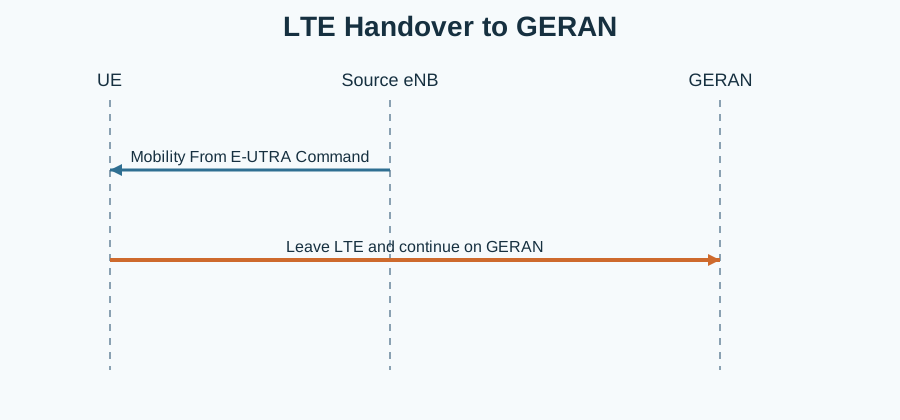
The source LTE side prepares the GSM branch, sends Mobility From E-UTRA Command, and the UE continues with GSM-side signaling after leaving LTE.
Use this page when the target technology is specifically GERAN.
What Is Handover to GERAN in Simple Terms?
- What starts the procedure: The network selects GSM as the target system.
- What the UE and network want to achieve: Leave LTE and continue service on GERAN.
- What success looks like: The UE exits LTE and begins the expected GSM continuation.
- What failure means: The GSM branch never starts or never stabilizes.
Why this procedure matters
This page gives the GSM-specific view of outbound inter-RAT mobility from LTE.
Quick Fact Sheet
| Procedure name | LTE Handover to GERAN |
|---|---|
| Domain | Outbound inter-RAT mobility from LTE to GSM |
| Main trigger | GERAN selected as the target RAT |
| Start state | UE is connected on LTE |
| End state | UE continues on GERAN |
| Main nodes | UE, source eNB, GERAN |
| Main protocols | LTE RRC and GERAN control signaling |
| Main success outcome | Service leaves LTE and continues on GSM |
| Main failure outcome | Inter-RAT transition to GERAN fails |
| Most important messages | Mobility From E-UTRA Command and GSM target continuation |
| Main specs | TS 36.331 and GERAN mobility specs |
Handover Concept
This illustration shows the basic handover concept used in this procedure: the UE leaves the serving side after the mobility decision and continues on the target side once the target path is ready.
Preconditions
- The UE is connected on LTE.
- GERAN is chosen as the target system.
- The GSM target branch is prepared.
Nodes and Interfaces
Nodes involved
| Node | Role in this procedure |
|---|---|
| UE | Leaves LTE and continues on GSM. |
| Source eNB | Delivers the outbound mobility command. |
| GERAN | Takes over the service branch after LTE exit. |
Interfaces used
| Interface | Path | Role |
|---|---|---|
| LTE Uu | UE <-> source eNB | Carries the LTE-side exit command. |
| GERAN target interface | UE <-> GERAN | Carries the post-LTE GSM continuation branch. |
End-to-End Call Flow
UE             Source eNB             GERAN
|<--Mobility From EUTRA Command--|      |
|==== leave LTE =======================>|
|------------ GERAN continuation ------->|
Major Phases
| Phase | What happens |
|---|---|
| 1. Prepare GERAN branch | The LTE side chooses GSM and prepares the target move. |
| 2. Deliver command | The UE receives the LTE-side exit command. |
| 3. Exit LTE | The current LTE serving path stops. |
| 4. Continue on GERAN | The GSM target branch starts. |
Step-by-Step Breakdown
Step 1: GERAN target preparation
Sender -> receiver: LTE side
Message(s): Inter-RAT preparation
Purpose: Prepare the GSM continuation branch.
State or context change: The UE is still on LTE.
Note: The target-specific path is already decided here.
Step 2: Mobility command
Sender -> receiver: source eNB -> UE
Message(s): Mobility From E-UTRA Command
Purpose: Tell the UE to leave LTE and continue on GERAN.
State or context change: The UE has the GSM target information.
Note: This is the LTE trace anchor for GSM continuation.
Step 3: LTE exit
Sender -> receiver: UE
Message(s): LTE exit execution
Purpose: Stop the LTE serving path.
State or context change: LTE connected service ends at this point.
Note: After this, the target trace becomes GSM-specific.
Step 4: GERAN continuation
Sender -> receiver: UE -> GERAN
Message(s): GERAN target access and completion
Purpose: Continue service on GSM.
State or context change: GERAN becomes active if the move succeeds.
Note: The next detailed analysis belongs on the GSM side.
Important Messages
| Message | Protocol | Direction | Purpose in this procedure | What to inspect briefly |
|---|---|---|---|---|
| Mobility From E-UTRA Command | RRC | source eNB -> UE | Carries the GERAN target move. | Inspect the target-system payload and the LTE exit timing. |
Important Parameters to Inspect
| Parameter | What it is | Where it appears | Why it matters | Common issues |
|---|---|---|---|---|
| Target RAT | GERAN as the destination system. | Mobility command | Confirms this is the GSM-specific branch. | Wrong target assumption. |
| Exit timing | The last LTE control point before GSM signaling. | Air trace | Useful for cross-system correlation. | Timing mismatch. |
| First GERAN message | The first target-side continuation message. | GERAN trace | Confirms the move reached GSM. | No target continuation. |
| Service expectation | What service is expected to continue on GSM. | Mobility context | Helps interpret the continuation branch. | Wrong continuity expectation. |
| Recovery result | What happened if GSM entry failed. | Later trace | Shows whether the UE recovered or lost service. | Failure hidden as generic radio loss. |
Successful Completion
Success means the UE leaves LTE and the GSM continuation branch begins as expected.
Common Failures and Troubleshooting
| Symptom | Likely cause | Where to inspect | Relevant message(s) | Relevant interface(s) | Likely next step |
|---|---|---|---|---|---|
| Command appears but GSM continuation is missing | The LTE exit branch was visible but the GERAN target branch never stabilized. | The LTE command and the first expected GSM message. | Mobility From E-UTRA Command | LTE Uu and GERAN target interface | Check whether the target GERAN preparation matched the expected system. |
What to Check in Logs and Traces
- Confirm that GERAN is the target named by the LTE command.
- Use the command timing to align LTE and GSM traces.
- Check whether the first GERAN message appears immediately after LTE exit.
Related Pages
Related sub-procedures
Related message reference pages
Related troubleshooting pages
Notes
Handover to GERAN is the GSM-specific branch. Treat the LTE command as the pivot point into GSM analysis.
FAQ
What is LTE handover to GERAN?
It is the inter-RAT path that moves connected service from LTE to GSM.