LTE Initial Context Setup Procedure Call Flow
LTE Initial Context Setup is the S1AP-driven procedure that creates the UE's initial core-side access context at the eNB after access signaling has already succeeded. It is the bridge where the MME delivers the UE context, NAS payload, security context, and E-RAB setup details needed for the next active service state.
This procedure appears in flows such as attach and service restoration. If it fails, the UE may receive some NAS progress while radio or bearer context still remains incomplete.
Introduction
The LTE Initial Context Setup procedure is mainly an MME -> eNB control step. It is not the first access step and not the final bearer-accept step. It sits in the middle, after early NAS progression and before fully usable radio and bearer context exist at the access side.
The main nodes are UE, eNB, MME, and usually SGW. The MME pushes the context, the eNB applies it, and the UE reflects the outcome through later RRC and NAS continuation.
What Is LTE Initial Context Setup in Simple Terms?
- What starts the procedure: The MME has enough validated UE context to ask the eNB to create the initial access-side context.
- What the UE and network want to achieve: Install UE-related security and bearer context at the eNB so the service flow can continue.
- What success looks like: The eNB accepts Initial Context Setup Request and later RRC or NAS completion continues cleanly.
- What failure means: The requested E-RAB or UE context cannot be built correctly at the eNB side.
Why this procedure matters
This is where core-side acceptance becomes access-side usable context. It is often the breakpoint between a clean NAS result and a broken bearer outcome.
Quick Fact Sheet
| Procedure name | LTE Initial Context Setup Procedure |
|---|---|
| Domain | Core-to-access UE context setup |
| Main trigger | MME has enough validated context to install the initial eNB-side UE context |
| Start state | Access exists, and the MME is ready to provision the eNB with UE and bearer context |
| End state | eNB has the initial UE context and later completion can continue |
| Main nodes | UE, eNB, MME, SGW |
| Main protocols | S1AP, RRC, NAS, GTPv2-C |
| Main success outcome | UE context and requested E-RAB details are applied at the eNB side |
| Main failure outcome | Context setup or E-RAB creation fails and later service remains incomplete |
| Most important messages | Initial Context Setup Request, Initial Context Setup Response, RRC Connection Reconfiguration |
| Main specs | TS 36.413, TS 23.401, TS 36.300 |
Preconditions
- The UE has already reached a usable early access signaling state.
- The MME has successful progress from identity, authentication, and security-related stages as needed for the scenario.
- The SGW-side bearer context exists or is ready enough for eNB-side context installation.
- The eNB is ready to receive and apply the UE context.
Nodes involved
| Node | Role in this procedure |
|---|---|
| UE | Receives the resulting radio-side configuration and later confirms continuation. |
| eNB | Applies the initial UE context and requested E-RAB information. |
| MME | Sends Initial Context Setup Request with the UE and bearer-related context. |
| SGW | Provides the user-plane endpoint relation needed for bearer-side setup. |
Interfaces used
| Interface | Path | Role |
|---|---|---|
| S1-MME | eNB <-> MME | Carries the Initial Context Setup procedure itself. |
| LTE Uu | UE <-> eNB | Carries the later RRC configuration and NAS payload delivery to the UE. |
| S1-U | eNB <-> SGW | Provides the user-plane relation once the E-RAB path is active. |
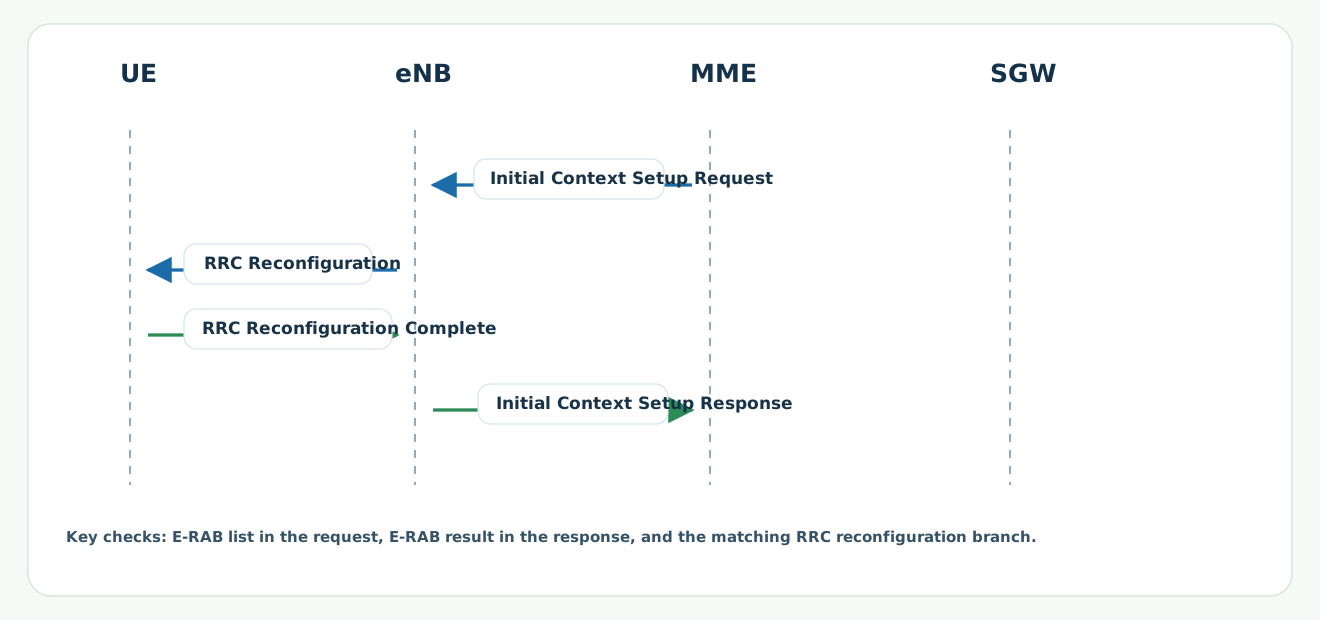
End-to-end call flow
UE               eNB               MME               SGW
|                 |                 |                 |
|                 |<- Initial Context Setup Request --|
|<- RRC Reconfiguration ------------|                 |
|-- RRC Reconfiguration Complete -->|                 |
|                 |-- Initial Context Setup Response ->|
|                 |                 |                 |
|   later NAS / bearer continuation                   |
Major phases
| Phase | What happens |
|---|---|
| 1. MME prepares context | The MME builds the initial UE context request. |
| 2. eNB receives setup | The eNB gets the UE security and E-RAB-related information. |
| 3. Radio application | The eNB pushes the needed RRC configuration toward the UE. |
| 4. Response | The eNB confirms which parts of the context were applied successfully. |
Step-by-step breakdown
Step 1: MME creates the setup package
Sender -> receiver: MME internal preparation
Message(s): No visible external message yet
Purpose: Collect UE context, NAS payload, security relation, and E-RAB details.
State or context change: The MME has a complete Initial Context Setup request to send.
Note: This step depends on earlier attach or service progression.
Step 2: Initial Context Setup Request
Sender -> receiver: MME -> eNB
Message(s): Initial Context Setup Request
Purpose: Ask the eNB to create the initial UE access-side context.
State or context change: The eNB now has the security and bearer-related context needed for setup.
Note: Missing or mismatched E-RAB details often surface here.
Step 3: eNB applies the context
Sender -> receiver: eNB -> UE
Message(s): Usually RRC Connection Reconfiguration and embedded NAS delivery when relevant
Purpose: Align the radio-side UE state with the requested core-side context.
State or context change: The UE receives the active setup needed for the scenario.
Note: This is where a clean NAS result can still fail to become usable service.
Step 4: Initial Context Setup Response
Sender -> receiver: eNB -> MME
Message(s): Initial Context Setup Response
Purpose: Report the setup result back to the MME.
State or context change: The MME learns whether the requested context and E-RAB path were accepted.
Note: The response is a key breakpoint for separating MME success from eNB-side failure.
Important messages
| Message | Protocol | Direction | Purpose in this procedure | What to inspect briefly |
|---|---|---|---|---|
| Initial Context Setup Request | S1AP | MME -> eNB | Creates the initial UE context at the eNB side. | E-RAB list, security relation, and included NAS payload. |
| RRC Connection Reconfiguration | RRC | eNB -> UE | Applies the radio-side part of the setup. | Whether the reconfiguration matches the requested context. |
| Initial Context Setup Response | S1AP | eNB -> MME | Confirms the setup result back to the MME. | Which E-RABs were accepted or failed. |
Important parameters to inspect
| Parameter | What it is | Where it appears | Why it matters | Common issues |
|---|---|---|---|---|
| E-RAB list | The bearer entries the MME asks the eNB to create. | Initial Context Setup Request | Defines what the eNB is expected to activate. | Missing or failed E-RAB item, mismatched QoS context. |
| S1AP UE IDs | The control-plane identifiers shared between eNB and MME. | Initial Context Setup signaling | Needed for clean correlation across S1-MME traces. | ID mismatch, merged contexts. |
| NAS payload continuity | The NAS message delivered together with or around context setup. | Initial Context Setup Request and later radio delivery | Shows which higher-level procedure this setup belongs to. | NAS result present, but bearer outcome missing. |
| E-RAB result | The acceptance or failure result returned by the eNB. | Initial Context Setup Response | Tells whether the requested access-side context really became active. | Partial acceptance, unexplained E-RAB failure. |
Successful completion of the procedure
Success means the eNB accepted the requested context and later UE-side reconfiguration and NAS continuation can proceed without access-side bearer mismatch.
Common failures in LTE Initial Context Setup
| Symptom | Likely cause | Where to inspect | Relevant message(s) | Relevant interface(s) | Likely next step |
|---|---|---|---|---|---|
| NAS accept is visible, but service is still unusable | Initial context or E-RAB setup failed at the eNB side. | Initial Context Setup Response and RRC reconfiguration branch. | Initial Context Setup Request, Response | S1-MME, LTE Uu | Check which E-RAB item failed before blaming the core result. |
| Partial bearer setup | Only part of the requested access-side context was accepted. | E-RAB result items in the response. | Initial Context Setup Response | S1-MME | Separate full failure from partial acceptance. |
| UE never confirms later radio continuation | Radio reconfiguration broke after the context request reached the eNB. | RRC reconfiguration and UE response timing. | RRC Connection Reconfiguration | LTE Uu | Move from S1AP into the radio branch. |
What to check in logs and traces
- Correlate Initial Context Setup Request with the exact higher-level procedure it belongs to.
- Inspect the E-RAB list and the final E-RAB result together.
- Check whether RRC reconfiguration at the UE side actually followed.
- Use Initial Context Setup Response to separate MME-side success from eNB-side failure.
Related Pages
Related sub-procedures
Related message reference pages
Related troubleshooting pages
Notes
Initial Context Setup is the handoff point where core acceptance becomes access-side usable context.
The most important pair is often Initial Context Setup Request and Initial Context Setup Response together with the following RRC reconfiguration branch.
FAQ
What is LTE Initial Context Setup?
It is the S1AP procedure that installs the initial UE context at the eNB after early access and NAS progress already exist.
Which nodes are most important here?
The main nodes are the MME and eNB, with the UE reflecting the resulting radio-side setup.
Why is this procedure important?
It explains why a clean NAS result can still fail to become a usable access and bearer state.