LTE Inter-RAT Handover Procedure Call Flow
LTE inter-RAT handover moves the UE between LTE and another radio technology such as UTRAN, GERAN, or CDMA2000 while preserving connected service as far as the target system allows.
This page is the umbrella reference for inter-RAT mobility before you move into a target-specific page such as handover to UTRAN or handover to GERAN.
Introduction
The procedure begins after LTE measurements or mobility rules show that service should leave LTE. The source LTE side prepares the target RAT branch, the UE receives the mobility command, and then target access continues according to the target technology.
The main nodes vary by target system, but the LTE side typically includes the UE, source eNB, and MME before the flow hands over to the target RAT.
What Is Inter-RAT Handover Procedure in Simple Terms?
- What starts the procedure: The network decides that connected service should move between LTE and another RAT.
- What the UE and network want to achieve: Preserve service continuity while leaving LTE or arriving from LTE context.
- What success looks like: The UE receives the inter-RAT command, accesses the target RAT, and continues service there.
- What failure means: The move breaks during the LTE exit or target-RAT entry branch.
Why this procedure matters
This page helps separate LTE-to-LTE mobility from technology-change mobility. It is often the best starting point when the target side is not another LTE cell.
Quick Fact Sheet
| Procedure name | LTE Inter-RAT Handover Procedure |
|---|---|
| Domain | Connected mobility between LTE and another radio technology |
| Main trigger | Measurement or policy-driven move out of LTE |
| Start state | UE is in connected LTE service |
| End state | UE continues on the target RAT or falls into recovery |
| Main nodes | UE, source eNB, MME, target RAT nodes |
| Main protocols | RRC, NAS, target-RAT control signaling |
| Main success outcome | Service moves off LTE onto the target RAT |
| Main failure outcome | Interrupted inter-system mobility |
| Most important messages | Measurement Report, Mobility From E-UTRA Command, target handover command |
| Main specs | TS 36.331, TS 23.401, target-RAT procedure specs |
Handover Concept
This illustration shows the basic handover concept used in this procedure: the UE leaves the serving side after the mobility decision and continues on the target side once the target path is ready.
Preconditions
- The UE is already in connected LTE service.
- Measurements or policy permit inter-RAT mobility.
- The target system is prepared and reachable.
Nodes and Interfaces
Nodes involved
| Node | Role in this procedure |
|---|---|
| UE | Receives the inter-RAT command and leaves LTE toward the target system. |
| Source eNB | Starts the LTE-side preparation and commands the UE to exit LTE. |
| MME | Supports the mobility context on the EPC side when needed. |
| Target RAT nodes | Complete the arrival and service continuation on the target system. |
Interfaces used
| Interface | Path | Role |
|---|---|---|
| LTE Uu | UE <-> source eNB | Carries the LTE-side measurement and exit command. |
| Core mobility interfaces | eNB <-> MME and beyond | Carry any EPC-side context needed for inter-system continuity. |
| Target RAT interface | UE <-> target system | Carries the post-LTE continuation branch. |
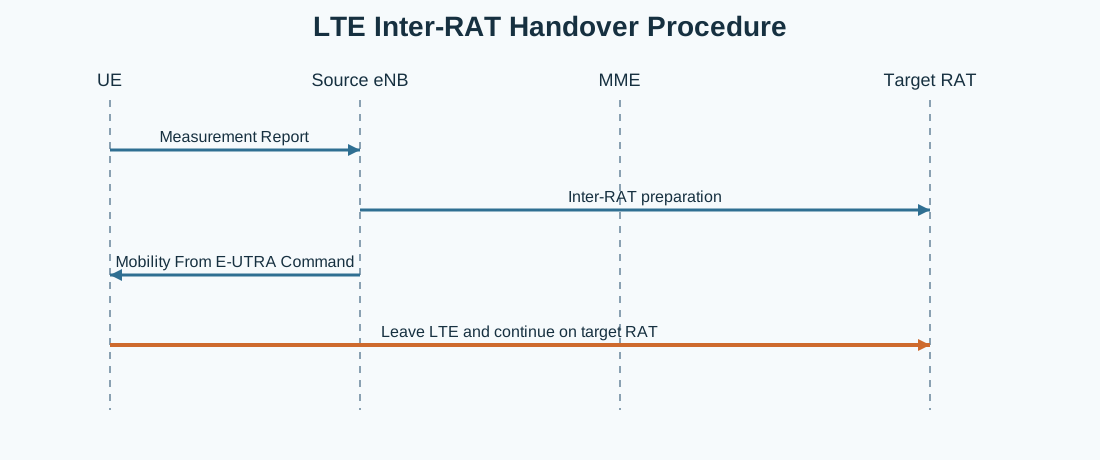
End-to-End Call Flow
UE         Source eNB             MME            Target RAT
|--Measurement Report->|                 |                 |
|                      |--prepare target->|--------------->|
|<--Mobility From EUTRA Command----------|                 |
|==== leave LTE and access target RAT ===================>|
|-------------------- target continuation ---------------->|
Major Phases
| Phase | What happens |
|---|---|
| 1. Inter-RAT trigger | The source side decides that service should leave LTE. |
| 2. Target-system preparation | The target branch is prepared before the UE exits LTE. |
| 3. LTE exit | The UE receives the mobility command and stops following the source LTE cell. |
| 4. Target continuation | The target system takes over the service branch. |
Step-by-Step Breakdown
Step 1: Inter-RAT trigger
Sender -> receiver: UE -> source eNB
Message(s): Measurement Report or policy-driven mobility context
Purpose: Show that another technology should become the serving system.
State or context change: The UE is still on LTE while the exit branch is built.
Note: Start here if the move looks like a wrong-system handover.
Step 2: Target preparation
Sender -> receiver: LTE side -> target system
Message(s): Inter-RAT preparation handling
Purpose: Prepare the target system before the UE leaves LTE.
State or context change: The target system becomes ready for arrival.
Note: The exact control signaling depends on the target technology.
Step 3: LTE exit command
Sender -> receiver: source eNB -> UE
Message(s): Mobility From E-UTRA Command
Purpose: Tell the UE to stop the current LTE serving path and move to the target technology.
State or context change: The UE exits LTE connected service.
Note: This is the defining LTE-side command for many outbound inter-RAT moves.
Step 4: Target continuation
Sender -> receiver: UE -> target RAT
Message(s): Target access and completion messages
Purpose: Continue service on the target technology.
State or context change: The target RAT becomes active if the move succeeds.
Note: The completion pattern depends on whether the target is UTRAN, GERAN, or CDMA2000.
Important Messages
| Message | Protocol | Direction | Purpose in this procedure | What to inspect briefly |
|---|---|---|---|---|
| Measurement Report | RRC | UE -> source eNB | Shows why the source side decided to leave LTE. | Inspect the target RAT measurement context. |
| Mobility From E-UTRA Command | RRC | source eNB -> UE | Commands the UE to leave LTE toward another RAT. | Inspect the target-system payload and timing. |
| Target completion message | Target RAT | UE -> target system | Confirms continuation on the target technology. | Check the target-specific completion branch. |
Important Parameters to Inspect
| Parameter | What it is | Where it appears | Why it matters | Common issues |
|---|---|---|---|---|
| Target RAT type | The technology chosen after LTE. | Measurement and mobility command | Determines which target procedure applies next. | Wrong interpretation of the target system. |
| Exit timing | The moment when the UE leaves LTE. | Mobility command and air trace | Useful for correlating LTE and target traces. | Capture gap or timing confusion. |
| Target command payload | The target-system information carried to the UE. | Mobility From E-UTRA Command | Needed for correct target access. | Incomplete or mismatched target data. |
| Service type | What service must continue on the target side. | Mobility context | Explains whether CS, PS, or another branch should survive. | Wrong assumption about preserved services. |
| Recovery branch | What happens if the target move fails. | Later trace | Shows whether the UE returned, recovered, or lost service. | Inter-RAT failure hidden as generic radio loss. |
Successful Completion
Success means the UE leaves LTE under network control and continues service on the target technology with the expected target-side completion branch.
Common Failures and Troubleshooting
| Symptom | Likely cause | Where to inspect | Relevant message(s) | Relevant interface(s) | Likely next step |
|---|---|---|---|---|---|
| Move leaves LTE but target continuation never appears | The inter-RAT exit succeeded but the target-side branch failed. | Mobility command and first target-access messages. | Mobility From E-UTRA Command and target completion branch | LTE Uu and target-RAT interface | Check the target-specific page for the missing continuation. |
What to Check in Logs and Traces
- Confirm whether the move is truly inter-RAT and not inter-frequency LTE mobility.
- Check the target RAT named in the mobility command.
- Correlate the LTE exit with the first target-system access message.
Related Pages
Related sub-procedures
- LTE Mobility From E-UTRA Procedure
- LTE Handover to UTRAN
- LTE Handover to GERAN
- LTE Handover to CDMA2000
Related message reference pages
Related troubleshooting pages
Notes
Inter-RAT handover is a family of target-specific procedures. Use this page as the umbrella, then move into the exact target technology page.
FAQ
What is inter-RAT handover?
It is connected mobility between LTE and another radio technology.
Which LTE-side message often commands the outbound move?
Mobility From E-UTRA Command is the main LTE-side command in many outbound inter-RAT cases.