LTE Intra-Frequency Handover Call Flow
LTE intra-frequency handover moves the UE between LTE cells on the same carrier layer. It is one of the most common connected mobility paths in live networks because the UE stays inside the same LTE frequency plan while the serving cell changes.
This page focuses on the same-frequency case, where the target decision is still measurement-driven but the UE does not have to change to another LTE carrier layer.
Introduction
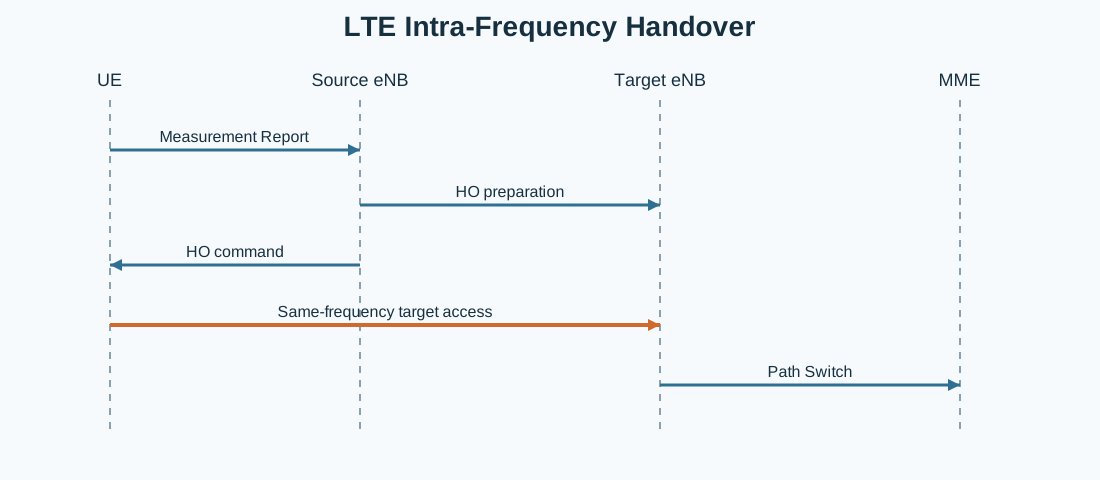
The flow starts after same-frequency neighbor measurements show that another LTE cell should become the serving cell. The preparation, command, target access, and path-switch pattern remains close to the baseline intra-LTE handover path.
The main nodes are the UE, source eNB, target eNB, and later the MME and SGW for continuity handling.
What Is Intra-Frequency Handover in Simple Terms?
- What starts the procedure: A connected UE sees a better LTE cell on the same frequency layer and the network chooses to move it.
- What the UE and network want to achieve: Change the serving LTE cell without leaving the current LTE carrier layer.
- What success looks like: The UE moves to the target cell and traffic continues there with normal continuity.
- What failure means: The same-frequency move breaks during execution or later continuity handling.
Why this procedure matters
This page separates same-frequency mobility from inter-frequency cases. It is useful when the mobility problem is cell-specific rather than layer-specific.
Quick Fact Sheet
| Procedure name | LTE Intra-Frequency Handover |
|---|---|
| Domain | Connected LTE mobility within one EARFCN layer |
| Main trigger | Neighbor-cell improvement on the same LTE frequency |
| Start state | UE is in RRC_CONNECTED on the source cell |
| End state | UE is connected on the target LTE cell on the same frequency layer |
| Main nodes | UE, source eNB, target eNB, MME, SGW |
| Main protocols | RRC, X2AP or S1AP, GTP-U |
| Main success outcome | Serving cell changes without leaving the current LTE carrier |
| Main failure outcome | Interrupted same-frequency connected mobility |
| Most important messages | Measurement Report, handover command, Path Switch Request |
| Main specs | TS 36.331, TS 36.300, TS 23.401 |
Handover Concept
This illustration shows the basic handover concept used in this procedure: the UE leaves the serving side after the mobility decision and continues on the target side once the target path is ready.
Preconditions
- The UE is already connected on LTE.
- Same-frequency neighbor relations are configured.
- The target same-layer cell is admitted and available.
Nodes and Interfaces
Nodes involved
| Node | Role in this procedure |
|---|---|
| UE | Reports same-frequency measurements and executes the move. |
| Source eNB | Triggers the same-layer move and delivers the handover command. |
| Target eNB | Admits the UE and becomes the new serving LTE cell. |
| MME | Handles later path-switch control updates. |
| SGW | Maintains user-plane continuity after the target side becomes active. |
Interfaces used
| Interface | Path | Role |
|---|---|---|
| LTE Uu | UE <-> eNB | Carries same-frequency measurement and execution signaling. |
| X2 or S1-MME | Source side <-> target side / MME | Carries target preparation and later EPC continuity handling. |
| S1-U | eNB <-> SGW | Carries user-plane continuity after the move. |
End-to-End Call Flow
UE          Source eNB         Target eNB           MME
|--Measurement Report->|                 |                 |
|                      |--HO preparation>|                 |
|                      |<--HO ack--------|                 |
|<--HO command---------|                 |                 |
|==== same-frequency target access ======================>|
|                      |                 |--Path Switch--->|
|                      |<--Release source context---------|
Major Phases
| Phase | What happens |
|---|---|
| 1. Same-layer trigger | Measurement results show a better LTE cell on the same frequency. |
| 2. Preparation | The target same-frequency cell receives UE context and reserves resources. |
| 3. Execution | The UE leaves the source side and accesses the target. |
| 4. Continuity update | The target side becomes the full serving path and the source is released. |
Step-by-Step Breakdown
Step 1: Same-frequency measurement
Sender -> receiver: UE -> source eNB
Message(s): Measurement Report
Purpose: Show that a same-layer LTE neighbor is the best target.
State or context change: The UE stays connected to the source cell while the decision is made.
Note: This is where A3-style neighbor dominance usually appears.
Step 2: Target preparation
Sender -> receiver: Source eNB -> target eNB
Message(s): Handover Request and acknowledgement
Purpose: Prepare target resources before moving the UE.
State or context change: The target same-frequency cell becomes ready for access.
Note: Admission rejection here prevents a bad move before execution starts.
Step 3: Command and move
Sender -> receiver: Source eNB -> UE -> target eNB
Message(s): RRC Connection Reconfiguration and target access
Purpose: Move the UE to the target same-frequency cell.
State or context change: The serving radio path changes cell while staying on the same layer.
Note: The frequency stays the same even though the serving cell changes.
Step 4: Path switch
Sender -> receiver: Target eNB -> MME
Message(s): Path Switch Request
Purpose: Finalize control and bearer continuity through the target side.
State or context change: Traffic follows the target LTE cell.
Note: A successful radio move still needs a successful EPC update.
Important Messages
| Message | Protocol | Direction | Purpose in this procedure | What to inspect briefly |
|---|---|---|---|---|
| Measurement Report | RRC | UE -> source eNB | Shows that a same-frequency target should be chosen. | Check the reported neighbor and event result. |
| RRC Connection Reconfiguration | RRC | source eNB -> UE | Carries the handover command. | Check that the target information matches the intended same-layer cell. |
| Path Switch Request | S1AP | target eNB -> MME | Completes the EPC side of the same-frequency move. | Inspect the target eNB identity and bearer continuity. |
Important Parameters to Inspect
| Parameter | What it is | Where it appears | Why it matters | Common issues |
|---|---|---|---|---|
| EARFCN | The LTE carrier layer used before and after the move. | Measurement and target data | Confirms this is a same-frequency case. | Accidental misclassification as inter-frequency. |
| PCI | Source and target physical cell identities. | Measurement report and handover command | Separates cell change from frequency change. | Wrong target cell interpretation. |
| Event result | Measurement trigger used for the move. | Measurement Report | Explains why the handover started. | Threshold mismatch or oscillation. |
| Bearer continuity | Target-side bearer mapping after the move. | Path switch handling | Shows whether service followed the cell move. | Partial bearer carry-over. |
| Timing | Spacing between measurement, command, and target access. | Full trace | Helps explain late or rushed same-layer moves. | Ping-pong or stale command timing. |
Successful Completion
Success means the UE changes serving cell on the same LTE frequency, the target side becomes active, and the bearer path follows the move.
Common Failures and Troubleshooting
| Symptom | Likely cause | Where to inspect | Relevant message(s) | Relevant interface(s) | Likely next step |
|---|---|---|---|---|---|
| Ping-pong behavior | The same-layer target choice is unstable. | Back-to-back measurement and command history. | Measurement Report, handover command | LTE Uu | Check the measurement trigger and neighbor relation quality. |
| Move breaks during target access | Execution failed after the source released the active path. | Command timing and target access branch. | RRC Connection Reconfiguration, later recovery | LTE Uu | Move into handover recovery. |
What to Check in Logs and Traces
- Verify that source and target share the same EARFCN.
- Check that the target PCI in the command matches the intended same-layer neighbor.
- Confirm whether the EPC path switch followed the radio move.
Related Pages
Related sub-procedures
- LTE Intra-LTE Handover Procedure
- LTE Measurement-Controlled Handover
- LTE Handover Failure and Recovery
Related message reference pages
Related troubleshooting pages
Notes
Intra-frequency handover is still a full handover. The UE keeps the same LTE carrier layer, but the serving cell and bearer path still change.
FAQ
What is intra-frequency handover?
It is an LTE handover between cells that use the same LTE carrier frequency.
How is it different from inter-frequency handover?
The target cell stays on the same LTE frequency layer instead of moving the UE to another LTE carrier.