LTE Intra-LTE Handover Procedure Call Flow
LTE Intra-LTE handover is the connected-mode mobility procedure that moves the UE from a source LTE cell to a target LTE cell while preserving ongoing service. It covers the normal LTE-to-LTE mobility path before the flow branches into interface-specific variants such as X2 or S1-based handover.
If this path does not complete cleanly, the UE may lose continuity, trigger RRC re-establishment, or fall into a broader recovery branch.
Introduction
The procedure begins after measurement-driven mobility evaluation while the UE is already in RRC_CONNECTED. The source side prepares the target cell, the UE receives the handover command, accesses the target, and the target side completes the path switch toward the EPC.
The main nodes are the UE, source eNB, target eNB, MME, and SGW. In practice, this is the baseline reference flow used to interpret more specific cases such as intra-frequency, inter-frequency, X2, and S1 handover.
What Is Intra-LTE Handover Procedure in Simple Terms?
- What starts the procedure: A connected UE is moving and the source side decides another LTE cell should become the serving cell.
- What the UE and network want to achieve: Keep the session active while moving the serving radio path to the target LTE cell.
- What success looks like: The UE accesses the target cell, the target eNB confirms completion, and the EPC switches the downlink path to the target side.
- What failure means: The UE loses connected continuity, target access fails, or later recovery replaces the intended mobility path.
Why this procedure matters
This is the core LTE connected-mobility flow. It explains how measurement-driven decisions become a real serving-cell move and where continuity can break between radio execution and EPC path update.
Quick Fact Sheet
| Procedure name | LTE Intra-LTE Handover Procedure |
|---|---|
| Domain | Connected LTE-to-LTE mobility |
| Main trigger | Measurement-driven connected mobility decision |
| Start state | UE is in RRC_CONNECTED on the source LTE cell |
| End state | UE is in RRC_CONNECTED on the target LTE cell with user-plane continuity restored |
| Main nodes | UE, source eNB, target eNB, MME, SGW |
| Main protocols | RRC, X2AP or S1AP, GTP-U |
| Main success outcome | Target cell becomes serving cell and the EPC path switches cleanly |
| Main failure outcome | Interrupted mobility or later recovery branch |
| Most important messages | Measurement Report, Handover Request, RRC Connection Reconfiguration, Path Switch Request |
| Main specs | TS 36.300, TS 36.331, TS 23.401 |
Handover Concept
This illustration shows the basic handover concept used in this procedure: the UE leaves the serving side after the mobility decision and continues on the target side once the target path is ready.
Preconditions
- The UE already has an active connected LTE context.
- Source and target LTE cells are known and mobility policy allows connected handover.
- Measurement information and target-cell admission logic support the move.
Nodes and Interfaces
Nodes involved
| Node | Role in this procedure |
|---|---|
| UE | Reports measurements, receives the handover command, accesses the target cell, and completes the move. |
| Source eNB | Decides or initiates the handover, prepares the target, and releases the source-side path after success. |
| Target eNB | Admits the UE, creates target-side context, and becomes the new serving eNB after execution. |
| MME | Carries S1-side control handling and receives the later path-switch update. |
| SGW | Anchors the user-plane path and applies the downlink switch toward the target eNB. |
Interfaces used
| Interface | Path | Role |
|---|---|---|
| LTE Uu | UE <-> source and target eNB | Carries the measurement reports, handover command, and target access leg. |
| X2 | Source eNB <-> target eNB | Often carries target preparation and status exchange for intra-LTE handover. |
| S1-MME | eNB <-> MME | Carries EPC control continuity and later path-switch handling. |
| S1-U | eNB <-> SGW | Carries user-plane tunneling before and after the move. |
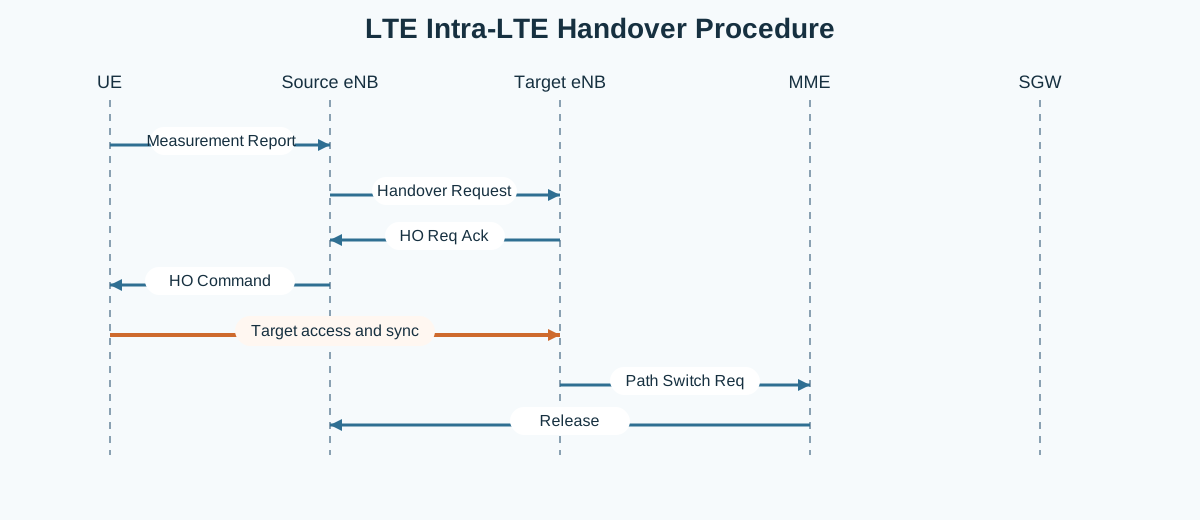
End-to-End Call Flow
UE          Source eNB          Target eNB             MME              SGW
|--Measurement Report->|                  |                  |                |
|                      |--Handover Request------------------>|                |
|                      |<--Handover Request Ack--------------|                |
|<--RRC Reconfiguration|                  |                  |                |
|==== target access and sync ===============================================>|
|                      |                  |--Path Switch Req->|                |
|                      |                  |<--Path Switch Ack-|                |
|                      |<--UE Context Release--------------- |                |
Major Phases
| Phase | What happens |
|---|---|
| 1. Mobility trigger | The source side evaluates measurement conditions and chooses a target LTE cell. |
| 2. Target preparation | The target eNB receives UE context, admission details, and bearer information. |
| 3. Handover execution | The UE receives the command, leaves the source side, and accesses the target cell. |
| 4. Path switch and cleanup | The target eNB updates the EPC path and the source side releases the old context. |
Step-by-Step Breakdown
Step 1: Measurement-driven trigger
Sender -> receiver: UE -> source eNB
Message(s): Measurement Report
Purpose: Show that the target cell now meets the handover condition.
State or context change: The UE remains on the source side while the mobility decision is made.
Note: Start here if the handover seems unexpected or too early.
Step 2: Target preparation
Sender -> receiver: Source eNB -> target eNB
Message(s): Handover Request and Handover Request Acknowledge
Purpose: Prepare target resources and copy the UE context to the target side.
State or context change: The target eNB is ready before the UE is told to move.
Note: Admission failure here stops the handover before UE execution starts.
Step 3: Handover command
Sender -> receiver: Source eNB -> UE
Message(s): RRC Connection Reconfiguration
Purpose: Deliver the target-side mobility information to the UE.
State or context change: The UE leaves the source serving path and begins target access.
Note: This is the critical transition between preparation and real execution.
Step 4: Target access
Sender -> receiver: UE -> target eNB
Message(s): Random access and handover confirm handling
Purpose: Create a working radio path on the target LTE cell.
State or context change: The target cell becomes the active radio side for the UE.
Note: If this leg fails, the issue becomes a mobility failure rather than a preparation problem.
Step 5: Path switch
Sender -> receiver: Target eNB -> MME -> SGW
Message(s): Path Switch Request and path update handling
Purpose: Move the EPC downlink path to the target eNB.
State or context change: User-plane continuity follows the target serving side.
Note: A clean target access does not guarantee the path switch also completed.
Important Messages
| Message | Protocol | Direction | Purpose in this procedure | What to inspect briefly |
|---|---|---|---|---|
| Measurement Report | RRC | UE -> source eNB | Triggers the source-side mobility decision. | Check the event result and the target cell identity. |
| Handover Request | X2AP or S1AP | source eNB -> target side | Prepares the target cell with UE context. | Inspect bearer list, target admission, and forwarding context. |
| Handover Request Ack | X2AP or S1AP | target side -> source eNB | Confirms target readiness. | Check whether admission was granted and whether transparent container data is present. |
| RRC Connection Reconfiguration | RRC | source eNB -> UE | Carries the handover command toward the UE. | Inspect the mobility command container and target details. |
| Path Switch Request | S1AP | target eNB -> MME | Moves EPC control and downlink path to the target side. | Check bearer mapping and the new serving eNB identity. |
Important Parameters to Inspect
| Parameter | What it is | Where it appears | Why it matters | Common issues |
|---|---|---|---|---|
| PCI / ECGI | Target cell identifiers used during the move. | Measurement results, handover command | They show exactly which target cell was selected. | Wrong target correlation or neighbor mismatch. |
| E-RAB list | Bearer set carried into the target preparation. | Handover Request, path switch handling | Shows which bearers should survive the move. | Missing bearer continuity or partial setup. |
| Target container | Radio configuration passed to the UE for target access. | RRC Connection Reconfiguration | Needed for a valid move to the target LTE cell. | Invalid target data or decode gap. |
| MME and S-GW path context | Core-side mobility continuity identifiers. | Path Switch Request and response | Shows whether the EPC moved the bearer path to the target side. | Path switch missing or stale bearer context. |
| Cause and timing | Mobility reason and execution timing pattern. | Measurement, command, target access, release | Helps separate bad preparation from bad execution. | Late command, rushed execution, or replay confusion. |
Successful Completion
Success means the UE is stably served by the target LTE cell, the target side has accepted the context, and the EPC path has switched to the target eNB.
After successful completion, the source-side context is released and the user-plane continuity follows the target cell.
Common Failures and Troubleshooting
| Symptom | Likely cause | Where to inspect | Relevant message(s) | Relevant interface(s) | Likely next step |
|---|---|---|---|---|---|
| Target prep fails | The target cell rejects admission or cannot create the required resources. | Handover Request and acknowledgment result. | Handover Request, Handover Request Ack | X2 or S1-MME | Check target admission cause and neighbor relation before looking at the UE. |
| UE receives the command but never reaches the target | Execution failed during the source-to-target move. | RRC command, target random access, and any later recovery branch. | RRC Connection Reconfiguration, later recovery messages | LTE Uu | Open handover failure and recovery. |
| Target access succeeds but traffic does not continue | The EPC path switch did not complete or bearers were not mapped correctly. | Target-side S1AP and path-switch result. | Path Switch Request, Path Switch Request Ack | S1-MME, S1-U | Compare the E-RAB list before and after the move. |
What to Check in Logs and Traces
- Correlate the Measurement Report with the target cell named in the handover command.
- Confirm whether target preparation finished before the UE received the handover command.
- Check whether the UE actually accessed the target side or dropped into recovery.
- Verify that the path switch happened after target access, not just the radio move.
Related Pages
Related sub-procedures
Related message reference pages
Related troubleshooting pages
Notes
Intra-LTE handover is the umbrella mobility view. X2 and S1 handover are execution variants of the same basic LTE-to-LTE move.
A good target-access trace is only part of the success path. The later path switch is what makes the EPC follow the UE to the new cell.
FAQ
What is LTE Intra-LTE handover?
It is the connected procedure that moves a UE from one LTE cell to another while keeping the service active.
Is every intra-LTE handover X2-based?
No. Some cases use direct X2 signaling, while others use S1 through the MME.
What confirms success?
Target access plus a clean path switch is the practical success pattern.