LTE Measurement-Controlled Handover Call Flow
LTE measurement-controlled handover is the decision path that turns measurement configuration and Measurement Report results into a real handover command. It sits between measurement logic and mobility execution.
This page focuses on how the network decides to start a handover, not only on the later execution steps.
Introduction
The procedure starts when the eNB configures measurements, the UE reports event-based results, and the source side uses those results to choose whether a target cell should take over. The later mobility branch can become intra-frequency, inter-frequency, or inter-RAT.
The main nodes are the UE and source eNB, with later target-side nodes depending on the mobility type selected.
What Is Measurement-Controlled Handover in Simple Terms?
- What starts the procedure: The source side configures measurements and the UE begins reporting event results.
- What the UE and network want to achieve: Decide whether connected mobility should start and which target should be chosen.
- What success looks like: Measurement results lead to a valid mobility decision and the right handover branch starts.
- What failure means: Bad measurement interpretation leads to no move, wrong target selection, or unstable mobility.
Why this procedure matters
This page explains why many handovers start when they do. It is the right reference when the mobility issue begins before the handover command is even sent.
Quick Fact Sheet
| Procedure name | LTE Measurement-Controlled Handover |
|---|---|
| Domain | Measurement-to-mobility decision path |
| Main trigger | Configured measurement events reach their handover condition |
| Start state | UE is connected and measurement configuration is active |
| End state | A specific handover branch starts or is intentionally not started |
| Main nodes | UE, source eNB, later target nodes |
| Main protocols | RRC |
| Main success outcome | Measurement results produce the correct mobility action |
| Main failure outcome | Wrong move timing, wrong target, or no move when needed |
| Most important messages | Measurement Control, Measurement Report, RRC Connection Reconfiguration |
| Main specs | TS 36.331 and mobility policy implementation |
Handover Concept
This illustration shows the basic handover concept used in this procedure: the UE leaves the serving side after the mobility decision and continues on the target side once the target path is ready.
Preconditions
- The UE is already in connected LTE service.
- Measurement configuration has been delivered.
- Neighbor or target data is available for mobility decisions.
Nodes and Interfaces
Nodes involved
| Node | Role in this procedure |
|---|---|
| UE | Applies measurement rules and reports results. |
| Source eNB | Configures measurements and decides whether to start mobility. |
| Target decision logic | Represents the policy layer that chooses the next mobility branch. |
Interfaces used
| Interface | Path | Role |
|---|---|---|
| LTE Uu | UE <-> source eNB | Carries measurement control and measurement reports. |
End-to-End Call Flow
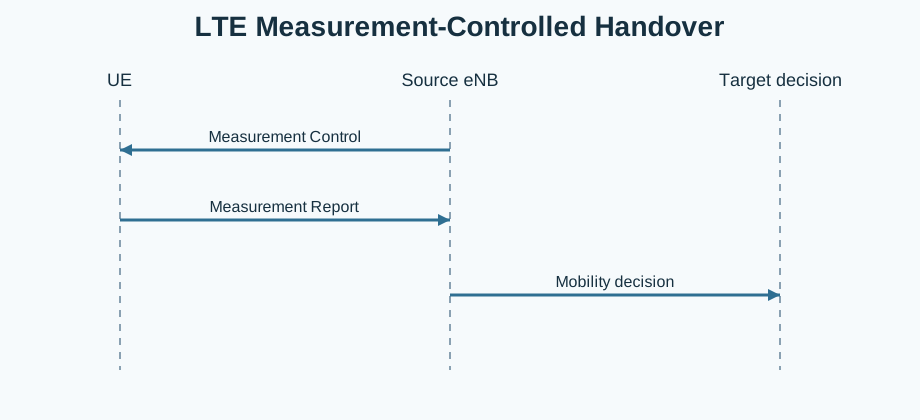
UE                Source eNB
|<--Measurement Control--|
|--Measurement Report--->|
|       decision         |
|<--handover command-----|
Major Phases
| Phase | What happens |
|---|---|
| 1. Configure | The source side sets up measurement rules. |
| 2. Report | The UE sends event-based results. |
| 3. Decide | The source side evaluates whether mobility should start. |
| 4. Launch the chosen branch | A concrete handover procedure begins. |
Step-by-Step Breakdown
Step 1: Measurement setup
Sender -> receiver: source eNB -> UE
Message(s): Measurement Control
Purpose: Tell the UE which events and cells to monitor.
State or context change: Measurement supervision becomes active in connected mode.
Note: Wrong setup here can mislead every later handover decision.
Step 2: Measurement report
Sender -> receiver: UE -> source eNB
Message(s): Measurement Report
Purpose: Return the event result that may trigger mobility.
State or context change: The source side can now evaluate a real target decision.
Note: This is the highest-value message for early mobility analysis.
Step 3: Decision
Sender -> receiver: source eNB
Message(s): Mobility policy evaluation
Purpose: Choose whether to hand over, wait, or reject the move.
State or context change: The source side either starts a handover or keeps the UE on the serving cell.
Note: A bad decision here can look like a later handover problem even when execution is fine.
Step 4: Start the branch
Sender -> receiver: source eNB -> UE and target side
Message(s): RRC Connection Reconfiguration or related handover start
Purpose: Convert the measurement decision into a real mobility branch.
State or context change: The page now hands off to the chosen mobility procedure.
Note: At this point you should move into the exact handover type page.
Important Messages
| Message | Protocol | Direction | Purpose in this procedure | What to inspect briefly |
|---|---|---|---|---|
| Measurement Report | RRC | UE -> source eNB | Carries the result that often triggers mobility. | Inspect event type, target identity, and measurement timing. |
| RRC Connection Reconfiguration | RRC | source eNB -> UE | Shows that the measurement decision became a real mobility command. | Check whether the selected target matches the report. |
Important Parameters to Inspect
| Parameter | What it is | Where it appears | Why it matters | Common issues |
|---|---|---|---|---|
| Event type | The measurement condition that was met. | Measurement Report | Explains why the move started. | Wrong threshold or unstable trigger. |
| Target identity | The candidate cell or RAT named by the report. | Measurement Report | Shows which target won the decision. | Mismatch between report and command. |
| Hysteresis and time-to-trigger | Decision-stability controls behind the event. | Measurement configuration | Help explain late, early, or oscillating moves. | Ping-pong or delayed mobility. |
| Decision timing | Delay between the report and the command. | Trace timing | Useful for spotting stale or rushed decisions. | Command sent too late. |
| Chosen branch | Whether the result became intra-frequency, inter-frequency, or inter-RAT mobility. | Later mobility start | Links the measurement stage to the right call-flow page. | Wrong follow-up procedure chosen. |
Successful Completion
Success means the measurement logic leads to the correct mobility branch at the correct time and the selected target matches the intended policy.
Common Failures and Troubleshooting
| Symptom | Likely cause | Where to inspect | Relevant message(s) | Relevant interface(s) | Likely next step |
|---|---|---|---|---|---|
| Handover starts too early or too late | Measurement conditions or policy timing are not tuned correctly. | Measurement report timing and configuration values. | Measurement Report | LTE Uu | Review event thresholds and decision delay. |
| Wrong target is chosen | Neighbor relation or decision logic did not match the strongest intended target. | Measurement report target versus handover command target. | Measurement Report, handover command | LTE Uu | Compare the reported target with the target carried in the command. |
What to Check in Logs and Traces
- Start with the measurement report, not the handover command.
- Check whether the target named in the report matches the target later chosen.
- Confirm whether the selected branch became intra-LTE or inter-RAT.
Related Pages
Related sub-procedures
Related message reference pages
Related troubleshooting pages
Notes
Measurement-controlled handover is the decision stage. If the target choice is wrong here, a later execution trace can still look technically correct.
FAQ
What is measurement-controlled handover?
It is the decision path that turns measurement results into a specific handover action.