LTE NE-DC Release Procedure Call Flow
LTE NE-DC Release Procedure is the connected-mode path used when the network removes the advanced secondary branch and returns the connection to a simpler master-side state.
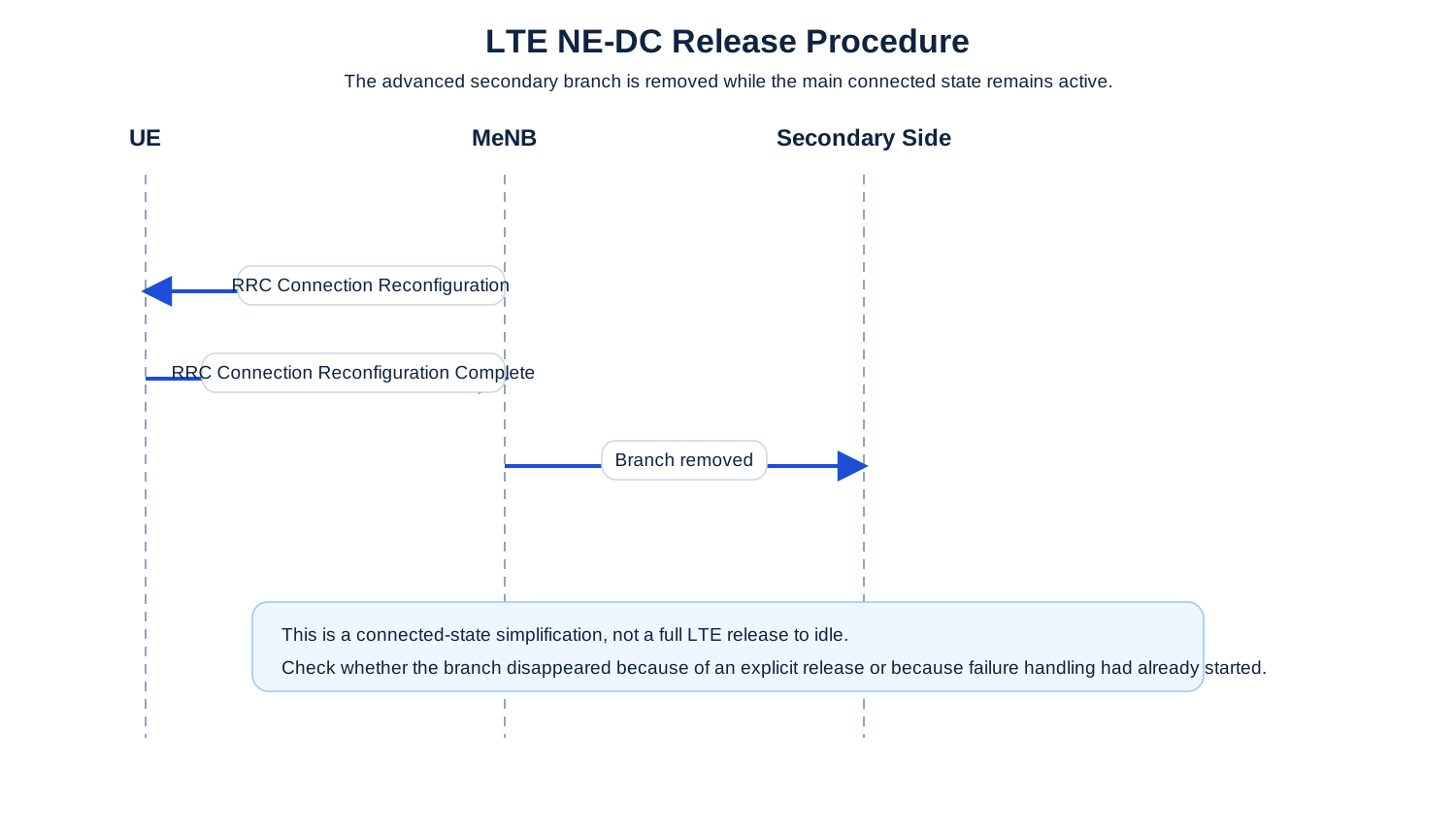
The key trace anchor is usually RRC Connection Reconfiguration, followed by RRC Connection Reconfiguration Complete and a clear reduction in branch complexity after the release takes effect.
Introduction
This procedure is not a full LTE release to idle. It is the removal of the extra branch or branch family inside an otherwise active connected state.
Use it when advanced branch use was present earlier in the trace and later disappeared through an explicit connected-mode simplification rather than through abrupt failure alone.
What Is LTE NE-DC Release Procedure in Simple Terms?
- What starts the procedure: The network decides that the advanced secondary branch should be removed from the active connected state.
- What the UE and network want to achieve: Return to a simpler master-side connected state without losing the whole connection.
- What success looks like: The branch is removed cleanly and the master-side service continues.
- What failure means: Release is incomplete, branch state becomes unclear, or service degrades after simplification.
Why this procedure matters
Advanced LTE traces often mix branch failure, branch recovery, and deliberate branch release. This page isolates the explicit release path so it is not confused with accidental branch collapse.
Quick Fact Sheet
| Procedure name | LTE NE-DC Release Procedure |
|---|---|
| Domain | Advanced branch simplification and removal |
| Main trigger | Need to remove the advanced secondary branch while keeping the connected state active |
| Start state | Advanced branch context is active inside an LTE connected session |
| End state | Connection continues with a simpler branch model |
| Main nodes | UE, MeNB, secondary side |
| Main protocols | RRC, inter-node coordination |
| Main success outcome | Advanced branch is released cleanly |
| Main failure outcome | Release and later service behavior do not line up |
| Most important messages | RRC Connection Reconfiguration, RRC Connection Reconfiguration Complete |
| Main specs | TS 36.331, TS 36.300 |
Preconditions
- An advanced secondary branch is already active or at least still represented in the connected state.
- The master side has decided to simplify the branch model.
- The UE can still receive and confirm connected-mode control updates.
Nodes and Interfaces
Nodes involved
| Node | Role in this procedure |
|---|---|
| UE | Maintains the master LTE connection and applies the added or changed secondary branch configuration. |
| MeNB / master eNB | Keeps the main LTE control anchor and decides when the secondary branch is added, changed, recovered, or removed. |
| SeNB / secondary node | Provides the secondary cell group resources used for extra throughput, split bearer handling, or EN-DC continuation. |
| Core transport | Carries the user-plane or control continuation behind bearer movement and branch release. |
Interfaces used
| Interface | Path | Role |
|---|---|---|
| LTE Uu | UE <-> MeNB / SeNB | Carries the LTE radio-control and user-plane behavior seen by the UE. |
| X2 / inter-node | MeNB <-> SeNB | Carries secondary-node preparation, coordination, and release handling. |
| S1-U / transport | eNB side <-> EPC | Carries the user-plane continuation behind bearer distribution and release. |
End-to-End Call Flow
UE                  MeNB                 Secondary side
|<--RRC Reconfig-----|                        |
|--Reconfig Complete>|                        |
|==== master-only or simplified continuation =>|
Major Phases
| Phase | What happens |
|---|---|
| 1. Decide the branch release | The network decides that the advanced branch should be removed. |
| 2. Coordinate the simplification | The network aligns the post-release state between master and secondary side. |
| 3. Deliver the release update | The UE receives the connected-mode update that removes the extra branch. |
| 4. Continue in the simpler state | The session continues without the released advanced branch. |
Step-by-Step Breakdown
Choose branch removal
Sender -> receiver: MeNB / secondary side
Message(s): Release decision
Purpose: Define the simpler connected-mode model that should remain after branch removal.
State or context change: The network now has a target post-release branch design.
Note: This is different from failure recovery because the intended result is explicit simplification.
Send release reconfiguration
Sender -> receiver: MeNB -> UE
Message(s): RRC Connection Reconfiguration
Purpose: Tell the UE to remove the advanced secondary branch from the connected context.
State or context change: The UE is moving from advanced multi-branch use toward a simpler connected state.
Note: The air-interface message looks similar to many other reconfigurations, so context is essential.
Confirm the simpler state
Sender -> receiver: UE -> MeNB
Message(s): RRC Connection Reconfiguration Complete
Purpose: Confirm that the advanced branch removal was applied.
State or context change: The connection now continues without the removed branch.
Note: If later service quality drops, it may be a post-release capability issue rather than a failed release itself.
Observe post-release continuation
Sender -> receiver: UE <-> MeNB
Message(s): Master-side continuation
Purpose: Verify that the simplified branch model still supports the expected service.
State or context change: The trace is now back in a reduced connected design.
Note: This is where planned simplification and accidental degradation must be separated.
Important Messages
| Message | Protocol | Direction | Purpose in this procedure | What to inspect briefly |
|---|---|---|---|---|
| RRC Connection Reconfiguration | RRC | MeNB -> UE | Carries the branch-removal update. | Check that the update is a deliberate simplification and not another recovery attempt. |
| RRC Connection Reconfiguration Complete | RRC | UE -> MeNB | Confirms the branch release was applied. | Check whether the simpler state is visible right after confirmation. |
| SCG Failure Information r12 | RRC | UE -> MeNB | Useful contrast when the branch disappeared because of failure instead of release. | Check whether the trace contains explicit failure reporting that changes the meaning of the release. |
| UL Information Transfer MRDC r15 | RRC | UE -> MeNB | Can help align later MR-DC context with the reduced post-release state. | Check whether later reporting still assumes an advanced branch that should already be gone. |
Important Parameters to Inspect
| Parameter | What it is | Where it appears | Why it matters | Common issues |
|---|---|---|---|---|
| Release intent | The branch-removal meaning of the reconfiguration. | Release reconfiguration | Shows that the target state is deliberate simplification. | A recovery action is mistaken for a release action or the reverse. |
| Pre-release branch inventory | The advanced branches that existed just before release. | Before the reconfiguration | Needed to prove what exactly was removed. | The trace assumes a branch was released that was already gone. |
| Post-release branch state | The connection model that remained after confirmation. | After reconfiguration complete | Confirms whether the release achieved the intended simpler state. | The connection still behaves like the removed branch should exist. |
| Service impact after release | How bearer or throughput behavior changed after simplification. | Post-release continuation | Shows whether the reduced design still matched service expectations. | Normal simplification is misread as a new failure or vice versa. |
| Failure overlap | Whether explicit branch failure reporting also appeared near the release. | Around the release window | Separates planned release from release after failure. | The whole branch-removal story is read without the surrounding failure context. |
Successful Completion
Success means the advanced branch is removed cleanly and the connection continues in the expected simpler state.
Common Failures and Troubleshooting
| Symptom | Likely cause | Where to inspect | Relevant message(s) | Relevant interface(s) | Likely next step |
|---|---|---|---|---|---|
| Release completes but the post-release state still looks inconsistent | The branch inventory before and after the release was not understood correctly. | Pre-release and post-release branch context together. | RRC Connection Reconfiguration, RRC Connection Reconfiguration Complete | LTE Uu | Prove exactly which branch state existed before and after the release. |
| Release is treated as normal but the trace actually shows failure cleanup | SCG or MCG failure reporting changed the meaning of the simplification path. | Nearby failure reports and the release timing. | SCG Failure Information r12, SCG Failure Information NR r15, MCG Failure Information r16 | LTE Uu | Separate deliberate release from failure-driven cleanup. |
What to Check in Logs and Traces
- Check whether the release is deliberate simplification or part of a failure branch.
- Compare the pre-release branch state with the post-release branch state directly.
- Validate service behavior after release, not just the release messages themselves.
Related Pages
Related sub-procedures
Related message reference pages
Related troubleshooting pages
Notes
This page is useful when the advanced branch disappears cleanly through connected-mode control. If the branch vanished abruptly first, start with the SCG failure page instead.
FAQ
What is the LTE NE-DC Release Procedure?
It is the connected-mode path that removes an advanced secondary branch while keeping the main LTE connection alive.
Is NE-DC release the same as RRC release to idle?
No. The master connected state stays active; only the advanced branch model is simplified.